

Canto
10
Chapter 13: Lord Brahmâ Steals the Boys and Calves
(1) S'rî S'uka said: 'Asking such very good questions you are a most fortunate soul, oh best of the devotees, because you, with your wish to hear the stories about the Lord again and again, lend them new charm. (2) This is what sets apart the truthful souls who accepted the essence of life: that what is their life's purpose, the aim of their understanding and what comes first to their mind, appears to be new every time they properly discuss matters in relation to the Infallible One, despite the repetition, just like every woman seems to be new to a womanizer. (3) Please listen carefully, oh King, I will relate it to you... even though it is a confidential subject. For gurus describe even hidden matters to a loving disciple.
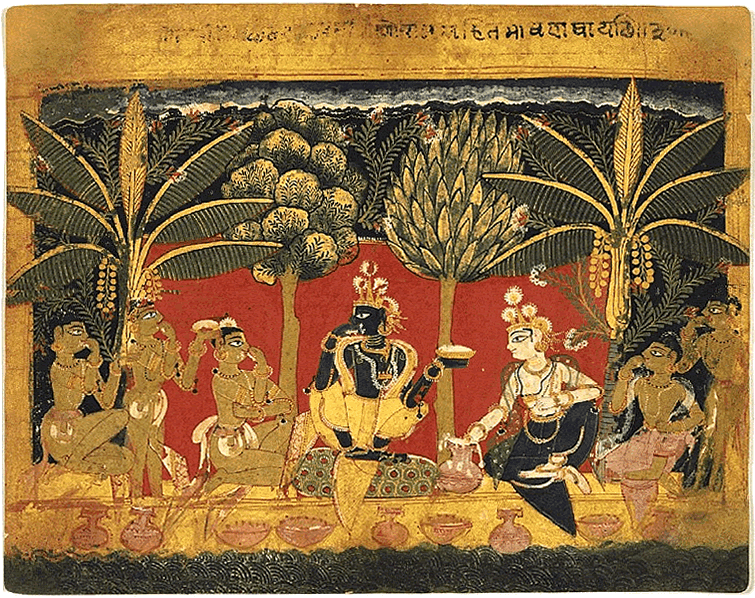
(4) After He had saved the boys and calves from the mouth of that deadly Agha, the Supreme Lord brought them to the river bank and spoke the following words: (5) 'Oh, how beautiful this river bank is, My dear friends! It offers all opportunity to play, with its soft and clean sands, the aroma of the blooming lotuses which attract the bumblebees, and the sounds of the chirping birds everywhere in the many trees! (6) Let us eat here. It is late now and we are weak from hunger. After the calves drank from the water, they at ease can eat from the nearby grasses.' (7) They consented, let the calves drink from the water and took them to the tender grasses. Then they opened their lunch bags and happily enjoyed their meal together with the Supreme Lord. (8) In a wide circle happily facing inward, the boys of Vraja grouped in rows around Krishna. Thus sitting down in the forest they looked as beautiful as the petals and leaves that make up the whorl of a lotus flower. (9) Some of them used flower petals as a plate while others used bunches of leaves, twigs, fruits, [the material of] their packets, the bark of trees or a slab of rock. (10) All of them allowed the others a taste of their own favorite food and thus they had a good time taking their lunch with the Lord while laughing and making others laugh. (11) With His flute tucked away in His belt and with the horn and the prod at His left side, He took the yogurt rice and pieces of fruit between His fingers. Keeping Himself in the middle of the circle of His comrades He made them laugh telling His jokes. The denizens of heaven thus witnessed how the Enjoyer of all Sacrifices was enjoying His childhood pastimes. (12) Oh scion of Bharata, while the Infallible One this way in harmony was eating together with the cowherds, the calves looking for grass had wandered deep into the forest. (13) Noticing that, Krishna, the Terror of Fear, said to the worried boys: 'Oh friends, stay where you are, I shall bring the calves back to this spot!' (14) Krishna, the Supreme Lord, after saying this, went away with a bit of food in His hand to look everywhere in the mountains, the caves, the bushes and the bowers for the calves of His friends.
(15) He who was born from the lotus and who resides in the beyond [Lord Brahmâ], was very charmed by the way the Lord had enchanted the boys. Just to see more of it he led the boys and their calves away to hide them elsewhere, oh man of the Kuru bond. This authority from heaven who before had witnessed the deliverance of Aghâsura, had become very astonished about the Almighty Personality [see footnote*]. (16) When Krishna nowhere could find the calves, He neither could find the cowherd boys after He had returned to the river bank. Thereupon He searched the entire forest for the both of them. (17) Neither finding the calves nor their caretakers anywhere in the forest, Krishna, well aware of everything going on in the universe, understood immediately that this was the work of Vidhi [Lord Brahmâ]. (18) In order to please the mothers of the boys and also him [Brahmâ], Krishna, the Controller managing the entire universe, thereupon expanded Himself to both the forms [of cowherd boy and calf]. (19) With a perfect likeness of the cowherd boys and their tender calves, having the same size of legs and hands and the same bugles, flutes, sticks and bags and such, with the same ornaments and dresses in all respects, with exactly their character, habits, features, attributes and traits and playing the same games and such, Krishna, the Unborn One, manifested Himself in expansions of Vishnu with the same voices and bodies they had. (20) Personally thus in different ways enjoying the company that He offered Himself in the form of the calves and the cowherd boys, He, the Soul of All, thereupon entered Vraja. (21) He brought Himself in the form of the different calves to the different cowsheds and next entered the different houses with the different persons He had become, oh King. (22) As soon as their mothers heard the sound of their flutes, they immediately abandoned what they were doing and lifted them like feathers up in their arms. They hugged them and allowed them, being wet from their love, to drink from their nectarean breast milk. In that spirit feeding their sons [they were thus of respect for] the Supreme Divinity [the Supreme Lord]. (23) Every time Mâdhava thereupon in the evening came home, oh ruler of man, having finished what He had to do, they happily took care of Him with their actions of massaging, bathing, smearing and decorating Him, chanting mantras for His protection, marking Him with tilaka and sumptuously feeding [all the boys He was]. (24) Thereafter the cows, which had arrived in their sheds, immediately loudly mooing called for their calves. These followed them, were time and again licked by them and fed with the milk that flowed from their udders. (25) From cow and gopî there was in this matter the motherly affection as there was before, be it that since this love now was derived from the Lord [in the form of the calves and boys], it was free from the bewilderment of 'this is my child' [free from 'I' and 'mine']. (26) Now that the children of the inhabitants of Vraja, unlike before, were all like Krishna for the time of a year, the creeper of affection for them [and Him] gradually, day by day, increased without a limit. (27) Thus for the period of a year tending Himself in the form of the calves by means of Himself in the form of the cowherd boys, He, the Supersoul, wished to play His game [His lîlâ] in the community and the forest.
(28) One day, five or six days before a whole year had passed, the Unborn Lord, together with Balarâma taking care of the calves, entered the forest. (29) In the vicinity of Vraja looking for grass for their calves, they at a distance were spotted by the mother cows that were pasturing on top of Govardhana hill. (30) As soon as they saw them they, urged by their love, forgot about the herd. Despite the difficult path, they broke away from their caretakers and loudly mooing galloped fast [downhill] with their necks raised to their humps, their heads and tails upwards and dripping milk from their udders. (31) The cows united with their calves at the foot of the hill and, despite having calved again, fed them with their flow of milk and anxiously licked their limbs as if they wanted to swallow them. (32) The gopas, being frustrated in their efforts to keep them from the difficult and dangerous path, felt greatly ashamed for having gotten angry with them, for when they got there, they found their sons together with the cows and calves. (33) Their minds were steeped in a mood of utter, transcendental love and with that great attraction their anger melted away like snow before the sun. Lifting their boys up in their arms to embrace them, they smelled their heads and experienced the highest pleasure. (34) Thereafter the elderly gopas, overjoyed with the embraces, could only with difficulty tear themselves loose from them and had tears in their eyes upon the memory. (35) When Balarâma saw the abundance of love and the constant attachment of all the inhabitants of Vraja, however long ago their children and the calves had left behind their mother's breast, He could not understand the reason for this and wondered: (36) 'What kind of miracle is happening here? The divine love [prema] of Me and everyone here in Vraja for the children and for Vâsudeva, the Soul of the Complete Whole, has never been so great! (37) Who would be behind all this? What has caused it? Is it a divine being, is it a woman or a she-devil? In any case it must be the special grace [Mâyâ-devî] of My Sustainer. Who else could bewilder Me like this?' (38) Pondering thus He through His mind's eye saw that all the calves, along with their companions, were [manifestations of] the Lord of Vaikunthha. (39) [Balarâma said to Krishna:] 'These boys are no [incarnated] masters of enlightenment, nor are these calves great sages. You, oh Supreme Controller, only You, are the One who manifests Himself in all the diversity of existence. How can You be everything that exists at the same time? Tell Me, what exactly is Your word to this?' By saying these words Baladeva then with His Lordship arrived at an understanding of the situation [**].
(40) The selfborn one [Brahmâ] returning after such a long time, saw that, even though it was but a moment later to his own notion [see kalpa], one year later the Lord was playing together with His expansions like He did before. (41) [He said to himself:] 'Because the many boys in Gokula together with their calves, are fast asleep situated on the bed of my deluding power, it cannot be so that they today would have risen again. (42) I therefore wonder where these boys here came from. They are different from the ones bewildered by my power of illusion. Yet the same number of them is for an entire year playing together with Vishnu!' (43) For a long time thus contemplating what the difference between the two would be, he, the selfborn one, by no means could determine who of them were the real ones and who not. (44) And thus even he, the unseen one, was factually bewildered by his own mystic power, he who wanted to mystify Vishnu, the One who, Himself being elevated above all misconception, mystifies the entire universe. (45) As meaningless as the obscurity of a fog is during the night and the light of a glowworm is during the day, a person of a lesser mystic potency will realize nothing but his own destruction, when he tries to use this power against a great personality. (46) And while the selfborn one was looking on, he saw the herders of the calves appearing with the complexion of a rain cloud and in clothes of yellow silk. (47-48) They had four arms and held a conch, a disc, a club and a lotus in Their hands. They wore helmets, earrings, necklaces and garlands of forest flowers. They were marked with the s'rîvatsa, carried the [Kaustubha] jewel around Their conch-striped necks and had bracelets around Their wrists. They had ornaments at Their feet and bangles on Their ankles. With Their belts around Their waists and Their rings around Their fingers, They were most beautiful to behold. (49) From head to toe all Their limbs were covered by strings of fresh, soft tulsî [basil] that had been offered by those [devotees] who are of great merit [see also 10.12: 7-11]. (50) With Their smiles as bright as moonlight and the clear glances of Their reddish eyes, They, being just like [the basic qualities of white] goodness and [reddish] passion, were the creators and protectors of the desires of Their devotees [compare 10.3: 20]. (51) The Praiseworthy Primal Being [of Vishnu] was by all beings moving and not moving, from the first being [of Brahmâ] down to the smallest clump of grass, worshiped in different ways, with [for instance] dance and song. (52) The glory of the perfections [siddhis, being like the smallest etc.], the mystic potencies headed by Ajâ [***] and the twenty-four elements of creation headed by the complete of them [the mahat-tattva] were standing around Them [in a personal appearance]. (53) They were worshiped by the time factor [kâla], the individual nature [svabhâva], the reform by purification [samskâra], desire [kâma], fruitive action [karma], the modes [guna] and other powers the glory of whose appearances was defeated by His greatness [see also B.G. 13: 22].(54) They were embodiments of the complete one essence full of knowledge, bliss, truth and eternity. In Their glory They were of a greatness beyond the reach of even the seers of philosophy [see also 1.2: 12 and *4]. (55) The selfborn Brahmâ thus saw Them all instantly as expansions of the Supreme Absolute Truth [para-brahman] by whose effulgence this entire creation, animate or inanimate, is manifested. (56) By Their radiance being caught in bliss and shaken in all his eleven senses, the selfborn one thereupon fell silent, just like the doll of a child [is nullified] by the presence of a locally worshiped deity.
(57) The One Never Born [Krishna] understood that the lord of Irâ [Brahmâ's consort Sarasvatî] thus was mystified. Because by [the presence of] Him who is known by the Vedas [as the Supreme Brahman] everything else is nullified, because that self-manifested [multiple] blissfulness above the material energy superseded Brahmâ's glory and he therefore could not fathom what he was dealing with, the Lord all at once tore away the veil of His yogamâyâ [see also 7.7: 23]. (58) Then, with his external consciousness revived, he like a dead man with difficulty stood up and opened his eyes to behold this [universe] including himself. (59) That moment looking in all directions he saw Vrindâvana situated in front of him with its many trees, a place sustaining and pleasing its inhabitants during all seasons. (60) Man and beast who are inimical by nature, live together like friends in that residence of the Invincible One from which all anger, thirst and all of that has fled away. (61) There the one residing in the beyond [Brahmâ], saw Him, the Absolute Truth Without a Second, the Supreme Unlimited One of Unfathomable Knowledge who had assumed the role of a child in a cowherd family. He saw Him the way He was before: all alone and searching everywhere for His calves and boys with a morsel of food in His hand [*5]. (62) When he saw that, he quickly came down from his carrier [the swan] and fell with his body flat to the ground like a golden rod. Therewith he with the tips of his four crowns touched His feet and bowing down performed a bathing ceremony with the pure water of his tears of joy. (63) Over and over thinking about what he previously had seen, he rose and fell for a long time again and again at the feet of Krishna, the greatness present there. (64) Gradually getting up again he, looking up at Mukunda, wiped his eyes and with his head bent over, a trembling body and a faltering voice extolled Him humbly with folded hands and a concentrated mind.'

Third revised edition, loaded July 2, 2020.
Previous Aadhar edition and Vedabase links:
S'rî S'uka said: 'Asking such very good questions you are a most fortunate soul, oh best of the devotees, because you, with your wish to hear the stories about the Lord again and again, lend them new charm.S'rî S'uka said: 'You've asked very good questions and that way you are most fortunate, o best of the devotees, because you lend a new charm in your wish to hear the stories about the Lord again and again. (Vedabase)
This is what sets apart the truthful souls who accepted the essence of life: that what is their life's purpose, the aim of their understanding and what comes first to their mind, appears to be new every time they properly discuss matters in relation to the Infallible One, despite the repetition, just like every woman seems to be new to a womanizer.
It is this what sets apart the truthful who accepted the essence of life: that which is the aim of life, the purpose of their understanding and comes first in their mind, appears, when they talk it over in relation to the Infallible One, every time, despite of the repetition, to be new to them, just like every woman seems to be new to a womanizer. (Vedabase)
Please listen carefully, oh King, I will relate it to you... even though it is a confidential subject. For gurus describe even hidden matters to a loving disciple.
Please listen carefully o King, I'll relate it to you even though it is a confidential subject, for even the hidden things are by gurus described to a loving disciple. (Vedabase)
After He had saved the boys and calves from the mouth of that deadly Agha, the Supreme Lord brought them to the river bank and spoke the following words:
After He had saved all the boys and calves from the mouth of that deadly Agha, brought the Supreme Lord them to the river bank and spoke He these words: (Vedabase)
'Oh, how beautiful this river bank is, My dear friends! It offers all opportunity to play, with its soft and clean sands, the aroma of the blooming lotuses which attract the bumblebees, and the sounds of the chirping birds everywhere in the many trees!
'Oh how beautiful this bank is, dear friends, with all its opportunity to play, its soft and clean sands, the aroma of the blooming lotuses attracting the bumblebees and the sounds of the chirping birds all around in the many trees! (Vedabase)
Let us eat here. It is late now and we are weak from hunger. After the calves drank from the water, they at ease can eat from the nearby grasses.'
Let's eat here, it is late now and we're weak from hunger; after drenching the calves in the water, can they at ease eat from the grasses nearby.' (Vedabase)
They consented, let the calves drink from the water and took them to the tender grasses. Then they opened their lunch bags and happily enjoyed their meal together with the Supreme Lord.
As said allowed they the calves to drink from the water, took they them to the tender grasses, opened they their lunch bags and enjoyed they happily eating together with the Supreme Lord. (Vedabase)
In a wide circle happily facing inward, the boys of Vraja grouped in rows around Krishna. Thus sitting down in the forest they looked as beautiful as the petals and leaves that make up the whorl of a lotus flower.
In a wide circle facing inward with a happy face grouped the boys of Vraja around Krishna and looked they thus sitting down in the forest as beautiful as the petals and leaves that make up the whorl of a lotus flower. (Vedabase)
Some of them used flower petals as a plate while others used bunches of leaves, twigs, fruits, [the material of] their packets, the bark of trees or a slab of rock.
To enjoy their meal made some of them use of flowers as a plate while others used bunches of leaves, twigs, fruits, their own packets, the bark of trees or a slab of rock. (Vedabase)
All of them allowed the others a taste of their own favorite food and thus they had a good time taking their lunch with the Lord while laughing and making others laugh.
Each of them allowing the others a taste of their own favorite food, amused they themselves having fun in taking their lunch with the Lord. (Vedabase)
With His flute tucked away in His belt and with the horn and the prod at His left side, He took the yogurt rice and pieces of fruit between His fingers. Keeping Himself in the middle of the circle of His comrades He made them laugh telling His jokes. The denizens of heaven thus witnessed how the Enjoyer of all Sacrifices was enjoying His childhood pastimes.
With His flute tucked away in His belt and with the horn and the prod at His left side, took He the yogurt rice and tasty fruits between His fingers. Keeping Himself in the middle of the circle of His comrades made He them laugh telling His jokes. And thus saw the denizens of heaven how the Enjoyer of all Sacrifices was enjoying His childhood pastimes. (Vedabase)
Oh scion of Bharata, while the Infallible One this way in harmony was eating together with the cowherds, the calves looking for grass had wandered deep into the forest.
O scion of Bharata, while the Infallible One this way was eating together with the cowherds so close to Him, had the calves looking for grass wandered deep into the forest. (Vedabase)
Noticing that, Krishna, the Terror of Fear, said to the worried boys: 'Oh friends, stay where you are, I shall bring the calves back to this spot!'
Seeing that said Krishna, the Fear of Fear, to the boys caught in anxiety: 'O friends, remain seated, I'll bring the calves right back here!' (Vedabase)
Krishna, the Supreme Lord, after saying this, went away with a bit of food in His hand to look everywhere in the mountains, the caves, the bushes and the bowers for the calves of His friends.
Saying this went Krishna, the Supreme Lord, with a bit of food in His hand, out to look for the calves of His friends everywhere in the mountains, the caves, the bushes and the bowers. (Vedabase)
He who was born from the lotus and who resides in the beyond [Lord Brahmâ], was very charmed by the way the Lord had enchanted the boys. Just to see more of it he led the boys and their calves away to hide them elsewhere, oh man of the Kuru bond. This authority from heaven who before had witnessed the deliverance of Aghâsura, had become very astonished about the Almighty Personality [see footnote*].
He born from the lotus [Brahmâ] residing in the beyond was very charmed by the way the Lord enchanted the boys and just to see more of it took He the boys and their calves to hide them elsewhere, o man of the Kuru bond. This authority from heaven who before had witnessed the deliverance of Aghâsura had grown very astonished of the All-potent Personality [see footnote*]. (Vedabase)
When Krishna nowhere could find the calves, He neither could find the cowherd boys after He had returned to the river bank. Thereupon He searched the entire forest for the both of them.
When He couldn't spot the calves and cowherd boys anywhere searched Krishna every nook and corner of the forest. (Vedabase)
Neither finding the calves nor their caretakers anywhere in the forest, Krishna, well aware of everything going on in the universe, understood immediately that this was the work of Vidhi [Lord Brahmâ].
Nor finding the calves or their caretakers elsewhere in the woods understood Krishna, well aware of everything going on in the universe, immediately that this was the work of Vidhi [Lord Brahmâ]. (Vedabase)
In order to please the mothers of the boys and also him [Brahmâ], Krishna, the Controller managing the entire universe, thereupon expanded Himself to both the forms [of cowherd boy and calf].
Nor finding the calves or their caretakers elsewhere in the woods understood Krishna, well aware of everything going on in the universe, immediately that this was the work of Vidhi [Lord Brahmâ]. (Vedabase)
With a perfect likeness of the cowherd boys and their tender calves, having the same size of legs and hands and the same bugles, flutes, sticks and bags and such, with the same ornaments and dresses in all respects, with exactly their character, habits, features, attributes and traits and playing the same games and such, Krishna, the Unborn One, manifested Himself in expansions of Vishnu with the same voices and bodies they had.
Perfectly alike the cowherd boys and their tender calves with the same size of legs and hands, with likewise bugles, flutes, sticks and bags and such; with the same ornaments and dress in all respects; with exactly their character, habits, features, attributes and traits, and of the same games and play, assumed the Unborn One as Vishnu expanding similar in every detail the words and physique of their identity. (Vedabase)
Personally thus in different ways enjoying the company that He offered Himself in the form of the calves and the cowherd boys, He, the Soul of All, thereupon entered Vraja.
Personally thus in different ways enjoying the company He offered Himself in the form of the calves and the herding boys, entered He, the Soul of All, next Vraja. (Vedabase)
He brought Himself in the form of the different calves to the different cowsheds and next entered the different houses with the different persons He had become, oh King.
Separately bringing Himself as different calves to different cowsheds entered He, in His expanding having divided Himself in different persons, thus the different houses o King. (Vedabase)
As soon as their mothers heard the sound of their flutes, they immediately abandoned what they were doing and lifted them like feathers up in their arms. They hugged them and allowed them, being wet from their love, to drink from their nectarean breast milk. In that spirit feeding their sons [they were thus of respect for] the Supreme Divinity [the Supreme Lord].
Their mothers, as soon as they heard the sound of their flutes, immediately abandoned what they were doing and lifted them as feathers up in their arms to hug them and allow them, being wet of affection, to drink from their nectarean breast milk; and thus feeding their sons were they of respect for the Supreme Lord. (Vedabase)
Every time Mâdhava thereupon in the evening came home, oh ruler of man, having finished what He had to do, they happily took care of Him with their actions of massaging, bathing, smearing and decorating Him, chanting mantras for His protection, marking Him with tilaka and sumptuously feeding [all the boys He was].
Every time Mâdhava thus in the evening came home, o ruler of man, having finished what He had to do, took they care of Him by massaging, bathing, oiling and decorating Him, chanting mantra's for His protection, marking Him with tilaka and sumptuously feeding [all the boys He was]. (Vedabase)
Thereafter the cows, which had arrived in their sheds, immediately loudly mooing called for their calves. These followed them, were time and again licked by them and fed with the milk that flowed from their udders.
Also the calves who were taken to their sheds were directely called by their loudly mooing mothers who, each followed by their own calf, licked them time and again and fed them with the milk flowing from their udders. (Vedabase)
From cow and gopî there was in this matter the motherly affection as there was before, be it that since this love now was derived from the Lord [in the form of the calves and boys], it was free from the bewilderment of 'this is my child' [free from 'I' and 'mine'].
Cow and gopî were in this of their usual motherly affection, but there was an increase of love for them they hadn't felt before, as well as a direct response from their children which, having now Him for their son, was without the bewildering [of the 'I' and 'mine']. (Vedabase)
Now that the children of the inhabitants of Vraja, unlike before, were all like Krishna for the time of a year, the creeper of affection for them [and Him] gradually, day by day, increased without a limit.
For the time of a year increased thus with all inhabitants of Vraja gradually but constantly the creeper of the dedication for their children the way they now, unlike before, were as loving with their children as they had been with Krishna. (Vedabase)
Thus for the period of a year tending Himself in the form of the calves by means of Himself in the form of the cowherd boys, He, the Supersoul, wished to play His game [His lîlâ] in the community and the forest.
This was the way how the Supreme Soul, who all by Himself in the form of the cowherd boys tended Himself as the calves, maintained Himself for a whole year, playing happily in the community and the forest. (Vedabase)
One day, five or six days before a whole year had passed, the Unborn Lord, together with Balarâma taking care of the calves, entered the forest.
One day, five or six days before a whole year had passed, entered the Unborn Lord, together with Balarâma taking care of the calves, the forest. (Vedabase)
In the vicinity of Vraja looking for grass for their calves, they at a distance were spotted by the mother cows that were pasturing on top of Govardhana hill.
In the vicinity of Vraja looking for grass with their calves, were they next spotted by the mother cows who nearby were pasturing on top of Govardhana hill. (Vedabase)
As soon as they saw them they, urged by their love, forgot about the herd. Despite the difficult path, they broke away from their caretakers and loudly mooing galloped fast [downhill] with their necks raised to their humps, their heads and tails upwards and dripping milk from their udders.
The moment they saw them forgot they, driven by their love, the herd and broke they, despite of the difficult path, with their necks raised to their humps in gallop away from their caretakers, heads and tails up and dripping milk while they loudly mooing sped for them. (Vedabase)
The cows united with their calves at the foot of the hill and, despite having calved again, fed them with their flow of milk and anxiously licked their limbs as if they wanted to swallow them.
As the cows with their calves united at the foot of the hill licked they, despite of having calved again, their limbs and fed they them anxiously with the milk flowing from them as if they were newly born calves. (Vedabase)
The gopas, being frustrated in their efforts to keep them from the difficult and dangerous path, felt greatly ashamed for having gotten angry with them, for when they got there, they found their sons together with the cows and calves.
The gopas frustrated of trying to keep them from the difficult and dangerous path, felt greatly ashamed of having gotten angry when they, reaching there, saw their sons with the cows and calves. (Vedabase)
Their minds were steeped in a mood of utter, transcendental love and with that great attraction their anger melted away like snow before the sun. Lifting their boys up in their arms to embrace them, they smelled their heads and experienced the highest pleasure.
With their minds bathing in a mood of utter, transcendental love melted with that great attraction their anger away as snow before the sun and experienced they, lifting their boys next up in their arms to embrace them, smelling their heads, the highest pleasure. (Vedabase)
Thereafter the elderly gopas, overjoyed with the embraces, could only with difficulty tear themselves loose from them and had tears in their eyes upon the memory.
Thereafter, overjoyed with the embraces, could the elderly gopas only with difficulty tear themselves away from them and had they tears in their eyes upon the memory. (Vedabase)
When Balarâma saw the abundance of love and the constant attachment of all the inhabitants of Vraja, however long ago their children and the calves had left behind their mother's breast, He could not understand the reason for this and wondered:
When Balarâma saw the abundance of love and the constant attachment of all the inhabitants of Vraja, however grown away their children were from the mother breast, couldn't He phathom the reason for this and wondered He: (Vedabase)
'What kind of miracle is happening here? The divine love [prema] of Me and everyone here in Vraja for the children and for Vâsudeva, the Soul of the Complete Whole, has never been so great!
'What is this wonder happening? The divine love [prema] of all here in Vraja and including Me for the children and Vâsudeva, the Soul of the Perfect Complete, has never been that big! (Vedabase)
Who would be behind all this? What has caused it? Is it a divine being, is it a woman or a she-devil? In any case it must be the special grace [Mâyâ-devî] of My Sustainer. Who else could bewilder Me like this?'
Who would be behind this, what is its origin; is it a divine being, is it a woman or a she-devil? In any case must it be the special grace [Mâyâ-devî] of My Sustainer, who else could bewilder Me this way?' (Vedabase)
Pondering thus He through His mind's eye saw that all the calves, along with their companions, were [manifestations of] the Lord of Vaikunthha.
Thinking it over saw He through the eye of transcendence all the calves along with their companions as [none other than] the Lord of Vaikunthha. (Vedabase)
[Balarâma said to Krishna:] 'These boys are no [incarnated] masters of enlightenment, nor are these calves great sages. You, oh Supreme Controller, only You, are the One who manifests Himself in all the diversity of existence. How can You be everything that exists at the same time? Tell Me, what exactly is Your word to this?' By saying these words Baladeva then with His Lordship arrived at an understanding of the situation [**].
'These boys are no [incarnated] masters of enlightenment, nor are these calves great sages. You alone, o Supreme Controller, are the One manifesting in all the diversity of existence. How can You at the same time be everything that exists, tell Me, what exactly is Your word to this?'; and by that mastery and presence of mind arrived Baladeva at an understanding of the situation [**]. (Vedabase)
The selfborn one [Brahmâ] returning after such a long time, saw that, even though it was but a moment later to his own notion [see kalpa], one year later the Lord was playing together with His expansions like He did before.
The selfborn one [Brahmâ] after so long a time returning, even though it was but a moment to his own reckoning [see kalpa], saw that one year later the Lord along with His expansions was playing like He did before. (Vedabase)
[He said to himself:] 'Because the many boys in Gokula together with their calves, are fast asleep situated on the bed of my deluding power, it cannot be so that they today would have risen again.
[He said to himself:] 'Because the many of all the boys in Gokula along with their calves are fast asleep on the bed of my deluding power can it not be so that they today would have risen again. (Vedabase)
I therefore wonder where these boys here came from? They are different from the ones bewildered by my power of illusion. Yet the same number of them is for an entire year playing together with Vishnu!'
Therefore I wonder where these ones came from; they are different from the ones bewildered by my power of illusion, yet there is the same number of them for a whole year playing together with Vishnu!' (Vedabase)
For a long time thus contemplating what the difference between the two would be, he, the selfborn one, by no means could determine who of them were the real ones and who not.
This way for a long time contemplating the difference between them could he, the selfborn one, by no means determine who now was real and who not. (Vedabase)
And thus even he, the unseen one, was factually bewildered by his own mystic power, he who wanted to mystify Vishnu, the One who, Himself being elevated above all misconception, mystifies the entire universe.
And so was even he, the one unseen, by his own mystic power in fact bewildered - he indeed who wanted to mystify Vishnu, the One who Himself, being above all misconception, mystifies the entire universe. (Vedabase)
As meaningless as the obscurity of a fog is during the night and the light of a glowworm is during the day, a person of a lesser mystic potency will realize nothing but his own destruction, when he tries to use this power against a great personality.
As futile as the obscurity of a fog during the night and the light of a glowworm during the day will a person of a lesser mystic potency realize nothing but his own destruction if he tries to use his power against a great personality. (Vedabase)
And while the selfborn one was looking on, he saw the herders of the calves appearing with the complexion of a rain cloud and in clothes of yellow silk.
And as he, the one self-born, watched them were calf and cowherd the very moment seen by him as having a complexion of rain clouds and being dressed in yellow silk. (Vedabase)They had four arms and held a conch, a disc, a club and a lotus in Their hands. They wore helmets, earrings, necklaces and garlands of forest flowers. They were marked with the s'rîvatsa, carried the [Kaustubha] jewel around Their conch-striped necks and had bracelets around Their wrists. They had ornaments at Their feet and bangles on Their ankles. With Their belts around Their waists and Their rings around Their fingers, They were most beautiful to behold.
With four arms, with the conch, the disc, the club and the lotus, with helmets, earrings, necklaces and garlands of forest flowers; with the s'rîvatsa, the jewel to Their conch-striped necks and with bracelets around Their wrists; with ornaments at Their feet and bangles on Their ankles appeared They most beautiful with Their belts and rings around Their fingers. (Vedabase)
From head to toe all Their limbs were covered by strings of fresh, soft tulsî [basil] that had been offered by those [devotees] who are of great merit [see also 10.12: 7-11].
From head to toe were all Their limbs covered by strings of fresh, soft tulsî that was offered by those of great merit [see also 10.12: 7-11]. (Vedabase)
With Their smiles as bright as moonlight and the clear glances of Their reddish eyes, They, being just like [the basic qualities of white] goodness and [reddish] passion, were the creators and protectors of the desires of Their devotees [compare 10.3: 20].
With Their smiles bright as moonshine and the clear glances of Their reddish eyes were They, like the modes of [white] goodness and [reddish] passion, the creators and protectors of the desires of Their own devotees [compare 10.3: 20]. (Vedabase)
The Praiseworthy Primal Being [of Vishnu] was by all beings moving and not moving, from the first being [of Brahmâ] down to the smallest clump of grass, worshiped in different ways, with [for instance] dance and song.
The Laudable Primal Being [of Vishnu thus] was by the first being [of Brahmâ] down to the smallest clump of grass, with forms moving and not moving, in different ways worshiped with dance and song. (Vedabase)
The glory of the perfections [siddhis, being like the smallest etc.], the mystic potencies headed by Ajâ [***] and the twenty-four elements of creation headed by the complete of them [the mahat-tattva] were standing around Them [in a personal appearance].
Each of Them was surrounded by all the glory of the perfections [siddhis, being like the smallest etc.], the mystic potencies with Ajâ [***] in front and the twenty-four elements of the creation with the complete of them [the mahat-tattva] first. (Vedabase)
They were worshiped by the time factor [kâla], the individual nature [svabhâva], the reform by purification [samskâra], desire [kâma], fruitive action [karma], the modes [guna] and other powers the glory of whose appearances was defeated by His greatness [see also B.G. 13: 22].
They were being worshiped by the time factor [kâla], the individual nature [svabhâva], reform [samskâra], desire [kâma], fruitive action [karma], the modes [guna] and others of whom, with each having assumed a form, the greatness was defeated by His glory [see also B.G. 13: 22]. (Vedabase)
They were embodiments of the complete one essence full of knowledge, bliss, truth and eternity. In Their glory They were of a greatness beyond the reach of even the seers of philosophy [see also 1.2: 12 and *4].
They being nothing but eternity, spiritual knowledge, the unlimited and the blissful, present in forms of the One Rapture, were in their glory of a greatness that is even out of reach for the seers engaged in philosophy [see also 1.2: 12 and *4]. (Vedabase)
The selfborn Brahmâ thus saw Them all instantly as expansions of the Supreme Absolute Truth [para-brahman] by whose effulgence this entire creation, animate or inanimate, is manifested.
Thus saw the selfborn Brahmâ, all at the same time, the complete of Them as expansions of the Supreme Absolute Truth [para-brahman] by whose effulgence all of this, moving or not moving, is manifested.(Vedabase)
By Their radiance being caught in bliss and shaken in all his eleven senses, the selfborn one thereupon fell silent, just like the doll of a child [is nullified] by the presence of a locally worshiped deity.
Then by their glare stunned in bliss and shaken in all his eleven senses, fell the one selfborn silent just like a child's doll in the presence of the village deity. (Vedabase)
The One Never Born [Krishna] understood that the lord of Irâ [Brahmâ's consort Sarasvatî] thus was mystified. Because by [the presence of] Him who is known by the Vedas [as the Supreme Brahman] everything else is nullified, because that self-manifested [multiple] blissfulness above the material energy superseded Brahmâ's glory and he therefore could not fathom what he was dealing with, the Lord all at once tore away the veil of His yogamâyâ [see also 7.7: 23].
Understanding that the lord of Irâ [Brahmâ's consort Sarasvatî] thus was mystified by the refutation of all the irrelevant, by that [Supreme Brahman] what is known in the Vedas, by that self-manifest blissfulness above the material energy superseding his own glory and that he could not fathom what this all was, tore the One Never Born [Krishna] all at once away the veil of yogamâyâ [see also 7.7: 23]. (Vedabase)
Then, with his external consciousness revived, he like a dead man with difficulty stood up and opened his eyes to behold this [universe] including himself.
Then, with his external consciousness revived, stood he like a dead man up with difficulty and opened he his eyes to behold this universe along with himself. (Vedabase)
That moment looking in all directions he saw Vrindâvana situated in front of him with its many trees, a place sustaining and pleasing its inhabitants during all seasons.
That moment looking in all directions saw he situated in front of him Vrindâvana so dense with its trees and pleasing in all seasons sustaining the inhabitants. (Vedabase)
Man and beast who are inimical by nature, live together like friends in that residence of the Invincible One from which all anger, thirst and all of that has fled away.
There, in that residence of the Invincible One do man and beast, by nature inimical, live together like friends and has all anger, thirst and all that fled away. (Vedabase)
There the one residing in the beyond [Brahmâ], saw Him, the Absolute Truth Without a Second, the Supreme Unlimited One of Unfathomable Knowledge who had assumed the role of a child in a cowherd family. He saw Him the way He was before: all alone and searching everywhere for His calves and boys with a morsel of food in His hand [*5].
There saw he, the one residing in the beyond [Brahmâ], Him, the Absolute Truth without a second, the Supreme unlimited of unfathomable knowledge, in having assumed the role of a child in a cowherd family, the way He was before all alone searching everywhere for His calves and boys with a morsel of food in His hand [*5]. (Vedabase)
When he saw that, he quickly came down from his carrier [the swan] and fell with his body flat to the ground like a golden rod. Therewith he with the tips of his four crowns touched His feet and bowing down performed a bathing ceremony with the pure water of his tears of joy.
Seeing this he quickly came down from his carrier and fell with his body to the ground like a golden rod with the tips of his four crowns touching His two feet and performed he bowing a bathing ceremony with the pure water of his tears of joy. (Vedabase)
Over and over thinking about what he previously had seen, he rose and fell for a long time again and again at the feet of Krishna, the greatness present there.
Over and over thinking of what he had previously seen, rose and fell he for a long time again and again at the feet of Krishna, the greatness there present. (Vedabase)
Gradually getting up again he, looking up at Mukunda, wiped his eyes and with his head bent over, a trembling body and a faltering voice extolled Him humbly with folded hands and a concentrated mind.'
By and by then getting up again wiped he his eyes looking up at Mukunda and with his head bent over, a trembling body and a faltering voice extolled he Him humbly with folded hands and a concentrated mind.' (Vedabase)
*: S'rîla Prabhupâda comments: 'Anyone materially born is subject to bewilderment. This pastime is therefore called brahma-vimohana-lîlâ, the pastime of bewildering Brahmâ. Mohitam nâbhijânâti mâm ebhyah param avyayam (B.G. 7: 13). Materially born persons cannot fully understand Krishna. Even the demigods cannot understand Him (muhyanti yat sûrayah). Tene brahmâ hridâ ya âdi-kavaye (S.B. 1.1: 1). Everyone, from Brahmâ down to the small insect, must take lessons from Krishna.'
**: S'rîla Prabhupâda comments: 'We should be careful to note that although the supreme source is one, the emanations from this source should be separately regarded as inferior and superior [meaning unconscious and conscious - ed.]. The difference between the Mâyâvâda and Vaishnava philosophies is that the Vaishnava philosophy recognizes this fact. S'rî Caitanya Mahâprabhu's philosophy, therefore, is called acintya-bhedâbheda - simultaneous oneness and difference.' [see also the dual position taken by Krishna in the Bhagavad Gîtâ 7: 3-6].
***: Ajah means unborn but Ajâ, the she-goat, is a nickname of His deluding power by Mâyâ-devî or Durgâ. According to Prabhupâda [the paramparâ] namely the word ajâ means mâyâ, or mystic power: everything mysterious is in full existence in Vishnu. Ajâ Taulvali is, according the Cologne lexicon, the name of a Muni who lived on the milk of a she-goat [an ajâ]. The term aja [the he-goat] itself refers to the leader of the flock, the driver, mover, instigator, and is used for indicating Indra, Rudra, one of the Maruts, Agni, the sun, Brahmâ, Vishnu and S'iva.
*4: S'rîla Prabhupâda comments: 'Yet although Krishna cannot be seen through the Upanishads, in some places it is said that Krishna can in fact be known in this way. Aupanishadam purusham: "He is known by the Upanishads." This means that when one is purified by Vedic knowledge, one is then allowed to enter into devotional understanding (mad-bhaktim labhate parâm [B.G. 18: 54]).'
*5: S'rîla Prabhupâda comments: 'A similar incident occurred when Brahmâ went to see Krishna in Dvârakâ. When Krishna's doorman informed Lord Krishna that Lord Brahmâ had arrived, Krishna responded, "Which Brahmâ? Ask him which Brahmâ." The doorman relayed this question, and Brahmâ was astonished. "Is there another Brahmâ besides me?" he thought. When the doorman informed Lord Krishna, "It is four-headed Brahmâ," Lord Krishna said, "Oh, four-headed. Call others. Show him".'


The Text
and audio
are offered under the conditions of the
Creative
Commons
Attribution-Noncommercial-Share Alike 3.0 Unported License.
The first painting is
titled:
'Krishna Shares Food with Balarâma and the Cowherds during the
Rainy
Season'.
Page from a series of the Bhagavata Purana (Story of the Lord
Vishnu).
source: Philadelphia
Museum of
Art.
The second painting depicts Lord Brahmâ hiding the gopas in a
cave.
ca. 1760-1765. India,
Pahari Hills, Basholi School, 18e eeuw. Ink and color on paper Source.
The third picture of Brahmâ returning the boys and prostrating
before
Krishna is a Pahari painting. Source: Gallery of
Pahari
Paintings.
Production: Filognostic Association of The Order of Time.

Feed-back | Links | Downloads | Music | Pictures | What's New | Search | Donations




 Text 1