
Canto
10
Canto
10
Chapter 85: Lord Krishna Instructs Vasudeva and Retrieves Devakî's Sons
(1) The son of Vyâsa said: 'One day, Sankarshana and Acyuta, the two sons of Vasudeva, visited Their father who, after They had honored his feet, welcomed Them affectionately and spoke to Them. (2) Having heard the words of the sages referring to the superhuman qualities of his two sons, he became convinced of Their heroic deeds. Addressing Them by name he said: (3) 'Krishna, oh Krishna, oh greatest yogi, oh eternal Sankarshana, I know that the two of You are the direct [representatives] of the original nature [or pradhâna] and the supreme principle [the purusha or person] of this universe. (4) You are directly the Supreme Lord, the masters of the original substance and the person. Whatever comes into existence, whenever, or for whatever reason, originates from You, is created by You and exists within You, is there for Your sake and belongs to You. (5) Oh Lord of the Beyond, this variegated universe You created from Yourself, is entered by You, oh Unborn One, and also maintained by You, the Supersoul [the Paramâtma], as the life principle of vitality [prâna] and individuality [jîva]. (6) Of both [the animate, and inanimate] entities, which differing from each other all belong to the Supreme and are thus dependent, You are the One constituting the creative potency, active within the life air and the other basic forces of the universe [see also 2.5: 32-33]. (7) The glow, brilliance, luminosity and the particular existence of the moon, the fire, the sun, the stars and lightning [B.G. 15: 12], the permanence of the mountains, and the fragrance and sustaining power of the earth, are all You in fact. (8) The quenching and the vitalizing capacity of water, as also the water itself and its taste, are You, oh Lord. Oh Controller, on the basis of Your air [the oxygen...] there is the body heat, the mental and physical vigor, the endeavor and the movement [see also B.G. 11: 39]. (9) You are the directions and the spaces they describe, the omnipresent ether and the elemental sound belonging thereto. You are the [primeval] sound constituting the syllable AUM and its differentiation in particular forms [of language, see also B.G. 7: 8]. (10) You are the power of sense perception, You are their gods [see also 3.12: 26] and of them You are the mercy [granting these sensations]. You are of the intelligence the power to decide and of the living being the power to remember things correctly [B.G. 7: 10 & 15: 15]. (11) You, the primeval Cause of all Causes [the non-manifest original substance pradhâna], are the source of [the false ego associated with] the physical elements [tamas], the passions of the senses [rajas] and the stream of consciousness of the creative gods [sattva, see also B.G. 14]. (12) Among the entities subject to destruction in this world, You are the imperishable being, just as the substance of something is observed [and not lost] with its transformations. (13) The modes of goodness, passion and ignorance, and their functions, are in this [imperishable] way regulated within You, the Supreme Absolute Truth, by Your internal potency [the yogamâyâ of Your pastimes]. (14) On that account there is in You [Yourself] no question of these modifications. Whenever they are conditioned by You [and in You] as products of creation, they have You inside of them, You who otherwise are not material [eternally free, nitya-mukta, see also B.G. 2: 12, 9: 4-5 & 8: 19]. (15) In this world they are ignorant who, impelled by their karma, [eternally bound, nitya-bandha] move around in the cycle of rebirth; they fail therewith to understand the transcendental destination that is the Soul of the Complete. (16) I was as fortunate to acquire with this life this difficult to attain, most suitable form of human existence, but because of Your deluding energy [mâyâ] I have spent my entire life in confusion about what one's own purpose in life would be. (17) With You, who in this world ties everyone together with the ropes of affection, there is, with the body and the progeny and other relations, the 'this I am' and 'these are mine' associated with it [see also e.g. 2.9: 2, 4.28: 17, 4.29: 5, 5.5: 8 and 6.16: 41]. (18) The two of You are not our sons but evidently the Lords of pradhâna and purusha who descended to remove the burden of rulers from the earth, as You have said [10.50: 7-10]. (19) I therefore today seek the shelter of Your lotus feet which, from the surrendered, from the distressed souls, take away the fear of being entangled [in the material world], oh Friend, and that is all. Enough, I have enough of the hankering for sense enjoyment that binds me to the mortal frame and makes me think of You, the Supreme One, as being my child. (20) In the maternity room You indeed said [see 10.3: 44] that You were the Unborn Soul who, age after age having taking birth with us, thus operates to defend Your dharma and therewith, just like a cloud [changing form], assume and give up various bodies [see B.G. 4: 8]. Oh, who can understand the mystic potency and powerful expansions of You, the all-pervading, most glorified Lord?'
(21) S'rî S'uka said: 'Having heard these statements of His father, the Supreme Lord, the best of the Sâtvatas, with humility bowed down and then in a gentle voice replied, broadly smiling. (22) The Supreme Lord said: 'I consider these meaningful words of yours appropriate, oh father, since by referring to Us, your Sons, you have expressed the complete of reality. (23) I, you, He, My brother, and these residents of Dvârakâ, must, together with everything moving and not moving, all be considered the same way [as expansions of Me], oh best of the Yadus [B.G. 9: 5 & 15 and the siddhânta]. (24) The Supreme Soul, being indeed one, self-luminous, eternal and distinct, by means of the basic qualities, from Himself has created the material entities belonging to those modes. Being free from the modes He is thus seen as many. (25) It is as with the ether, the air, the fire, the water and the earth, that, being single elements, depending their locations, in their manifest and un-manifest, small and large products, appear as many [see also B.G. 13: 31].'
(26) S'rî S'uka said: 'Vasudeva thus having been addressed by the Supreme Lord, oh King, was liberated from his thinking in opposites and became silent, being satisfied within. (27-28) Then at that place, oh best of the Kurus, Devakî, the worshipable goddess of all who to her utter amazement had heard of [the retrieval of] the son of Their guru [10.45], asked Krishna and Râma loudly and clear to bring back her own sons who were murdered by Kamsa. With that in mind looking back, she spoke sad and distraught with tears in her eyes. (29) S'rî Devakî said: 'Râma, oh Râma, oh Immeasurable Soul; oh Krishna, Master of the Yoga Masters, I know that the two of You are the Original Personalities, the Lords of the Creators of the Universe [see also catur-vyûha]. (30) Having taken birth from me, You have now descended because of the kings who, living in defiance of the scriptures and with their good qualities destroyed by the time [of Kali-yuga], became a burden to the earth. (31) Oh Soul of All That Be, today I have come to seek shelter with You, who, by a partial expansion [the modes] of an expansion [the material energy] of an expansion [Nârâyana] of Yours, gives rise to the generation, prospering and dissolution of the universe [see also 2.5]. (32-33) One says that Your guru ordered You to retrieve his son who had died a long time ago. You brought him from the place of the forefathers to Your spiritual master as a gift of gratitude to the teacher. Please, oh You two Masters of the Yoga Masters, fulfill the same way my desire. I would like to see my sons brought back who were killed by Kamsa [see 10.4].'
(34) The rishi [S'uka] said: 'Thus entreated by Their mother, oh descendant of Bharata, Râma and Krishna entered the nether world of Sutala, utilizing Their internal potency [see 5.24: 18]. (35) The Daitya king [Bali], who saw Them entering, stood immediately up to bow down to Them together with his entourage. He was overwhelmed with joy of seeing Them, the Supreme Soul and Self of the Universe, who were his favorite divinity of worship. (36) Bringing Them royal seats, They were happy to sit down there. He washed the feet of the two Great Souls and together with his followers took the water [upon their heads] that purifies [everyone], up to Brahmâ. (37) He worshiped Them by presenting all the wealth of himself and his family: the most valuable riches, garments, ornaments, fragrant pastes, bethel nut, lamps, nectarean food and so on [*]. (38) He who had conquered Indra [see 8.15], over and over took hold of the Supreme Lord's feet. With a heart melting of love, with tears of happiness in his eyes and with his hair standing on end, oh King, he spoke with a choked up voice. (39) Bali said: 'My obeisances to Ananta, the Greatest Being, and Krishna, the Absolute Truth, the Supersoul, the Disseminator and Creator of analytical knowledge [sânkhya, see 3.25-32] and [the science of bhakti-]yoga. (40) To see You is indeed something rarely achieved by the living beings. But [if You endeavor to reach us] of Your own accord, it lies even within the reach of people like us, whose natures are of passion and ignorance [see B.G. 3: 21-23]. (41-43) The sons of Diti and Dâna, the singers of heaven, the perfected souls, the scientists, the venerable persons, the wealth keepers, the wild, the carnivorous and the paranormal ones, the mystics, the politicians, we and others like them, are constantly fixed in a grudge against the physical presence of You, the direct embodiment of the revealed scriptures who are of pure goodness. Some are obstinate with hatred and some are of devotion with a certain lust [an ulterior motive], while the enlightened souls, predominated by the mode of goodness, are not so attracted [compare: the âtmârâma-verse 1.7: 10]. (44) Oh Master of Yoga Masters, when not even expert yogis know Your bewildering power of yoga, which for the greater part is characterized by terms like this [svarûpa and vis'esha, on inborn and outer differences based, game of identity], what then to expect of us? (45) Have therefore mercy with me and lead me out of the blind well of a householder's life towards the other shelter of Your lotus feet sought by selfless souls. Thus I may wander everywhere alone, or else under the protection of those [saints, devotees, Vaishnavas, desire trees] who are willing to help everyone in the world, the souls at whose feet one finds peace and obtains what one needs in life [the 'vritti']. (46) Please direct us, oh Controller of the ones [self-]controlled, make us sinless, oh Master, turn us into a person who executes with faith and is thus freed from [scriptural, ritual] fixations.'
(47) The Supreme Lord said: 'Once, during the first Manu, Marîci fathered six sons born from Ûrnâ. They were demigods who laughed when they saw that the loving one ['kam', or Brahmâ in this case] wanted to copulate with his daughter [called Vâk, see 3.12: 28-35, compare 3.20: 23]. (48-49) Because of that offense they immediately entered a womb to be born to Hiranyakas'ipu. They were then by Yogamâyâ transferred to be born from the womb of Devakî, oh King. They were murdered by Kamsa. She laments over them as being her own sons. These same sons are living here near you [see also ** and 10.2*]. (50) We would like to take them from here in order to dispel their mother's sadness. When thereafter the curse is lifted, they, being freed from the misery, will come back to their own [heavenly] world. (51) By My grace these six - Smara [Kîrtimân, see 10.1: 57], Udgîtha, Parishvanga, Patanga, Kshudrabhrit and Ghrinî - will return to the destination of the saintly souls.'
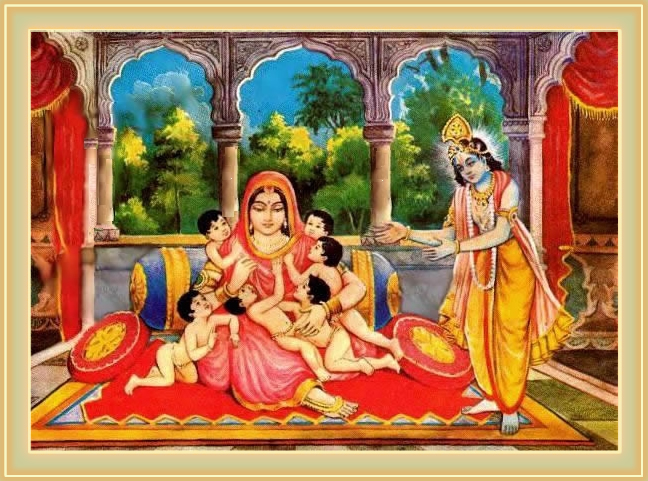
(52) Thus having spoken, They, both being honored by Bali, took the sons back to Dvârakâ and presented them to their mother. (53) When she saw the boys, the breasts of the goddess flowed because of her affection for her sons. She placed them on her lap and embraced them, over and over smelling their heads. (54) Bewildered by the illusory energy of Vishnu, because of which the creation comes into being, she lovingly allowed her sons to drink from her breasts, which were wet as they touched them. (55-56) Having drunk her nectarean milk, which had remained from the milk the Wielder of the Club had drank [before Vasudeva carried Him to Gokula], they, because of [thus] coming in touch with the body of Nârâyana, regained the awareness of their original selves. Bowing down to Govinda, Devakî, their father and Balarâma, they, for everyone to see, went to [heaven,] the abode where the gods reside. (57) Seeing this return and departure of the dead [her sons], divine Devakî thought in great amazement about the magic that was arranged by Krishna, oh King. (58) Oh descendant of Bharata, there are of Krishna, the Supreme Soul unlimited in His valor, countless heroic acts like this.'
(59) S'rî Sûta said [at Naimishâranya, 1.1: 4]: "Whoever devoutly hears or recounts the way this pastime of Murâri, whose glories are unlimited, is described by Vyâsa's respected son, will, by thus fixing his mind on the Supreme Lord, go to His all-auspicious heavenly abode, for this true delight for His devotees' ears fully annihilates the sins of the living being."


Third revised edition, loaded December 15, 2021.
Previous Aadhar edition and Vedabase links:
The son of Vyâsa said: 'One day, Sankarshana and Acyuta, the two sons of Vasudeva, visited Their father who, after They had honored his feet, welcomed Them affectionately and spoke to Them.
The son of Vyâsa said: 'Then, one day, visited Sankarshana and Acyuta, the two sons of Vasudeva, Their father who, after They had honored his feet, welcomed Them affectionately and spoke to Them. (Vedabase)
Having heard the words of the sages referring to the superhuman qualities of his two sons, he became convinced of Their heroic deeds. Addressing Them by name he said:
Having heard the words of the sages referring to the powers of his two sons, got he also in regard of their valorous deeds convinced of Them and said he, addressing Them by name: (Vedabase)
'Krishna, oh Krishna, oh greatest yogi, oh eternal Sankarshana, I know that the two of You are the direct [representatives] of the original nature [or pradhâna] and the supreme principle [the purusha or person] of this universe.
'Krishna, o Krishna, o greatest yogi, o eternal Sankarshana, I know You two are the direct representatives of the primary nature [or pradhâna] and male principle [the purusha or person] out here. (Vedabase)
You are directly the Supreme Lord, the masters of the original substance and the person. Whatever comes into existence, whenever, or for whatever reason, originates from You, is created by You and exists within You, is there for Your sake and belongs to You.
Whatever, however or whenever, in, by, from, of or unto this [universe] comes into existence, all represents directly the One who Predominates, the Supreme Lord, the primary nature and person. (Vedabase)
Oh Lord of the Beyond, this variegated universe You created from Yourself, is entered by You, oh Unborn One, and also maintained by You, the Supersoul [the Paramâtma], as the life principle of vitality [prâna] and individuality [jîva].
This variegated universe that You created from Yourself, o Lord of the Beyond, do You, o Unborn One, entering it by Yourself, maintain as the Supreme Soul and principle of vitality and individuality. (Vedabase)
Of both [the animate, and inanimate] entities, which differing from each other all belong to the Supreme and are thus dependent, You are the One constituting the creative potency, active within the life air and the other basic forces of the universe [see also 2.5: 32-33].
Of both [the animate, and inanimate] entities which, different as they are and all belonging to the Supreme, are thus dependent, are You the One who constitutes the creative potency of the life air and the other basic elements of the universe [see also 2.5: 32-33]. (Vedabase)
The glow, brilliance, luminosity and the particular existence of the moon, the fire, the sun, the stars and lightning [B.G. 15: 12], the permanence of the mountains, and the fragrance and sustaining power of the earth, are all You in fact.
The glow, brilliance, luminosity, the particular of the moon, the fire, the sun, the stars and the lightning [B.G. 15: 12], the permanence of the mountains and the fragrance and sustaining power of the earth, are all You in fact. (Vedabase)
The quenching and the vitalizing capacity of water, as also the water itself and its taste, are You, oh Lord. Oh Controller, on the basis of Your air [the oxygen...] there is the body heat, the mental and physical vigor, the endeavor and the movement [see also B.G. 11: 39].
The quenching, the vitalizing capacity of water as also the water itself and its taste are You o Lord. O Controller, of You is there on the basis of the air [so one says] the body heat, the mental and physical vigor, the endeavor and the movement [see also B.G. 11: 39]. (Vedabase)
You are the directions and the spaces they describe, the omnipresent ether and the elemental sound belonging thereto. You are the [primeval] sound constituting the syllable AUM and its differentiation in particular forms [of language, see also B.G. 7: 8].
You are the directions and the spaces they describe, the omnipresent ether and the elemental sound belonging thereto. You are the primeval vibration that is the syllable AUM and its differentiation in particular forms [of language, see also B.G. 7: 8]. (Vedabase)
You are the power of sense perception, You are their gods [see also 3.12: 26] and of them You are the mercy [granting these sensations]. You are of the intelligence the power to decide and of the living being the power to remember things correctly [B.G. 7: 10 & 15: 15].
You are of the senses the power to perceive, You are their gods [see also see also 3.12: 26] and of them are You the mercy; You are of the intelligence the power to decide and of the living being the power to remember the things as they are [B.G. 7: 10 15: 15]. (Vedabase)
You, the primeval Cause of all Causes [the non-manifest original substance pradhâna], are the source of [the false ego associated with] the physical elements [tamas], the passions of the senses [rajas] and the stream of consciousness of the creative gods [sattva, see also B.G. 14].
You, the primeval Cause of all Causes, are the source of the physical elements [tamas], the passions of the senses [rajas] and the stream of consciousness of the creative gods [sattva, see also B.G. 14]. (Vedabase)
Among the entities subject to destruction in this world, You are the imperishable being, just as the substance of something is observed [and not lost] with its transformations.
Of the entities that are subject to destruction in this world are You the indestructible being, the way the substance itself is relative to its transformations. (Vedabase)
The modes of goodness, passion and ignorance, and their functions, are in this [imperishable] way regulated within You, the Supreme Absolute Truth, by Your internal potency [the yogamâyâ of Your pastimes].
The modes of goodness, passion and ignorance and their functions are this way within You, within the Supreme Absolute Truth, regulated by the internal potency [the yogamâyâ of Your pastimes]. (Vedabase)
On that account there is in You [Yourself] no question of these modifications. Whenever they are conditioned by You [and in You] as products of creation, they have You inside of them, You who otherwise are not material [eternally free, nitya-mukta, see also B.G. 2: 12, 9: 4-5 & 8: 19].
On that account are these entities not [really] destroyed when they - at other times indeed being nonmaterial - conditioned within You as products of creation, also have You within them [as a believer, as the life force or caitanya, as a nitya-mukta, an eternally liberated, conscious soul or a jîvâtmâ, see B.G 2: 12, 9: 4-5 & 8: 19]. (Vedabase)
In this world they are ignorant who, impelled by their karma, [eternally bound, nitya-bandha] move around in the cycle of rebirth; they fail therewith to understand the transcendental destination that is the Soul of the Complete.
Those then in this world are ignorant who, failing in understanding the destination that is the Soul of Everything, by their karma are impelled to move around in the flow of the material ocean. (Vedabase)
I was as fortunate to acquire with this life this difficult to attain, most suitable form of human existence, but because of Your deluding energy [mâyâ] I have spent my entire life in confusion about what one's own purpose in life would be.
Somehow or other with this life having obtained the most desirable status of a human being - a status that is so difficult to achieve -, may someone deluded by the material energy [like me], o Controller, [still] have spent his entire life in confusion about his own best interest. (Vedabase)
With You, who in this world ties everyone together with the ropes of affection, there is, with the body and the progeny and other relations, the 'this I am' and 'these are mine' associated with it [see also e.g. 2.9: 2, 4.28: 17, 4.29: 5, 5.5: 8 and 6.16: 41].
With You who in this world ties everyone together with the ropes of affection is there with the body and the progeny and other relations the 'this I am' and 'these are mine' to it [see also e.g. 2.9: 2, 4.28: 17, 4.29: 5, 5.5: 8 and 6.16: 41]. (Vedabase)
The two of You are not our sons but evidently the Lords of pradhâna and purusha who descended to remove the burden of rulers from the earth, as You have said [10.50: 7-10].
The two of You are not our sons but evidently the Controllers of pradhâna and purusha that descended to remove the burden of rulers from the earth, as You Yourselves have said [10.50: 7-10]. (Vedabase)
I therefore today seek the shelter of Your lotus feet which, from the surrendered, from the distressed souls, take away the fear of being entangled [in the material world], oh Friend, and that is all. Enough, I have enough of the hankering for sense enjoyment that binds me to the mortal frame and makes me think of You, the Supreme One, as being my child.
Therefore do I today seek Your shelter, Your lotus feet that, from the surrendered, the distressed, take away the fear of being entangled, o Friend, and that is all. Enough, I have enough of that hankering for sense enjoyment which binds me to the mortal frame and makes me think of You, the One Supreme, as being my child. (Vedabase)
In the maternity room You indeed said [see 10.3: 44] that You were the Unborn Soul who, age after age having taking birth with us, thus operates to defend Your dharma and therewith, just like a cloud [changing form], assume and give up various bodies [see B.G. 4: 8]. Oh, who can understand the mystic potency and powerful expansions of You, the all-pervading, most glorified Lord?'
In the maternity room You indeed said [see 10.3: 44] that You, taking birth with us, were the Unborn One who that way age after age operates in defense of Your dharma and as a cloud therewith assume and relinquish various bodies [see B.G. 4: 8]; o, who can understand the mystic potency and manifold of You, the all-pervading, most glorified Lord?' (Vedabase)
S'rî S'uka said: 'Having heard these statements of His father, the Supreme Lord, the best of the Sâtvatas, with humility bowed down and then in a gentle voice replied, broadly smiling.
S'rî S'uka said: 'Having heard what His father thus said replied the Supreme Lord, the best of the Sâtvatas, broadly smiling with a gentle voice after with humility having bowed down. (Vedabase)
The Supreme Lord said: 'I consider these meaningful words of yours appropriate oh father, since by referring to Us, your Sons, you have expressed the complete of reality.
The Supreme Lord said: 'I consider these words of you appropriate, o father, since by referring to Us, your Sons, you have expressed the complete of reality. (Vedabase)
I, you, He, My brother, and these residents of Dvârakâ, must, together with everything moving and not moving, all be considered the same way [as expansions of Me], oh best of the Yadus [B.G. 9: 5 & 15 and the siddhânta].
I, you, He, My brother, and these residents of Dvârakâ, must together with everything that moves and not moves, all be considered the same way [as expansions of Me], o best of the Yadus [B.G. 9: 5 & 15 and the siddhânta]. (Vedabase)
The Supreme Soul, being indeed one, self-luminous, eternal and distinct, by means of the basic qualities, from Himself has created the material entities belonging to those modes. Being free from the modes He is thus seen as many.
The Supreme Soul indeed is one, self-luminous, eternal and distinct; being free from the modes is He seen as many, in His by the modes from Himself having created the material entities that belong to those modes. (Vedabase)
It is as with the ether, the air, the fire, the water and the earth, that, being single elements, depending their locations, in their manifest and un-manifest, small and large products, appear as many [see also B.G. 13: 31].'
It is as with the ether, the air, the fire, the water and the earth that, being single elements, depending their locations, in their products, whether they are manifest or unmanifest, small or large, appear as many [see also B.G. 13: 31].' (Vedabase)
S'rî S'uka said: 'Vasudeva thus having been addressed by the Supreme Lord oh King, was liberated from his thinking in opposites and became silent, being satisfied within.
S'rî S'uka said: 'Vasudeva who thus was addressed by the Supreme Lord, o King, was freed from his thinking in opposites and became silent, being satisfied within. (Vedabase)
Then at that place, oh best of the Kurus, Devakî, the worshipable goddess of all who to her utter amazement had heard of [the retrieval of] the son of Their guru [10.45], asked Krishna and Râma loudly and clear to bring back her own sons who were murdered by Kamsa. With that in mind looking back, she spoke sad and distraught with tears in her eyes.
Then at that place, o best of the Kurus, asked loudly and clear Devakî, the worshipable goddess of all who to her utter amazement had heard of [the retrieval of] the son of Their guru [10.45], Krishna and Râma to bring back her own sons who were murdered by Kamsa; and looking back with that in mind she was sad and spoke she distraught with tears in her eyes. (Vedabase)
S'rî Devakî said: 'Râma, oh Râma, oh Immeasurable Soul; oh Krishna, Master of the Yoga Masters, I know that the two of You are the Original Personalities, the Lords of the Creators of the Universe [see also catur-vyûha].
S'rî Devakî said: 'Râma, o Râma, o Immeasurable Soul; o Krishna, Master of the Yoga Masters, I know You both are the Original Personalities, the Lords of the Creators of the Universe [see also catur-vyûha]. (Vedabase)
Having taken birth from me, You have now descended because of the kings who, living in defiance of the scriptures and with their good qualities destroyed by the time [of Kali-yuga], became a burden to the earth.
You have now descended taking birth from me because of the kings who, living in defiance of the scriptures and with their good qualities destroyed by the time [of Kali-yuga], became a burden to the earth. (Vedabase)
Oh Soul of All That Be, today I have come to seek shelter with You, who, by a partial expansion [the modes] of an expansion [the material energy] of an expansion [Nârâyana] of Yours, gives rise to the generation, prospering and dissolution of the universe [see also 2.5].
O Soul of All that Be, today came I for my shelter to Him, to You, who by a partial expansion [the modes] of an expansion [the material energy] of an expansion [Nârâyana] gives rise to the generation, prospering and dissolution of the universe [see also 2.5]. (Vedabase)
One says that Your guru ordered You to retrieve his son who had died a long time ago. You brought him from the place of the forefathers to Your spiritual master as a gift of gratitude to the teacher. Please, oh You two Masters of the Yoga Masters, fulfill the same way my desire. I would like to see my sons brought back who were killed by Kamsa [see 10.4].'
One says that Your guru ordered You to retrieve his son wo had died a long time ago. You brought him from the place of the forefathers to Your spiritual master as a gift of gratitude to the teacher. Please, o You two Masters of the Yoga Masters, fulfill the same way my desire: I'd like to see my sons brought back who were killed by Kamsa [see 10.4]. (Vedabase)
The rishi [S'uka] said: 'Thus entreated by Their mother, oh descendant of Bharata, Râma and Krishna entered the nether world of Sutala, utilizing Their internal potency [see 5.24: 18].
The rishi [S'uka] said: 'Thus entreated by Their mother, o descendant of Bharata entered Râma and Krishna utilizing Their internal potency the nether world of Sutala [see 5.24: 18]. (Vedabase)
The daitya king [Bali], who saw Them entering, stood immediately up to bow down to Them together with his entourage. He was overwhelmed with joy of seeing Them, the Supreme Soul and Self of the Universe, who were his favorite divinity of worship.
Having entered there stood the daitya king [Bali] immediately up to bow to Them together with his entourage. He was overwhelmed with joy of seeing Them, the Supreme Soul and Godhead of the Universe who were his favorite divinity of worship. (Vedabase)
Bringing Them royal seats, They were happy to sit down there. He washed the feet of the two Great Souls and together with his followers took the water [upon their heads] that purifies [everyone], up to Brahmâ.
Bringing Them royal seats, was he, as They sat, happy to wash the two Great Souls Their feet, and together with his followers took he the water [upon their heads] that purifies up to Brahmâ. (Vedabase)
He worshiped Them by presenting all the wealth of himself and his family: the most valuable riches, garments, ornaments, fragrant pastes, bethel nut, lamps, nectarean food and so on [*].
He, worshipping with all the wealth of himself and his family, thus offered Them the most valuable riches, garments, ornaments, fragrant pastes, bethel nut, lamps, nectarean food and so on [*]. (Vedabase)
He who had conquered Indra [see 8.15], over and over took hold of the Supreme Lord's feet. With a heart melting of love, with tears of happiness in his eyes and with his hair standing on end, oh King, he spoke with a choked up voice.
He who had conquered Indra [see 8.15] then spoke, over and over taking hold of the Supreme Lord's feet, with a heart melting of love, with tears in his eyes of ecstasy and with his hair standing on end o King, with a choked up voice. (Vedabase)
Bali said: 'My obeisances to Ananta, the Greatest Being, and Krishna, the Absolute Truth, the Supersoul, the Disseminator and Creator of analytical knowledge [sânkhya, see 3.25-32] and [the science of bhakti-]yoga.
Bali said: 'My respects for Ananta, the Greatest Being; my obeisances for Krishna, the Absolute Truth, the Supersoul, the Disseminator and Creator of the analytical knowledge [sânkhya, see 3.25-32] and science of [bhakti-] yoga. (Vedabase)
To see You is indeed something rarely achieved by the living beings. But [if You endeavor to reach us] of Your own accord, it lies even within the reach of people like us, whose natures are of passion and ignorance [see B.G. 3: 21-23].
The vision of You indeed is, though by the living beings rarely achieved, yet still for people like us, whose natures are in passion and ignorance, not difficult to obtain with You endeavoring to reach us on Your own accord [see B.G. 3: 21-23]. (Vedabase)
The sons of Diti and Dâna, the singers of heaven, the perfected souls, the scientists, the venerable persons, the wealth keepers, the wild, the carnivorous and the paranormal ones, the mystics, the politicians, we and others like them, are constantly fixed in a grudge against the physical presence of You, the direct embodiment of the revealed scriptures who are of pure goodness. Some are obstinate with hatred and some are of devotion with a certain lust [an ulterior motive], while the enlightened souls, predominated by the mode of goodness, are not so attracted [compare: the âtmârâma-verse 1.7: 10].
The sons of Diti and Dâna, the singers of heaven, the perfected, the scientific, the venerable, the wealthkeepers, the wild, the carnivorous and the paranormal, the mystics, the politicians, we and others like them are attracted to You despite of constantly being fixed with a grudge against the Direct Embodiment of Pure Goodness in the divine form of the revealed scriptures; some are especially obstinate with hatred, some are of devotion with ulterior motives, but the enlightened and the rest of the ones lusting in goodness, are not that attracted at all [compare: the âtmârâma-verse 1.7: 10]. (Vedabase)
Oh Master of Yoga Masters, when not even expert yogis know Your bewildering power of yoga which for the greater part is characterized by terms like this [svarûpa and vis'esha, on inborn and outer differences based, game of identity], what then to expect of us?
O Controller when not even the masters of yoga know Your bewildering power of yoga that for the greater part is characterized in terms like this [svarûpa and vis'esha game of identity], what then of us? (Vedabase)
Have therefore mercy with me and lead me out of the blind well of a householder's life towards the other shelter of Your lotus feet sought by selfless souls. Thus I may wander everywhere alone, or else under the protection of those [saints, devotees, Vaishnavas, desire trees] who are willing to help everyone in the world, the souls at whose feet one finds peace and obtains what one needs in life [the 'vritti'].
Therefore o shelter of the lotus feet that are sought by the selfless, have mercy with me and lead me out of the blind well of a household life, so that I in peace may wander alone or else may wander with the friends of all, those [saints, devotees, Vaishnavas, desire trees] who are willing to help all in the world and at whose feet the subsistence [the 'vritti'] is obtained. (Vedabase)
Please direct us oh Controller of the ones [self-]controlled, make us sinless, oh Master, turn us into a person who executes with faith and is thus freed from [scriptural, ritual] fixations.'
Please direct us o Controller of the ones controlled, make us sinless o Master, turn us into a person who executes with faith and thus is freed from [scriptural] fixations.' (Vedabase)
The Supreme Lord said: 'Once, during the first Manu, Marîci fathered six sons born from Ûrnâ. They were demigods who laughed when they saw that the loving one ['kam', or Brahmâ in this case] wanted to copulate with his daughter [called Vâk, see 3.12: 28-35, compare 3.20: 23].
The Supreme Lord said: 'Once, during the first Manu, were there of Marîci six sons born from Ûrnâ, demigods, who laughed when they saw how the one of love ['kam', or Brahmâ in this case] wanted to copulate with his daughter [called Vâk, see 3.12: 28-35, compare 3.20: 23]. (Vedabase)
Because of that offense they immediately entered a womb to be born to Hiranyakas'ipu. They were then by Yogamâyâ transferred to be born from the womb of Devakî, oh King. They were murdered by Kamsa. She laments over them as being her own sons. These same sons are living here near you [see also ** and 10.2*].
Because of that offense entered they immediately a womb to be born to Hiranyakas'ipu. They were then by Yogamâyâ transferred to be born from the womb of Devakî, o King, and were murdered by Kamsa. She laments over them as being her own sons; they, these same sons are living here with you [see also ** and 10.2*]. (Vedabase)
We would like to take them from here in order to dispel their mother's sadness. When thereafter the curse is lifted, they, being freed from the misery, will come back to their own [heavenly] world.
We want to take them from here in order to dispel their mother's sadness; when thereafter the curse is lifted will they being freed from the misery go back to their own world. (Vedabase)
By My grace these six - Smara [Kîrtimân, see 10.1: 57], Udgîtha, Parishvanga, Patanga, Kshudrabhrit and Ghrinî - will return to the destination of the saintly souls.'
By My grace will these six - Smara [Kîrtimân, see 10.1: 57], Udgîtha, Parishvanga, Patanga, Kshudrabhrit and Ghrinî - return to the destination of the saintly.' (Vedabase)
Thus having spoken, They, both being honored by Bali, took the sons back to Dvârakâ and presented them to their mother.
Thus having spoken took They, both honored by Bali, them back to Dvârakâ and presented They the sons to their mother. (Vedabase)
When she saw the boys, the breasts of the goddess flowed because of her affection for her sons. She placed them on her lap and embraced them, over and over smelling their heads.
Seeing the boys made the breasts of the goddess out of her affection for her sons flow, and placing them on her lap embraced she them, over and over smelling their heads. (Vedabase)
Bewildered by the illusory energy of Vishnu because of which the creation comes into being, she lovingly allowed her sons to drink from her breasts, which were wet as they touched them.
Bewildered by Vishnu's illusory energy because of which the creation comes into being, allowed she lovingly her sons to drink from her breasts that were wet the moment they touched them. (Vedabase)
Having drunk her nectarean milk, which had remained from the milk the Wielder of the Club had drank [before Vasudeva carried Him to Gokula], they, because of [thus] coming in touch with the body of Nârâyana, regained the awareness of their original selves. Bowing down to Govinda, Devakî, their father and Balarâma, they, for everyone to see, went to [heaven,] the abode where the gods reside.
Having drunk her nectarean milk, the remnants of what the Wielder of the Club drank [before Vasudeva carried Him to Gokula], regained they, because they came in touch with the body of Nârâyana, the awareness of their original selves. Bowing down to Govinda, Devakî, their father and Balarâma went they, for everyone to see, to the abode where the gods live. (Vedabase)
Seeing this return and departure of the dead [her sons], divine Devakî thought in great amazement about the magic that was arranged by Krishna, oh King.
Seeing this return and departure of the dead, thought devine Devakî in great amazement about the magic that was arranged by Krishna, o King. (Vedabase)
Oh descendant of Bharata, there are of Krishna, the Supreme Soul unlimited in His valor, countless heroic acts like this.'
Of Krishna, the Supreme Soul unlimited in His valor, are there a countless number of feats like this, o descendant of Bharata.' (Vedabase)
S'rî Sûta said [at Naimishâranya, 1.1: 4]: "Whoever devoutly hears or recounts the way this pastime of Murâri, whose glories are unlimited, is described by Vyâsa's respected son, will, by thus fixing his mind on the Supreme Lord, go to His all-auspicious heavenly abode, for this true delight for His devotees' ears fully annihilates the sins of the living being."
S'rî Sûta [at Naimishâranya, 1.1: 4] said: "Whoever devoutly hears or recounts this pastime of Murâri whose glories are unlimited, the way it is described by Vyâsa's respected son, will, because this true delight for His devotees' ears fully annihilates the sins of the living being, with fixing his mind on the Supreme Lord, go to His all-auspicious heavenly abode." (Vedabase)
*: The paramparâ adds here that there are nine standard processes of devotional service as Prahlâda points out in 7.5: 23-24, and that the last, âtma-samarpanam, the handing over of one's wealth as modeled by Bali Mahârâja for the sake of the âtma-nivedanam of self-communication with the Lord, is the culmination at which every endeavor should aim. If one tries to impress the Lord with wealth, power, intelligence and so on, but fails to humbly understand oneself as being His servant, one's so-called devotion is only a presumptuous show. The paramparâ thus warns here against the false religion of pompous ceremony without regard for the yogic retreat as of Daksha in 4.2. See also B.G. 2: 42-43.
**: The paramparâ explains with the âcâryas S'rîdhara Svâmî and Vis'vanâtha Cakravartî that, after taking Marîci's six sons from Hiranyakas'ipu, Lord Krishna's Yogamâyâ first made them pass through one more life as children of another great demon, Kâlanemi [the previous incarnation of Kamsa, see 10.1: 68], and then she finally transferred them to the womb of Devakî. For the full story see footnote 10.1***.

The text and audio are offered
under the conditions of the
Creative
Commons
Attribution-Noncommercial-Share
Alike 3.0 Unported License.
The
painting on this page is by B.K. Mitra.
Production: Filognostic Association of The Order of Time.

Feed-back | Links | Downloads | Music | Pictures | What's New | Search | Donations



 Text 1