
Canto 10
Canto 10
Chapter 88: Lord S'iva Saved from Vrikâsura
(1) The king [Parîkchit] said: 'The demigods, demons and human beings who worship the austere Lord S'iva, are usually rich and enjoy their senses, contrary to those who honor Lakshmî and her Husband, Lord Hari. (2) We are in great doubt about this and would like to understand this matter of the contradictory destinations of the worshipers of the two Lords, who are of such opposite characters.'
(3) S'rî S'uka said: 'S'iva, who is always united with his s'akti, covers the basic qualities of nature with the three characteristics of his emotion [his sattva], his authority [his rajas] and his darkness [his tamas]. He thus constitutes the [embodiment of the] threefold principle of [false] ego. (4) From them the sixteen transformations [lingas] have manifested [of the mind, the ten senses and the five elements]. Someone who turns to [the S'iva manifestation ruling over] any of them, will enjoy all kinds of [corresponding] material wealth [see under S'iva]. (5) Lord Hari however, the Original Person, is transcendental to material nature and absolutely untouched by the modes. He is the [inner] witness seeing everything. By worshiping Him one is freed from [the influence of] the gunas. (6) This is what your grandfather the king [Yudishthhira] asked Acyuta when he, after completing his horse sacrifices, heard from Him about the dharma. (7) The Supreme Lord, his Master, who for the sake of the ultimate benefit of all men had descended into the Yadu family, then was pleased to speak to him as he eagerly listened. (8) The Supreme Lord said: 'From the one I favor I gradually take away the wealth. Wanting he will suffer one distress after the other and be abandoned by his friends and relatives [see also 7.15: 15, 9.21: 12, 10.81: 14 & 20, 10.87: 40, B.G. 9: 22]. (9) When he, failing in his attempts to endeavor for money, gets frustrated and becomes friends with My devotees, I will show him My mercy. (10) Intelligent with the wisdom, understanding that the subtle, pure, eternal spirit of the Supreme Infinite Brahman constitutes one's true self, one is freed from samsâra. (11) Leaving Me aside because I am most difficult to worship, people worship others, who are quickly satisfied. From them receiving royal opulence, they become arrogant and proud, and next, surprisingly, become negligent and insulting towards those whom they owe the benedictions [see also B.G. 2: 42-44; 4: 12; 7: 20-25; 17: 22, 18: 28].'
(12) S'rî S'uka said: 'Brahmâ, Vishnu, S'iva and others, are capable of pronouncing curses and granting favors. Brahmâ and S'iva are quick with their condemnations and blessings, my dear King, but the Infallible One [Lord Vishnu] is not. (13) In this connection the following ancient story is told as an example about Giris'a [S'iva], who ran into danger because he offered the demon Vrikâsura the choice of a benediction. (14) The demon, called Vrika, was a son of S'akuni [see 9.24: 5]. He once met Nârada on the road and wickedly asked him whom of the three Lords would be most quickly pleased. (15) He said: 'For quick success you better worship S'iva. He is as quickly satisfied with your qualities, as he is angered by your faults. (16) Satisfied about Ten-head [Râvana] and Bâna, who like minstrels sang his glories, he ran into great trouble when he gave them unequaled power.'
(17) Thus being informed, the Asura worshiped him [Lord S'iva] at Kedâra [in the Himalayas], by offering oblations of flesh from his own limbs into the fire that is S'iva's mouth. (18-19) Out of frustration not to obtain the sight of the Lord, he, at the seventh day, with his hair wetted in the waters of that holy place, was about to cut off his head with a hatchet. But at that moment S'iva supremely merciful rose from the fire, looking like Agni. He stopped him by seizing his arms, just like we would do. By that touch his body was restored to its original complete state. (20) He told him: 'Enough, enough, dear man, please listen. Choose a benediction from me, I will bestow whatever boon you desire. Ah, tormenting your body so greatly is useless, for I am [already] pleased by persons who with some water approach me for shelter [see also B.G. 17: 5-6]!'
(21) The sinner then asked the god for a boon that terrified all living beings: 'May everyone die upon whose head I place my hand!'
(22) Oh son of Bharata, when Rudra heard this, he disgruntled vibrated om in consent and granted the request with a forced smile, like he was giving milk to a snake [see also 10.16: 37]. (23) To put the favor to a test, the demon then tried to put his hand on the head of Lord S'ambu, S'iva, who thus became afraid of what he had caused himself. (24) Trembling with fear being pursued by him, he from the north [of his residence] fled in all directions, to the limits of the earth and the sky. (25-26) Not knowing what to do against it, the chief demigods remained silent. He [S'iva] thereupon went to Vaikunthha, the place of light beyond all darkness, where Nârâyana, the Supreme Goal, is personally present. That place constitutes the destination from where renunciates do not return who stopped with the violence [against other creatures] and found peace [see also S'vetadvîpa]. (27-28) The Supreme Lord, the Eradicator of Distress, who from a distance saw the danger, by the power of His yogamâyâ turned Himself into a young brahmin student and came before him. Complete with a belt, deerskin, rod and prayer beads, He had an effulgence that glowed like fire. He respectfully greeted him humbly with kus'a grass in His hands. (29) The Supreme Lord said: 'Dear son of S'akuni, you seem to be tired. Why have you come from so far? Please rest a while, should we not attend to all the desires of this personal body? (30) If We may hear about it, oh mighty one, please tell Us what you have in mind. One usually accomplishes one's purposes with the help of others, is it not?'
(31) S'rî S'uka said: 'Thus being questioned by the Supreme Lord with words that rained like nectar, all his fatigue vanished. He told Him what he had done. (32) The Supreme Lord [then] said [to Vrika]: 'If that is the case, We cannot put faith in S'iva's statements, for he has been cursed by Daksha to become diabolical as the king of the ghosts and devils [see 4.2: 9-16]. (33) If you, oh King of the Dânavas, put faith in him as the 'spiritual master of the universe', then see right now what happens when you place your hand on your own head! (34) If S'ambhu's words thus or otherwise prove to be false, oh best of the Dânavas, then please kill him who has been fooling you, so that he never lies again.'
(35) He was thus as bewildered by the so very clever, excellent words of the Supreme Lord, that he no longer thought and foolishly placed his hand on his own head. (36) Like being hit by lightening his head was instantly shattered. He fell down, whereupon from the sky the sounds could be heard of 'Victory!', 'Hail!' and 'Well done!' (37) Now that, with the death of the sinful Asura Vrika, S'iva was freed from the danger, the celestial sages, the ancestors and the singers of heaven released a rain of flowers. (38-39) Bhagavân, the Supreme Personality, then addressed the delivered Giris'a: 'Ah, dear Mahâdeva, see how this sinner was killed by his own sinfulness! What happiness, oh master, can there be for a living being of offense towards the elevated saints, not to mention being of offense with the Lord of the Universe, the Guru of the Living Being [see also 1.18: 42, 7.4: 20 and B.G. 16: 23]? (40) Whoever hears or speaks about this rescue of Lord S'iva by the Lord of the Supersoul, the Inconceivable Personal Manifestation of the Ocean of All Energies, will be freed from his enemies as also from the repetition of birth and death.'


Third revised edition, loaded January 4, 2022.
Previous Aadhar edition and Vedabase links:
The king [Parîkchit] said: 'The demigods, demons and human beings who worship the austere Lord S'iva, are usually rich and enjoy their senses, contrary to those who honor Lakshmî and her Husband, Lord Hari.The honorable king [Parîkchit] said: 'The godly, the ones of darkness and the humans who worship the austere Lord S'iva, are usually rich and enjoy the senses, but not so those of Lakshmî and her Husband the Lord Hari. (Vedabase)
We are in great doubt about this and would like to understand this matter of the contradictory destinations of the worshipers of the two Lords, who are of such opposite characters.'
On our part indeed of great doubt in this, we wish to understand this matter of the destinations of the worshipers of the two lords so opposite of character.' (Vedabase)
S'rî S'uka said: 'S'iva, who is always united with his s'akti, covers the basic qualities of nature with the three characteristics of his emotion [his sattva], his authority [his rajas] and his darkness [his tamas]. He thus constitutes the [embodiment of the] threefold principle of [false] ego.
S'rî S'uka said: 'S'iva, always united with his s'akti, is prayed to in his three manifest features of guna: the emotion [his sattva], the authority [his rajas] and the inertia [his tamas], and is thus the [embodiment of the] threefold of ego. (Vedabase)
From them the sixteen transformations [lingas] have manifested [of the mind, the ten senses and the five elements]. Someone who turns to [the S'iva manifestation ruling over] any of them, will enjoy all kinds of [corresponding] material wealth [see under S'iva].
From that have the sixteen transformations [lingas] manifested of which someone, pursuing any of these, enjoys the acquisition of material assets [see under S'iva]. (Vedabase)
Lord Hari however, the Original Person, is transcendental to material nature and absolutely untouched by the modes. He is the [inner] witness seeing everything. By worshiping Him one is freed from [the influence of] the gunas.
Lord Hari however is, indeed absolutely untouched by the modes, the Original Person transcendental to material nature; He is the witness seeing everything, by worshiping Him one becomes free from the gunas. (Vedabase)
This is what your grandfather the king [Yudishthhira] asked Acyuta when he, after completing his horse sacrifices, heard from Him about the dharma.
our grandfather the king [Yudishthhira] asked Acyuta this as he was hearing from Him about the dharma. (Vedabase)
The Supreme Lord, his Master, who for the sake of the ultimate benefit of all men had descended into the Yadu family, then was pleased to speak to him as he eagerly listened.
He, the Supreme Lord, his Master, who for the sake of the ultimate benefit of all men had descended into the Yadu-family, then spoke pleased to him who was eagerly listening. (Vedabase)
The Supreme Lord said: 'From the one I favor I gradually take away the wealth. Wanting he will suffer one distress after the other and be abandoned by his friends and relatives [see also 7.15: 15, 9.21: 12, 10.81: 14 & 20, 10.87: 40, B.G. 9: 22].
The Supreme Lord said: 'From the one I favor I gradually take away the wealth, after which then poor, suffering one distress after another, that person will be abandoned by his own [attached] people [see also 7.15: 15, 9.21: 12, 10.81: 14 & 20, 10.87: 40, B.G. 9: 22]. (Vedabase)
When he, failing in his attempts to endeavor for money, gets frustrated and becomes friends with My devotees, I will show him My mercy.
When he futile in his attempts to serve the capital gets frustrated and makes friends with those devoted to Me, will I show My mercy. (Vedabase)
Intelligent with the wisdom, understanding that the subtle, pure, eternal spirit of the Supreme Infinite Brahman constitutes one's true self, one is freed from samsâra.
Sober with the wisdom understanding that the subtle, pure, eternal spirit of the Supreme Brahman is one's true self, is one freed from samsâra. (Vedabase)
Leaving Me aside because I am most difficult to worship, people worship others, who are quickly satisfied. From them receiving royal opulence, they become arrogant and proud, and next, surprisingly, become negligent and insulting towards those whom they owe the benedictions [see also B.G. 2: 42-44; 4: 12; 7: 20-25; 17: 22, 18: 28].'
Leaving aside Me because I am most difficult to worship, do people worship others from which they quickly find satisfaction in receiving royal opulence. Having become arrogant, proud and negligent do they, surprisingly, then insult those whom they owe the benedictions [see also B.G. 2.42-44 ; 4: 12; 7: 20-25; 17: 22, 18: 28].' (Vedabase)
S'rî S'uka said: 'Brahmâ, Vishnu, S'iva and others, are capable of pronouncing curses and granting favors. Brahmâ and S'iva are quick with their condemnations and blessings, my dear King, but the Infallible One [Lord Vishnu] is not.
S'rî S'uka said: 'Brahmâ, S'iva and others are capable of cursing and showing favor. Brahmâ and S'iva are quick with their condemnations and blessings, my dear King, but the Infallible One [Vishnu] is not. (Vedabase)
In this connection the following ancient story is told as an example about Giris'a [S'iva], who ran into danger because he offered the demon Vrikâsura the choice of a benediction.
In this connection is as an example the following ancient story told of Giris'a running into danger by offering a choice of benedictions to the demon Vrikâsura. (Vedabase)
The demon, called Vrika, was a son of S'akuni [see 9.24: 5]. He once met Nârada on the road and wickedly asked him whom of the three Lords would be most quickly pleased.
An Asura named Vrika, a son of S'akuni [see 9.24: 5], meeting Nârada on the road, wickedly asked which of the three Lords was most quickly pleased. (Vedabase)
He said: 'For quick success you better worship S'iva. He is as quickly satisfied with your qualities, as he is angered by your faults.
He said: 'For quick success you better worship S'iva, he is as quickly satisfied by qualities as he is angered by faults. (Vedabase)
Satisfied about Ten-head [Râvana] and Bâna, who like minstrels sang his glories, he ran into great trouble when he gave them unequaled power.'
Satisfied with Ten-head [Râvana] and with Bâna who like minstrels sang his glories, got he in great trouble [though] giving them unequaled power.' (Vedabase)
Thus being informed, the Asura worshiped him [Lord S'iva] at Kedâra [in the Himalayas], by offering oblations of flesh from his own limbs into the fire that is S'iva's mouth.
Thus informed worshiped the Asura him at Kedâra [in the Himalayas] by offering oblations of flesh from his own limbs into the fire that is S'iva's mouth. (Vedabase)
Out of frustration not to obtain the sight of the Lord, he, at the seventh day, with his hair wetted in the waters of that holy place, was about to cut off his head with a hatchet. But at that moment S'iva supremely merciful rose from the fire, looking like Agni. He stopped him by seizing his arms, just like we would do. By that touch his body was restored to its original complete state.
Out of frustration to obtain the sight of the Lord, was he the seventh day with his hair wetted in the waters of that holy place, about to cuet off his head with a hatchet. But then supremely merciful rising from the fire looking like Agni stopped he him seizing his arms and restored he his body on the touch, just like we would. (Vedabase)
He told him: 'Enough, enough, dear man, please listen. Choose a benediction from me, I will bestow whatever boon you desire. Ah, tormenting your body so greatly is useless, for I am [already] pleased by persons who with some water approach me for shelter [see also B.G. 17: 5-6]!'
He told him: 'Enough, enough, dear man, please listen, choose a benediction from me, I'll bestow upon you whatever boon you desire; ah, your greatly tormenting your body is useless, I am pleased by persons who with water approach me for shelter [see also B.G. 17: 5-6]!' (Vedabase)
The sinner then asked the god for a boon that terrified all living beings: 'May everyone die upon whose head I place my hand!'
With that offer of the god chose the sinner a boon that terrified all living beings as he said: 'May whomever die on whose head I place my hand!' (Vedabase)
Oh son of Bharata, when Rudra heard this, he disgruntled vibrated om in consent and granted the request with a forced smile, like he was giving milk to a snake [see also 10.16: 37].
O son of Bharata, Rudra hearing this, disgruntled vibrated om and granted it him with an ironic smile; it was like giving milk to a snake [see also 10.16: 37]. (Vedabase)
To put the favor to a test, the demon then tried to put his hand on the head of Lord S'ambu, S'iva, who thus became afraid of what he had caused himself.
To put the favor to a test tried the demon then to put his hand on the head of S'iva and made that way his flesh creep about what he had caused. (Vedabase)
Trembling with fear being pursued by him, he from the north [of his residence] fled in all directions, to the limits of the earth and the sky.
Pursued by him fled he trembling with fear from the north [of his residence] to as far as the limits of the earth and the sky in all directions. (Vedabase)
Not knowing what to do against it, the chief demigods remained silent. He [S'iva] thereupon went to Vaikunthha, the place of light beyond all darkness, where Nârâyana, the Supreme Goal, is personally present. That place constitutes the destination from where renunciates do not return who stopped with the violence [against other creatures] and found peace [see also S'vetadvîpa].
Not knowing what to do against it remained the chief demigods silent. Thereupon he went to Vaikunthha, the place luminous beyond all darkness where Nârâyana, the Supreme Goal is manifest. That place is the destination from where the renunciates who in peace gave up the violence do not return [see also S'vetadvîpa]. (Vedabase)
The Supreme Lord, the Eradicator of Distress, who from a distance saw the danger, by the power of His yogamâyâ turned Himself into a young brahmin student and came before him. Complete with a belt, deerskin, rod and prayer beads, He had an effulgence that glowed like fire. He respectfully greeted him humbly with kus'a grass in His hands.
The Supreme Lord, the Eradicator of Distress, who from a distance saw the danger, came before him having turned Himself by the power of His yogamâyâ into a young brahmin student. Complete with a belt, deerskin, rod and prayer beads had He an effulgence that glowed like fire. He respectfully greeted him humbly with kus'a grass in His hands. (Vedabase)
The Supreme Lord said: 'Dear son of S'akuni, you seem to be tired. Why have you come from so far? Please rest a while, should we not attend to all the desires of this personal body?
The Supreme Lord said: 'Dear son of S'akuni, you seem to be tired, for what reason have you come from so far? Please rest a while, shouldn't this personal body be the fulfillment of all desires? (Vedabase)
If We may hear about it, oh mighty one, please tell Us what you have in mind. One usually accomplishes one's purposes with the help of others, is it not?'
If suitable to Our ear, o mighty one, please tell Us what you have in mind. One usually accomplishes one's purposes with the help of others isn't it?' (Vedabase)
S'rî S'uka said: 'Thus being questioned by the Supreme Lord with words that rained like nectar, all his fatigue vanished. He told Him what he had done.
S'rî S'uka said: 'Thus questioned by the Supreme Lord with words that rained like nectar, vanished all his fatigue and told he Him what he had done. (Vedabase)
The Supreme Lord [then] said [to Vrika]: 'If that is the case, We cannot put faith in S'iva's statements, for he has been cursed by Daksha to become diabolical as the king of the ghosts and devils [see 4.2: 9-16].
The Supreme Lord said [then to Vrika]: 'That being the case, We can't put faith in his statements. For he's the one cursed by Daksha to become diabolical as the king of the ghosts and devils [see 4.2: 9-16]. (Vedabase)
If you, oh King of the Dânavas, put faith in him as the 'spiritual master of the universe', then see right now what happens when you place your hand on your own head!
If you put faith in him as the 'spiritual master of the universe', then dear friend, just see right now what happens if you place your hand on your own head! (Vedabase)
If S'ambhu's words thus or otherwise prove to be false, oh best of the Dânavas, then please kill him who has been fooling you, so that he never lies again.'
If S'ambhu's words this way - or another - prove to be false, o best of the Dânavas, then please kill him who's been fooling you, so that he never lies again.' (Vedabase)
He was thus as bewildered by the so very clever, excellent words of the Supreme Lord, that he no longer thought and foolishly placed his hand on his own head.
He this manner bewildered by the o so clever words of the Supreme Lord, thought no longer and foolishly placed his hand on his own head. (Vedabase)
Like being hit by lightening his head was instantly shattered. He fell down, whereupon from the sky the sounds could be heard of 'Victory!', 'Hail!' and 'Well done!'
Like being hit by lightening was it instantly shattered. He fell down whereupon from the sky could be heard the sounds of 'Victory!', 'Hail!' and 'Right so!' (Vedabase)
Now that, with the death of the sinful Asura Vrika, S'iva was freed from the danger, the celestial sages, the ancestors and the singers of heaven released a rain of flowers.
With S'iva freed from the danger now the sinful Asura Vrika was killed, released the celestial sages, the ancestors and the singers of heaven a rain of flowers. (Vedabase)
Bhagavân, the Supreme Personality, then addressed the delivered Giris'a: 'Ah, dear Mahâdeva, see how this sinner was killed by his own sinfulness! What happiness, oh master, can there be for a living being of offense towards the elevated saints, not to mention being of offense with the Lord of the Universe, the Guru of the Living Being [see also 1.18: 42, 7.4: 20 and B.G. 16: 23]?
Bhagavân, the Supreme Personality, then addressed the delivered Giris'a: 'Ah, dear Mahâdeva, see how this sinner was killed by his own sinfulness! What fortune indeed o master, can there be for a living being who was of offense with the elevated saints, not to mention having been in offense with the Lord of the Universe, the Spiritual Master of the Living Being [see also 1.18: 42, 7.4: 20 and B.G. 16: 23]. (Vedabase)
Whoever hears or speaks about this rescue of Lord S'iva by the Lord of the Supersoul, the Inconceivable Personal Manifestation of the Ocean of All Energies, will be freed from his enemies as also from the repetition of birth and death.'
Whoever hears of or recites this rescuing of lord S'iva by the Lord of the Supersoul, the Inconceivable Personal Manifestation of the Ocean of All Energies, is freed from as well enemies as from the repetition of birth and death. (Vedabase)

The text and audio are offered
under the conditions of the
Creative
Commons
Attribution-Noncommercial-Share
Alike 3.0 Unported License.
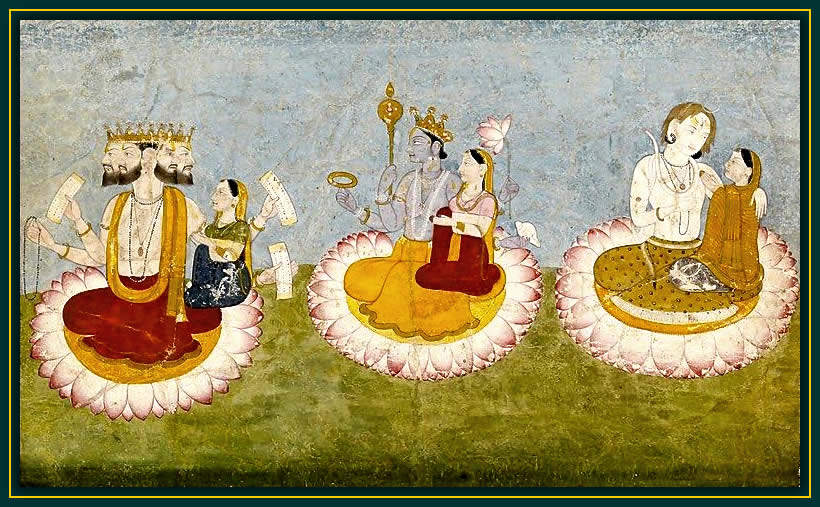
The image on this page shows Brahmâ, Vishnu and Shiva seated on
lotuses with their consorts,
Saraswati, Lakshmi and Paravati, resp. ca 1770. Guler, India.
Victoria and Albert Museum, UK.
Source: Wikipedia
Production:
Filognostic
Association of The Order of Time.

Feed-back | Links | Downloads | Music | Pictures | What's New | Search | Donations



 Text 1