

Canto
11
Canto
11
Chapter 12: The Confidential Secret Beyond Renunciation and Knowledge
(1-2) The Supreme Lord said: 'One does not ascend to Me by mysticism or analysis, common piety or the study of the scriptures, by penances, renunciation, pious works or charity, by respecting vows, ceremonies, Vedic hymns, pilgrimage, by general discipline or the basic rules. One rather closes Me in one's heart by the sat-sanga with My devotees [see 11.11: 25] that drives away all attachment to sense gratification. (3-6) By associating with My devotees many living beings in every age achieved My refuge, like the sons of Diti, the malicious ones, the animals, the birds, the singers and dancers of heaven, the souls of excellence and of perfection, the venerable souls and the treasure keepers, the scientific ones among the humans and the merchants, laborers and women, the uncivilized ones and those of passion and slowness. So also did Vritrâsura, the son of Kayâdhu [Prahlâda, see 6.18: 12-13] and others like them, Vrishaparvâ [see 9.18: 26], Bali, Bâna, Maya as also Vibhîshana [brother of Râvana], Sugrîva [leader of the Vânaras] and Hanumân, Jâmbavân, Gajendra, Jathâyu, Tulâdhâra, Dharma-vyâdha, Kubjâ and the gopîs in Vraja, the wives of the brahmins [see 10.23] and others. (7) Not having studied the sacred scriptures, nor having worshiped the great saints, they all, without vows and not having undergone austerities, attained Me by association with My devotees. (8-9) Only by unalloyed love indeed, the gopîs, just as others of a limited intelligence like the cows, the immobile creatures, the snakes [like Kâliya] and more animals, managed to achieve perfection and quite easily attained Me, I who cannot even be reached by greatly endeavoring in yoga, analysis, charity, vows, penances, ritualistic sacrifices, exegesis, personal study or taking to the renounced order. (10) When Akrûra took Me and Balarâma to Mathurâ, they, [the inhabitants of Vrindâvana] whose hearts were attached [to Me] with the deepest love, suffered greatly because of the separation, for they saw no one else to make them happy [see 10: 39]. (11) All the nights they in Vrindâvana spent with Me, their most dearly Beloved, oh Uddhava, seemed to take but a moment to them, but again bereft of Me they became as long as a kalpa. (12) Just as sages fully absorbed lose the awareness of names and forms - like they are rivers entering the water of the ocean - also they, whose consciousness was intimately bound to Me, had no awareness anymore of their bodies, their present or their future [see also B.G. 2: 70]. (13) The hundreds and thousands [of women] who desired Me as their friend and lover, had no knowledge of My actual position and attained Me by associating with Me, the Absolute Supreme Truth. (14-15) Therefore, oh Uddhava, give up the [religious] precepts and prohibitions, denial and routines, and that what you should listen to and have listened to. Choose for Me alone, the actual shelter of the Soul within all embodied beings. With that exclusive devotion you will enjoy My mercy and have nothing to fear from any side [compare B.g. 18: 66].'
(16) S'rî Uddhava said: 'Hearing Your words, oh master of all yoga masters, has not dispelled the doubt in my heart that is clouding my mind.'
(17) The Supreme Lord said: 'He, the living being in person [the Lord], is manifest within along with the prâna. He after all entered the heart and has His place in the subtle sound vibration that fills the mind with the grosser form of the [sounds of words, that are] different intonations of short and long vowels and consonants. (18) Just as fire confined within wood, with the help of air, kindled by friction is born very tiny and increases with ghee, I similarly manifest Myself in this [Vedic, inner] voice. (19) Speech, the function of the hands and legs, the genitals and the anus [the karmendriyas], smell, taste, sight, touch and hearing [the jñânendriyas], and the functions of one's determination, wisdom and self concern [or 'mind, intelligence and false ego'], as also the primary cause of matter [pradhâna or the 'thread', see 11.9: 19] and [the gunas] rajas, tamas and sattva, are thus [to be understood as] transformations [of My nature]. (20) This living entity, one and unmanifest, which is concerned with the threefold [nature of the gunas], constitutes the source of the lotus of creation. He who is eternal, in the course of time divided [therewith] His potencies in many divisions, just like seeds do that fell on fertile soil. (21) The complete of t his universe, expanding long and wide like cloth expanding along the threads of its warp and woof, is situated in Him [on His thread, see also 6.3: 12 and B.G. 7: 7]. Since time immemorial there is this tree of material existence [samsâra] that, blossoming and producing fruits, is naturally inclined to fruitive action [or karma]. (22-23) Of this tree extending in the sun there are two seeds [sin and piety], hundreds of roots [the living entities], three lower trunks [the modes], five upper trunks [the elements], five saps produced [sound, form, touch, taste and aroma], eleven branches [the mind and the ten indriyas], two birds having a nest [jîva and âtmâ], three types of bark [air, bile and mucus] and two fruits [happiness and distress]. Those who fervently desiring live a household life [the 'vultures'], enjoy one fruit of the tree [that of sin], whereas the other fruit [of piety] is enjoyed by the swanlike [sages] who live in the forest. He who, with the help of the worshipable souls, [the devotees, the gurus] knows the Oneness of Him who, by dint of His mâyâ, appears in many forms, knows the [actual meaning of the] Vedas. (24) The sober soul who, thus with unalloyed devotion, honors the spiritual master and with the axe of knowledge cuts with the subtle body of attachment entertained by the individual soul, attains with the greatest care [living spiritually] the Supreme Soul, and then abandons the means [by which he attained, see also B.G. 15: 3-4].'


Third revised edition, loaded April 17, 2022.
Previous Aadhar edition and Vedabase links:
The Supreme Lord said: 'One does not ascend to Me by mysticism or analysis, common piety or the study of the scriptures, by penances, renunciation, pious works or charity, by respecting vows, ceremonies, Vedic hymns, pilgrimage, by general discipline or the basic rules. One rather closes Me in one's heart by the sat-sanga with My devotees [see 11.11: 25] that drives away all attachment to sense gratification.The Supreme Lord said: 'Mysticism nor analysis, common piety, and also not the study of the scriptures, penances, renunciation, desirable and pious works, and charity neither; the following of vows, ceremonies, vedic hymns, pilgrimage, general discipline nor the basic rules do contain Me the way the sat-sanga [see 11.11: 25] captures Me that removes all material association. (Vedabase)
By associating with My devotees many living beings in every age achieved My refuge, like the sons of Diti, the malicious ones, the animals, the birds, the singers and dancers of heaven, the souls of excellence and of perfection, the venerable souls and the treasure keepers, the scientific ones among the humans and the merchants, laborers and women, the uncivilized ones and those of passion and slowness. So also did Vritrâsura, the son of Kayâdhu [Prahlâda, see 6.18: 12-13] and others like them, Vrishaparvâ [see 9.18: 26], Bali, Bâna, Maya as also Vibhîshana [brother of Râvana], Sugrîva [leader of the Vânaras] and Hanumân, Jâmbavân, Gajendra, Jathâyu, Tulâdhâra, Dharma-vyâdha, Kubjâ and the gopîs in Vraja, the wives of the brahmins [see 10.23] and others.
By means of sat-sanga only many living entities, like the sons of Diti, the malicious ones, the animals, the birds, the singers and dancers of heaven, the excellent and perfected, the venerable and the treasure keepers, the scientific ones among the humans and the merchants, laborers and women, the uncivilized and the ones of passion and slowness, in each and every age achieve My abode. And so did Vritrâsura, the son of Kayâdhû [Prahlâda, see 6.18: 12-13] and others like them, Vrishaparvâ [see 9.18: 26], Bali, Bâna, Maya as also Vibhîshana [brother of Râvana], Sugrîva [leader of the Vânaras] and Hanumân, Jâmbavân, Gajendra, Jatâyu, Tulâdhâra, Dharma-vyâdha, Kubjâ and the gopîs in Vraja, as also the wives of the brahmins [see 10.23] and others. (Vedabase)
Not having studied the sacred scriptures, nor having worshiped the great saints, they all, without vows and not having undergone austerities, attained Me by association with My devotees.
They, not having studied the sacred scriptures, nor having worshiped the great saints, attained, without vows not having undergone austerities, Me by My association. (Vedabase)
Only by unalloyed love indeed, the gopîs, just as others of a limited intelligence like the cows, the immobile creatures, the snakes [like Kâliya] and more animals, managed to achieve perfection and quite easily attained Me, I who cannot even be reached by greatly endeavoring in yoga, analysis, charity, vows, penances, ritualistic sacrifices, exegesis, personal study or taking to the renounced order.
Indeed purely by love achieved the gopîs, the cows, the immobile creatures, the animals, the snakes [like Kâliya] and others who were stunted in their intelligence, the perfection quite easily as they came to Me, whom cannot even be reached greatly endeavoring with yoga, analysis, charity, vows, penances, ritualistic sacrifices, exegesis, personal study or taking to the renounced order. (Vedabase)
When Akrûra took Me and Balarâma to Mathurâ, they, [the inhabitants of Vrindâvana] whose hearts were attached [to Me] with the deepest love, suffered greatly because of the separation, for they saw no one else to make them happy [see 10: 39].
When Akrûra took Me together with Balarâma to Mathurâ were those constantly attached whose consciousness was most profound of their love, seeing no one else but Me to make them happy, of great anxiety upon the separation [see 10: 39]. (Vedabase)
All the nights they in Vrindâvana spent with Me, their most dearly Beloved, oh Uddhava, seemed to take but a moment to them, but again bereft of Me they became as long as a kalpa.
All the nights they in Vrindâvana had spent with Me, their most dearly Beloved, o Uddhava seemed to them just like half a moment, but again bereft of Me they became as long as a kalpa. (Vedabase)
Just as sages fully absorbed lose the awareness of names and forms - like they are rivers entering the water of the ocean - also they, whose consciousness was intimately bound to Me, had no awareness anymore of their bodies, their present or their future [see also B.G. 2: 70].
They with their consciousness bound up in intimacy with Me were not aware of their own bodies, just as sages in full absorption consider something very near as names and forms as far removed as rivers are, once they have entered the ocean [B.G. 2: 70]. (Vedabase)
The hundreds and thousands [of women] who desired Me as their friend and lover, had no knowledge of My actual position and attained Me by associating with Me, the Absolute Supreme Truth.
The women with Me, a charming lover to their desire, a lover of another man's wives, had no idea of the actual position of Me, the Absolute Truth Supreme, whom they by the hundreds of thousands in association achieved. (Vedabase)
Therefore, oh Uddhava, give up the [religious] precepts and prohibitions, denial and routines, and that what you should listen to and have listened to. Choose for Me alone, the actual shelter of the Soul within all embodied beings. With that exclusive devotion you will enjoy My mercy and have nothing to fear from any side [compare B.g. 18: 66].'
Therefore o Uddhava give up the injunctions, the regulations about them and the ritual culture for its own sake, that what you learnt and will be learning; go for Me alone, the actual shelter of the soul within all the embodied; with that exclusive devotion should you by My mercy have nothing to fear from any side [compare B.G. 18: 66]. ' (Vedabase)
S'rî Uddhava said: 'Hearing Your words, oh master of all yoga masters, has not dispelled the doubt in my heart that is clouding my mind.'
S'rî Uddhava said: hearing Your words. o Lord of the Lords of Yoga, has not dispelled the doubt that nestled in my heart and of which my mind is bewildered.' (Vedabase)
The Supreme Lord said: 'He, the living being in person [the Lord], is manifest within along with the prâna. He after all entered the heart and has His place in the subtle sound vibration that fills the mind with the grosser form of the [sounds of words, that are] different intonations of short and long vowels and consonants.
The Supreme Lord said: 'He, the living being Himself, is, along with the prâna, manifest within having entered the heart with His place in the subtle sound vibration that fills the mind in the grosser form of the different intonations of short and long vowels and consonants. (Vedabase)
Just as fire confined within wood, with the help of air, kindled by friction is born very tiny and increases with ghee, I similarly manifest Myself in this [Vedic, inner] voice.
Just as fire confined within wood, with the help of air, kindled by friction very tiny is born and increases with ghee, is it similar to this indeed with My manifestation for sure so in words. (Vedabase)
Speech, the function of the hands and legs, the genitals and the anus [the karmendriyas], smell, taste, sight, touch and hearing [the jñânendriyas], and the functions of one's determination, wisdom and self concern [or 'mind, intelligence and false ego'], as also the primary cause of matter [pradhâna or the 'thread', see 11.9: 19] and [the gunas] rajas, tamas and sattva, are thus [to be understood as] transformations [of My nature].
Thus are speech, the function of the hands and legs, the genitals and the anus [the karmendriyas]; the smell, taste, sight, touch and hearing [the jñânendriyas] and the functions of the determination, the wisdom and and the selfconcern [or 'mind, intelligence and false ego'] as well as the primary of matter [pradhâna or the thread, see 11.9: 19] and the rajas, tama and sattva [the gunas] there as the transformation [of Me]. (Vedabase)
This living entity, one and unmanifest, which is concerned with the threefold [nature of the gunas], constitutes the source of the lotus of creation. He who is eternal, in the course of time divided [therewith] His potencies in many divisions, just like seeds do that fell on fertile soil.
Indeed this living entity, one and unmanifest, that is concerned with the threefold, is the source of the lotus of creation; He, being eternal, in the course of time dividing His potencies in many divisions, appears just like seeds do fallen in a fertile field. (Vedabase)
The complete of this universe, expanding long and wide like cloth expanding along the threads of its warp and woof, is situated in Him [on His thread, see also 6.3: 12 and B.G. 7: 7]. Since time immemorial there is this tree of material existence [samsâra] that, blossoming and producing fruits, is naturally inclined to fruitive action [or karma].
Just as cloth expands on the warp and woof of its threads, is the whole of this Universe, expanding long and wide, situated in Him [on His thread, see also 6.3: 12 and B.G. 7: 7] as this material existence, of which this tree [this organic body] existing since time immemorial is naturally inclined to fruitive action [or karma] as it blossoming produces the fruits. (Vedabase)
Of this tree extending in the sun there are two seeds [sin and piety], hundreds of roots [the living entities], three lower trunks [the modes], five upper trunks [the elements], five saps produced [sound, form, touch, taste and aroma], eleven branches [the mind and the ten indriyas], two birds having a nest [jîva and âtmâ], three types of bark [air, bile and mucus] and two fruits [happiness and distress]. Those who fervently desiring live a household life [the 'vultures'], enjoy one fruit of the tree [that of sin], whereas the other fruit [of piety] is enjoyed by the swanlike [sages] who live in the forest. He who, with the help of the worshipable souls, [the devotees, the gurus] knows the Oneness of Him who, by dint of His mâyâ, appears in many forms, knows the [actual meaning of the] Vedas.
Of this tree extending in the sun there are two seeds [sin and piety], hundreds of roots [the living entities], three lower trunks [the modes], five upper trunks [the elements], five saps produced [sound, form, touch, taste and aroma], eleven branches [the mind and the ten indriyas]; two birds having a nest [jîva and âtmâ], three types of bark [air, bile and mucus] and two fruits [happiness and distress]. The lusty one living in a household enjoys one fruit of the tree whereas the other swanlike ones living in the forest with the help of the worshipable [the devotees, the gurus] know the One who by dint of His mâyâ appears in many forms. (Vedabase)
The sober soul who, thus with unalloyed devotion, honors the spiritual master and with the axe of knowledge cuts with the subtle body of attachment entertained by the individual soul, attains with the greatest care [living spiritually] the Supreme Soul, and then abandons the means [by which he attained, see also B.G. 15: 3-4].'
Thus of unalloyed devotional service developed by worship of the guru, should the sober one by means of the sharp axe of knowledge cut down the individual soul its subtle body of attachment and with the greatest care living spiritually achieve the Supreme Soul, after which he should relinquish the means by which he attained.' (Vedabase)


The text and audio are offered
under the conditions of the
Creative
Commons
Attribution-Noncommercial-Share
Alike 3.0 Unported License.
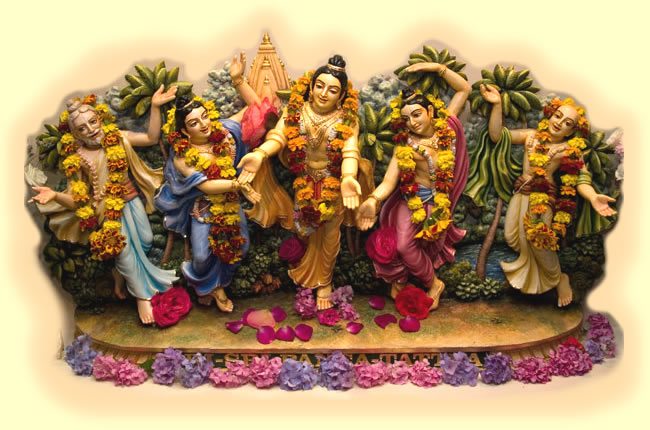
The image is of a statue of
Lord Krishna-Caitanya Mahâprabhu
singing with His close associates [PañcaTattva].
Production: Filognostic Association of The Order of Time

Feed-back | Links | Downloads | Music | Pictures | What's New | Search | Donations



 Text 1-2