Canto
3
Chapter 7: Further Inquiries by Vidura
(1) S'rî S'uka said: 'Thus speaking with Maitreya Muni, the learned son of Dvaipâyana Vyâsa, Vidura, respectfully expressed a request. (2) Vidura said: 'Oh brahmin, the Supreme Lord is the unchangeable one of the complete whole. How can despite Him being outside of the modes of nature His pastimes take place of acting with the basic qualities of material nature? (3) Boys who want to play with other boys are enthused in the matter of playing, but in what respect is that different with someone who is self-satisfied and at all times detached? (4) This universe with its three basic qualities, the gunas, was by the Supreme Lord brought about by means of His internal potency. And by that potency He also maintains the complete of it and annihilates it again. (5) How can He, the Pure Self whose consciousness is never obscured by time or circumstance, by His own actions, by others or by what has manifested [as nature], [be situated in the normal position of a living entity and] be caught in the material energy? (6) How can the one Supreme Lord who is present in every field of action [in all kshetras of the lives] of all living beings [see also B.G. 13: 3], run into any karmically settled misfortune or obstruction? (7) Oh learned one, because of the ignorance I suffer from, my mind gives me trouble. Therefore, oh mighty soul, please drive away the great impurity of my mind.'
(8) S'rî S'uka said: 'The sage this way urged on by Vidura's anxiety to find out about the reality, acted surprised and then without hesitation gave a God-conscious reply. (9) Maitreya said: 'It is contradictory to say that the Fortunate One is subject to material illusion on the one hand and that He is free from imperfections and bondage on the other hand. (10) A person loses his way because of such a contradiction about the soul, it is like seeing from the outside oneself with having one's head cut off. (11) The way by the quality of water the moon reflected in it is trembling, the quality of the physical self offers an illusory image to the inner witness differing from it. (12) When you, by the mercy of Vâsudeva, engage in detachment and in relation to the Fortunate One unite your consciousness in devotion [in bhakti-yoga], in this earthly existence that [illusion] will gradually diminish. (13) With the senses thus satisfied in the transcendental true self of the seer, all misery completely dissolves in the Lord, like one enjoyed sound sleep. (14) When one can put an end to all kinds of misery by simply hearing about [meditating upon] the qualities and such of Murâri [Krishna as the enemy of Mura], what then may one expect from the, according to one's nature, serving in the dust of His lotus feet?'
(15) Vidura said: 'Oh powerful sage, now that you have cut down my doubts with the weapon of your words, oh greatest of all, my mind concerning the two [of the independent Lord and the living being] has arrived at a perfect union. (16) Dear learned soul, you are perfectly right in stating that [reasoning from] the bewildering energy of the Lord is not the path for the soul to follow; it proves itself as meaningless when one engages without the basis of the Supreme Source apart from which one misses the point. (17) In this world both the ignorant fool and the one whose intelligence has attained the transcendental position enjoy happiness, whereas persons situated in between these two positions have to suffer. (18) Being certain of the fact that one abiding by outer appearances misses the essence, misses the soul, I with being of service at your feet can give up [the mistaken notion that the Supreme One would be subject to illusion]. (19) In serving the immutable Personality of Godhead who is the enemy of the demon Madhu, one develops by one's pleasure with the lotus feet [step by step] in different relationships [or râsas] the intensity [of one's rapture] that vanquishes distress. (20) Those who are of little austerity are rarely found on the path of service towards Vaikunthha [the ultimate spiritual goal] where the Lord is continually glorified by the gods as the controller of all living beings.
(21) After the creation in the beginning of the cosmic intelligence and the other elements, in a gradual process of differentiation [evolution] the universal form along with the functions of the senses manifested therefrom in which later on the Almighty One entered [for His incarnations]. (22) He who is called the original person has thousands of limbs, legs and hands, and accommodates all the worlds of the universe with all the life that has its existence on them. (23) You explained how there are three kinds of life [according to the basic qualities] in which one has ten kinds of life force with the [five] senses and their [fivefold] interest. Please describe now to me what the specific powers of the societal divisions are. (24) In these [divisions], with the sons, grandsons and family members of the different generations, that prowess has spread itself in the different forms of existence. (25) Who are the original progenitors [the Prajâpatis] evolved by their original leader [Brahmâ]? What are the generations of these fathers of mankind and which generations followed them? Which Manus ruled over the different manvantaras [cultural periods]? (26) Which worlds are there above and below the earthly worlds, oh son of Mitrâ? Please describe what their positions and sizes are as also the measures and proportions of the earthly worlds. (27) Tell me what the generations and subdivisions are of the infrahuman, human and superhuman living beings the way they are born from eggs, wombs, from moisture [micro-organisms] and from earth [the plants]. (28) Kindly describe the incarnations according to the modes of nature for the sake of the creation, maintenance and destruction of the universe [Brahmâ, Vishnu and S'iva] as also the magnanimous activities of the Personality of Godhead living with the Goddess of Fortune, of Him [S'rînivâsa] who constitutes the ultimate shelter.
(29) What are the divisions of societal status [varna] and spiritual order [âs'rama] and what are their features, how do they behave and what is their character? What are the birth and activities of the sages and what are the divisions of the Veda? (30) What, oh master, are all the ceremonies of sacrificing and what are the different ways of the yoga perfections, of the analytical study of knowledge and of relating to the Personality of God with regulative principles? (31) What are the ways followed by the faithless and what are their shortcomings? What is the situation of those who stem from mixed marriages and what is the destiny of life of the many types of individual souls according to the modes they follow and the kinds of labor they perform? (32) How can the different interests of religiosity, economic development, sense-gratification and salvation, the different means of livelihood, the codes of law, the scriptural injunctions and the different regulative principles be balanced? (33) Oh brahmin, how are the periodical offerings [of S'râddha] regulated to honor the deceased and to respect what the forefathers have created and how are the times settled in respect of the positions of the luminaries like the planets and the stars? (34) What may one expect from charity, penance and the endeavoring for reservoirs of water, and how are the duties described for someone away from home and for a man in danger? (35) Please describe to me, oh sinless one, how He, the Supreme Person, the Father of Religion and Controller of All, can be satisfied completely and who of us could do that? (36) Oh best among the brahmins, the spiritual masters, who are so kind to the needy, tell their devoted disciples and sons even what they did not ask for. (37) Oh supreme master, how many dissolutions [or end times] are there for the elements of nature? Who are they who are saved then and who are they who [being of praise] may serve Him? And who may merge with Him when He goes asleep? (38) And what is the nature and identity of the individual person and of the Supreme, what is the leading motive of the Vedic wisdom and what moves the guru and his disciples? (39) Spotless devotees speak of this source of knowledge in the world. How would someone of his own accord have knowledge of devotional service and detachment?
(40) All these questions I have asked in my desire to know about the pastimes of the Lord. Please answer them as a friend to me [and everyone else] who in his ignorance with the external energy has lost his vision. (41) Oh spotless sage, the assurance of an existence free from fear one obtains from someone like you, cannot in any way be compared with the liberation offered by all the Vedas, sacrifices, penances and charity.'
(42) S'rî S'uka said: 'He [Maitreya], the chief among the sages so well versed in the stories [Purânas], was most delighted to hear these questions posed by the chief of the Kurus and thus being urged to the topics about the Supreme Lord, he with a smile gave Vidura his reply.'


Third revised edition, loaded September 2, 2023.
Previous Aadhar edition and Vedabase links:
Srî S'uka said: 'Thus speaking with Maitreya Muni, the learned son of Dvaipâyana Vyâsa, Vidura, respectfully expressed a request.S'rî S'uka said: 'Thus speaking with Maitreya Muni, the learned son of Dvaipâyana Vyâsa,Vidura, respectfully expressed a request. (Vedabase)
Vidura said: 'Oh brahmin, the Supreme Lord is the unchangeable one of the complete whole. How can despite Him being outside of the modes of nature His pastimes take place of acting with the basic qualities of material nature?
Vidura said: 'O brahmin, how can of the Supreme Lord, although He is of the complete whole and the unchangeable, His pastimes take place of acting with the modes of nature while He Himself is outside of them?' (Vedabase)
Boys who want to play with other boys are enthused in the matter of playing, but in what respect is that different with someone who is self-satisfied and at all times detached?
Boys willing to play with other boys are enthused in the matter of playing, but how is that different for one who is self-satisfied and at all times detached? (Vedabase)
This universe with its three basic qualities, the gunas, was by the Supreme Lord brought about by means of His internal potency. And by that potency He also maintains the complete of it and annihilates it again.
Caused to create the universe with the three modes of nature, the primal Self by the potency of the Supreme Lord maintains all of it and again conversely dissolves it. (Vedabase)
How can He, the Pure Self whose consciousness is never obscured by time or circumstance, by His own actions, by others or by what has manifested [as nature], [be situated in the normal position of a living entity and] be caught in the material energy?
How can He, the Pure Self whose consciousness, nor from Himself, nor from others nor by any time, place or situation is obscured, in the normal position of a living entity be associated with nescience? (Vedabase)
How can the one Supreme Lord who is present in every field of action [in all kshetras of the lives] of all living beings [see also B.G. 13: 3], run into any karmically settled misfortune or obstruction?
By what kind of activities does the one Supreme Lord of all this, in whom the living entities dwell, result in either misfortune or misery? (Vedabase)
Oh learned one, because of the ignorance I suffer from, my mind gives me trouble. Therefore, oh mighty soul, please drive away the great impurity of my mind.'
On this, o learned one, is, in distress of nescience, my mind causing me trouble and therefore, o great one, please clear the great impurity of my mind.' (Vedabase)
S'rî S'uka said: 'The sage this way urged on by Vidura's anxiety to find out about the reality, acted surprised and then without hesitation gave a God-conscious reply.
S'rî S'uka said: 'He, this way urged by Vidura so anxious to find out about the reality, as a great sage acted as if wondered and then without hesitation God-consciously replied. (Vedabase)
Maitreya said: 'It is contradictory to say that the Fortunate One is subject to material illusion on the one hand and that He is free from imperfections and bondage on the other hand.
Maitreya said: 'Saying that of the Supreme Lord one is of illusion, that of the ever liberated of His Lordship there would be insufficiency or the idea of bondage, one becomes logically contradictory. (Vedabase)
A person loses his way because of such a contradiction about the soul, it is like seeing from the outside oneself with having one's head cut off.
Of that kind of confusion of the identifying self of people one is thus bereft of meaning, which from the outside looks like if one's own head is being cut off. (Vedabase)
The way by the quality of water the moon reflected in it is trembling, the quality of the physical self offers an illusory image to the inner witness differing from it.
The way because of the quality of water the moon reflected in it is trembling, offers the quality of the body, an illusory image to the seer differing from it. (Vedabase)
When you, by the mercy of Vâsudeva, engage in detachment and in relation to the Fortunate One unite your consciousness in devotion [in bhakti-yoga], in this earthly existence that [illusion] will gradually diminish.
In this existence does, in bhakti-yoga relating to the Fortunate One, indeed that [illusion] diminish gradually, when one by the mercy of Vâsudeva is engaged in detachment. (Vedabase)
With the senses thus satisfied in the transcendental true self of the seer, all misery completely dissolves in the Lord, like one enjoyed sound sleep.
When the senses thus are satisfied with the observing soul that to the Lord finds engagement in transcendence, are the miseries completely vanquished as if one has enjoyed sound sleep. (Vedabase)
When one can put an end to all kinds of misery by simply hearing about [meditating upon] the qualities and such of Murâri [Krishna as the enemy of Mura], what then may one expect from the, according to one's nature, serving in the dust of His lotus feet?'
If one can put an end to all kinds of misery by simply listening to the repeated explanations about the qualities of Murarî [Krishna as the enemy of Mura], what then again to say of the, to one's heart's desire, serving of the dust of His lotus feet?'' (Vedabase)
Vidura said: 'Oh powerful sage, now that you have cut down my doubts with the weapon of your words, oh greatest of all, my mind concerning the two [of the independent Lord and the living being] has arrived at a perfect union.
Vidura said: 'O learned one, you're perfectly right in stating that [reasoning from] the deluding energy of the Lord is not the path for the soul to follow; it proves itself as meaningless without the basis of the Supreme root outside of which one misses the point. (Vedabase)
Text 16
Dear learned soul, you are perfectly right in stating that [reasoning from] the bewildering energy of the Lord is not the path for the soul to follow; it proves itself as meaningless when one engages without the basis of the Supreme Source apart from which one misses the point.
All these explanations you gave are as good as they should be, o learned one, the self is not without the apparent meaning in being moved by the external of the Lord, as outside the origin of the Supreme there is no basis. (Vedabase)
In this world both the ignorant fool and the one whose intelligence has attained the transcendental position enjoy happiness, whereas persons situated in between these two positions have to suffer.
In this world the one slowest of understanding and the one of transcendental intelligence both enjoy in happiness while the persons in between do suffer. (Vedabase)
Being certain of the fact that one abiding by outer appearances misses the essence, misses the soul, I with being of service at your feet can give up [the mistaken notion that the Supreme One would be subject to illusion].
Having aknowledged and being convinced of what is insubstantial, of that what is not the soul, am I, by the service of your feet, thus able to give up [the notion that one is in illusion because of the Lord]. (Vedabase)
In serving the immutable Personality of Godhead who is the enemy of the demon Madhu, one develops by one's pleasure with the lotus feet [step by step] in different relationships [or râsas] the intensity [of one's rapture] that vanquishes distress.
In serving the Personality of Godhead who is the unchangeable enemy of the demon Madhu, one develops, in different relationships [râsas] to the feet, the highly ecstatic that vanquishes distress. (Vedabase)
Those who are of little austerity are rarely found on the path of service towards Vaikunthha [the ultimate spiritual goal] where the Lord is continually glorified by the gods as the controller of all living beings.
Of those who are meager in their austerity it is certainly rarely seen that they are on the path of service towards the Kingdom of God [Vaikunthha] in which the Lord by the godly is always glorified as the controller of all living beings. (Vedabase)
After the creation in the beginning of the cosmic intelligence and the other elements, in a gradual process of differentiation [evolution] the universal form along with the functions of the senses manifested therefrom in which later on the Almighty One entered [for His incarnations].
After the creation of first the complete of the material energy, in a gradual process of differentiation [evolution] the universal form manifested along with its senses and organs in which later the Almighty entered [for His incarnations]. (Vedabase)
He who is called the original person has thousands of limbs, legs and hands, and accommodates all the worlds of the universe with all the life that has its existence on them.
He who is called the original person has thousands of limbs, legs and hands living in all the worlds of the universe according the evolution of each. (Vedabase)You explained how there are three kinds of life [according to the basic qualities] in which one has ten kinds of life force with the [five] senses and their [fivefold] interest. Please describe now to me what the specific powers of the societal divisions are.
You explained how there are three kinds of life [to the modes] in which one has ten kinds of life-force with the [five] senses and their [fivefold] interest, please describe now to me what the specific powers of the societal divisions are. (Vedabase)
In these [divisions], with the sons, grandsons and family members of the different generations, that prowess has spread itself in the different forms of existence.
In these [divisions] has, with the sons, grandsons and family-members of the different generations, that prowess spread itself in the different forms of existence. (Vedabase)
Who are the original progenitors [the Prajâpatis] evolved by their original leader [Brahmâ]? What are the generations of these fathers of mankind and which generations followed them? Which Manus ruled over the different manvantaras [cultural periods]?
What were all the Manus [heads of the age], and also the generations that for certain followed, to which He was decided as the leader or the father of the living beings [the prajâpati, or Brahmâ] of the generations, and what was their descend? (Vedabase)
Which worlds are there above and below the earthly worlds, oh son of Mitrâ? Please describe what their positions and sizes are as also the measures and proportions of the earthly worlds.
What worlds are there at the head and which earthly worlds are lying beneath, o son of Mitrâ; please describe what their situation is and what the extend of their worldly locations is. (Vedabase)
Tell me what the generations and subdivisions are of the infrahuman, human and superhuman living beings the way they are born from eggs, whombs, from moisture [micro-organisms] and from earth [de plants].
Describe me the infrahuman, the human and the superhuman, as there are the generations and subdivisions of the ones born from the reptiles [or the birds], from wombs, from moist, from the twice-born and from the soil [the plants and vegetables]. (Vedabase)
Kindly describe the incarnations according to the modes of nature for the sake of the creation, maintenance and destruction of the universe [Brahmâ, Vishnu and S'iva] as also the magnanimous activities of the Personality of Godhead living with the Goddess of Fortune, of Him [S'rînivâsa] who constitutes the ultimate shelter.
Kindly describe the incarnations to the modes of material nature for the creation, maintenance and destruction of the universe and the magnanimous activities of the one Personality of Godhead who forms the ultimate shelter. (Vedabase)
What are the divisions of societal status [varna] and spiritual order [âs'rama] and what are their features, how do they behave and what is their character? What are the birth and activities of the sages and what are the divisions of the Veda?
What are to the respective divisions of the statusorientations to age and vocation in society the embodiments, the character and the births of the sages and their activities, and the divisions of the Veda in categories? (Vedabase)
What, oh master, are all the ceremonies of sacrificing and what are the different ways of the yoga perfections, of the analytical study of knowledge and of relating to the Personality of God with regulative principles?
And of what sacrifices and ways are the expansions of the yogic capacity, o master, and what is the path of devotional service, in the nonmaterial interest and analytical study as well, of relating to the Personality of God with regulative principles? (Vedabase)
What are the ways followed by the faithless and what are their shortcomings? What is the situation of those who stem from mixed marriages and what is the destiny of life of the many types of individual souls according to the modes they follow and the kinds of labor they perform?
The paths and imperfections of the faithless, they who go against the grain, and the situation and movements of the individual souls as many as there are to the modes and the types of work, what are they? (Vedabase)
How can the different interests of religiosity, economic development, sense-gratification and salvation, the different means of livelihood, the codes of law, the scriptural injunctions and the different regulative principles be balanced?
And what are the non-contradictory causes of religiosity, economic development, sense-gratification and salvation, what are the different means of livelihood, the codes of law, the scriptural injunctions and what are the different regulative principles? (Vedabase)
Oh brahmin, how are the periodical offerings [of S'râddha] regulated to honor the deceased and to respect what the forefathers have created and how are the times settled in respect of the positions of the luminaries like the planets and the stars?
How are the periodical offerings of respect regulated, o brahmin, to that what the forefathers have created and how are the timedurations settled to the planets, the stars and luminaries? (Vedabase)
What may one expect from charity, penance and the endeavoring for reservoirs of water, and how are the duties described for someone away from home and for a man in danger?
What may one expect from charity, penance and the endeavoring for reservoirs of water and how are the duties described for someone away from home and for a man in danger? (Vedabase)
Please describe to me, oh sinless one, how He, the Supreme Person, the Father of Religion and Controller of All, can be satisfied completely and who of us could do that?
Please describe to me, o sinless one, how He as either the Supreme Person, the Father of the Religion, or the Controller of All, or as all of these can be satisfied completely. (Vedabase)
Oh best among the brahmins, the spiritual masters, who are so kind to the needy, tell their devoted disciples and sons even what they did not ask for.
O best among the brahmins, please describe the spiritual masters so kind to the needy, who tell their followers, their disciples and sons, even what they didn't ask for. (Vedabase)
Oh supreme master, how many dissolutions [or end times] are there for the elements of nature? Who are they who are saved then and who are they who [being of praise] may serve Him? And who may merge with Him when He goes asleep?
O supreme one, how many dissolutions are there for the elements of nature, who are they who in this are thereupon saved, and who are they who [of praise] may join in Him when He is asleep? (Vedabase)
And what is the nature and identity of the individual person and of the Supreme, what is the leading motive of the Vedic wisdom and what moves the guru and his disciples?
And what is the nature and identity of as well the individual person as of the Supreme, what is the leading motive of the vedic wisdom and what moves the guru and his disciples? (Vedabase)
Spotless devotees speak of this source of knowledge in the world. How would someone of his own accord have knowledge of devotional service and detachment?
How in the world is from a person his devotion as also his detachment, there the source of the self-sufficient spiritual knowledge as defended by the spotless devotees? (Vedabase)
All these questions I have asked in my desire to know about the pastimes of the Lord. Please answer them as a friend to me [and everyone else] who in his ignorance with the external energy has lost his vision.
All these questions I asked in the desire to know about the pastimes of the Lord; please answer them to me as a friend for those ignorant ones who lost their vision by the external energy. (Vedabase)
Oh spotless sage, the assurance of an existence free from fear one obtains from someone like you cannot in any way be compared with the liberation offered by all the Vedas, sacrifices, penances and charity.'
All the Vedas, sacrifices, charities and penances, o spotless one, do for sure not even partially compare to the freedom from fear that an individual soul is offered by a person imparting the teaching [like you].' (Vedabase)
Sr'î S'uka said: 'He [Maitreya], the chief among the sages so well versed in the stories [Purânas], was most delighted to hear these questions posed by the chief of the Kurus and thus being urged to the topics about the Supreme Lord, he with a smile gave Vidura his reply.'
S'rî S'uka said: 'He [Maitreya], the chief among the sages so well known with the stories [Purânas], thus being questioned by the chief of the Kurus was sufficiently satisfied and inspired and thus being stimulated on the topics about the Supreme Lord, he smilingly replied Vidura.' (Vedabase)

The text and audio are offered under the
conditions of
the
Creative Commons Attribution-Noncommercial-Share Alike
3.0
Unported License.
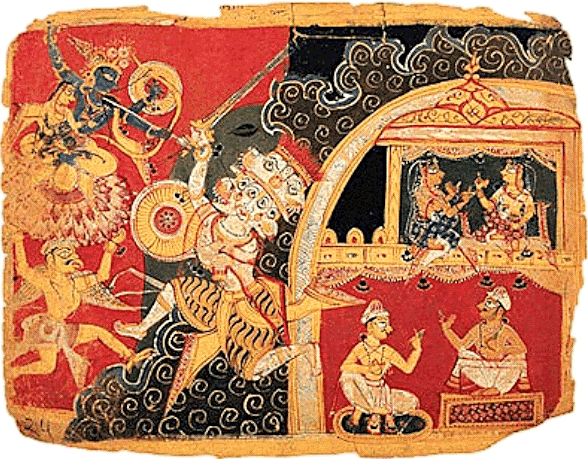
The picture of Krishna killing the demon Mura
is an original folio of a Bhâgavata Purâna manuscript.
Pre-Mughal
c.a. 1550. Source.
Production: Filognostic
Association
of The
Order of Time

Feed-back | Links | Downloads | Music | Pictures | What's New | Search | Donations