Canto
4
Chapter 5: Frustration of the Sacrifice of Daksha
(1) Maitreya said: 'When Lord S'iva heard from Nârada about the death of Satî because of the impudence shown by the Prajâpati and that the soldiers of his associates had been driven away by the Ribhus produced from Daksha's sacrificial fire, his anger knew no bounds. (2) Angrily clenching his lips with his teeth he snatched from a cluster of hair on his head one hair that blazed terribly like an electric fire. Briskly standing up Rudra laughed with a deep sound and dashed the hair to the ground. (3) Thereupon a great black man appeared with a sky-high body that had a thousand arms upholding several kinds of weapons. He radiated as bright as three suns combined, had fearful teeth, a garland of skulls around his neck and hair on his head that looked like a burning fire. (4) When he [Vîrabhadra] asked the great Lord with folded hands: 'What can I do for you, oh Lord of the Ghosts?', the Lord told him: 'You as the chief of my associates, oh Rudra, oh expert in combat born from my body, go and put an end to Daksha and his sacrifice!'
(5) Thus being ordered he, as the anger of the anger of the god of the gods, circumambulated the mighty S'iva. Invested with the irresistible power of the mightiest one he considered himself to be all-powerful, my dear Vidura, and thus capable of coping with any force. (6) With bangles on his ankles that made a loud sound and carrying a frightening trident that could even kill death, he with a loud roar hurried away, being followed by S'iva's soldiers roaring [along] with a tumultuous noise. (7) At that moment the priests, Daksha the leader of the yajña and all the persons assembled, saw the darkness of a dust storm emerging from the north, whereupon the brahmins and their wives began to speculate about where this dust came from: (8) ''The winds do not blow, it cannot be plunderers since old King Barhi is still alive to punish them and the cows are not herded either; so where is this dust coming from? Does it mean that the world is about to end?'
(9) The women of Daksha headed by Prasûti said most afraid: 'This now is the danger resulting from the sin of Daksha who, as Satî's lord and creator, has insulted his completely innocent daughter in the presence of her sisters. (10) Or would it be he who, at the time of dissolution, dances with his weapons raised like flags in his hands and with the bunch of his hair scattered, while he pierces the rulers with his pointed trident and sends his loud laughter in all directions like a clap of thunder? (11) How can there be happiness when one, being of Brahmâ, angers him, raises the fury of him who with an unbearable effulgence full of anger now darkens the luminaries with the terrible sight of his fearful teeth and the movement of his eyebrows?'
(12) While the people of Daksha [assembled at the sacrifice] all were talking like this they, looking around nervously, could observe everywhere and repeatedly the countless fearful omens in the sky and on the earth [as a result of the anger] of the great Lordship. (13) Soon, oh Vidura, the arena of the sacrifice was surrounded by the followers of Rudra who with al kinds of raised weapons were running all around with their short, blackish and yellowish, shark-like bodies and faces.
(14) Some pulled down the pillars of the pandal while others invaded the quarters of the women, the sacrificial arena, the residence of the priests and the place where one was cooking. (15) Some shattered the pots used for the sacrifice, some extinguished the fires burning for the sacrifice, some tore down the boundary lines demarcating the arena and some urinated there. (16) Others blocked the sages their way and some threatened the women and arrested the godly souls who sat nearby and fled. (17) Manimân got hold of Bhrigu Muni, Vîrabhadra ['the great one'] caught Prajâpati Daksha, Candes'a captured Pûshâ and Nandîs'vara seized the demigod Bhaga. (18) Suffering a hail of stones, all the priests, godly souls and other members of the sacrifice who saw all of this happening, utterly agonized spread in all directions. (19) S'iva's mighty appearance [Vîrabhadra], in the midst of the assembly, tore off the mustache of Bhrigu Muni who had held the sacrificial ladle for doing oblations, for he with his [proud] mustache had dared to laugh at S'iva. (20) Bhaga's eyes were by the great warlord, who in great fury had thrust him to the ground, plucked out in the presence of the Vis'vasriks, because he with the movement of his eyebrows had encouraged the cursing of Lord S'iva. (21) Like Baladeva did with the king of Kalinga [during the gambling match at the marriage ceremony of Aniruddha], he [Vîrabhadra] knocked out the teeth of Pûshâ who had shown his teeth as he smiled during the cursing of S'iva. (22) But when he, with his foot on Daksha's chest, with a sharp blade tried to sever his head from his body, the three eyed giant could not get it done. (23) Nor with weapons, nor with the help of mantras being able to even scratch his skin, Vîrabhadra was struck with wonder and had to think deeply. (24) Then he spotted the device used for killing the sacrificial animals and managed therewith to sever the head from the body of Daksha, the lord ruling the sacrifice, who now was an animal of sacrifice himself.
(25) All the Bhûtas, Pretas and Pis'âcas of S'iva joyfully cheered the very moment they saw him doing that, while the followers of Daksha suffered the opposite. (26) Out of his great anger with Daksha, Vîrabhadra threw the head as an oblation in the southern sacrificial fire and set ablaze all the arrangements for the sacrifice of the godly souls. Then they departed for their master's abode ['where the Guhyakas reside' or Kailâsa].'



Previous Aadhar edition and Vedabase links:
Maitreya said: 'When Lord S'iva heard from Nârada about the death of Satî because of the impudence shown by the Prajâpati and that the soldiers of his associates had been driven away by the Ribhus produced from Daksha's sacrificial fire, his anger knew no bounds.Maitreya said: 'When Lord S'iva heard from Nârada about the death of Satî because of being insulted by Daksha and that the soldiers of his associates had been driven away by the Ribhus produced from Daksha's sacrificial fire, he showed an unbounded anger. (Vedabase)
Angrily clenching his lips with his teeth he snatched from a cluster of hair on his head one hair that blazed terribly like an electric fire. Briskly standing up Rudra laughed with a deep sound and dashed the hair to the ground.
Very angry pressing his lips with his teeth he snatched from a cluster of hair from his head one hair blazing terribly like electricity or fire and immediately standing up Rudra laughed with a deep sound and dashed that hair on the ground. (Vedabase)
Thereupon a great black man appeared with a sky-high body that had a thousand arms upholding several kinds of weapons. He radiated as bright as three suns combined, had fearful teeth, a garland of skulls around his neck and hair on his head that looked like a burning fire.
Then a great black man with a sky-high body as bright as three suns combined together appeared that had a thousand arms upholding several kinds of weapons, fearful teeth, a garland of skulls and hair on his head that looked like a burning fire. (Vedabase)
When he [Vîrabhadra] asked the great Lord with folded hands: 'What can I do for you, oh Lord of the Ghosts?', the Lord told him: 'You as the chief of my associates, oh Rudra, oh expert in combat born from my body, go and put an end to Daksha and his sacrifice!'
Upon asking him, the great Lord, with folded hands: 'What can I do for you, o Lord of the Ghosts?', he was told: 'You as the chief of my associates, o Rudra, o expert of combat born from my body, go and put an end to Daksha and his sacrifice!' (Vedabase)"
Thus being ordered he, as the anger of the anger of the god of the gods, circumambulated the mighty S'iva. Invested with the irresistible power of the mightiest one he considered himself to be all-powerful, my dear Vidura, and thus capable of coping with any force.
Ordered this way he, angry by the very personification of anger that is worshiped by the godly, circumambulated him, the mighty one, considering himself, endowed with his unopposable power, to be of the greatest power, my dear Vidura, capable of coping with any force against him. (Vedabase)
With bangles on his ankles that made a loud sound and carrying a frightening trident that could even kill death, he with a loud roar hurried away, being followed by S'iva's soldiers roaring [along] with a tumultuous noise.
Followed by the soldiers of S'iva who roared with a tumultuous sound, he hurried there carrying a trident fearful enough to kill even death and bangles on his ankles that made a loud sound. (Vedabase)
At that moment the priests, Daksha the leader of the yajña and all the persons assembled, saw the darkness of a dust storm emerging from the north, whereupon the brahmins and their wives began to speculate about where this dust came from:
At that moment the priests, Daksha the leader of the Yajña and all the persons assembled saw, coming from the north, the darkness of a duststorm, upon which the brahmins and their wives began to speculate on where this dust came from: (Vedabase)
''The winds do not blow, it cannot be plunderers since old King Barhi is still alive to punish them and the cows are not herded either; so where is this dust coming from? Does it mean that the world is about to end?'
'The winds don't blow, it can't be plunderers since old King Barhi is still alive to punish them, the cows aren't driven out; so from where do we have this dust? Does this mean that the world is about to end?' (Vedabase)?
The women of Daksha headed by Prasûti said most afraid: 'This now is the danger resulting from the sin of Daksha who, as Satî's lord and creator, has insulted his completely innocent daughter in the presence of her sisters.
The women of Daksha headed by Prasûti being very afraid said: 'This is indeed the danger resulting from the sin of, as her Lord and creator, having insulted his completely innocent daughter Satî in the presence of her sisters. (Vedabase)
Or would it be he who, at the time of dissolution, dances with his weapons raised like flags in his hands and with the bunch of his hair scattered, while he pierces the rulers with his pointed trident and sends his loud laughter in all directions like a clap of thunder?
But he who at the time of dissolution dances with the bunch of his hair scattered, pierces the rulers of all directions on his trident and laughs aloud, dividing those directions with the sound of thunder while raising the weapons in his hands like flags. (Vedabase)
How can there be happiness when one, being of Brahmâ, angers him, raises the fury of him who with an unbearable effulgence full of anger now darkens the luminaries with the terrible sight of his fearful teeth and the movement of his eyebrows?'
How could there be good fortune having, of Brahmâ, raised the anger of him who with an unbearable effulgence full of anger now scatters the luminaries with the unbearable sight of his fearful teeth and the movement of his eyebrows?' (Vedabase)
While the people of Daksha [assembled at the sacrifice] all were talking like this they, looking around nervously, could observe everywhere and repeatedly the countless fearful omens in the sky and on the earth [as a result of the anger] of the great Lordship.
While the people assembled at Daksha's sacrifice were all talking like this, looking around nervously, could, of the great soul, everywhere and repeatedly countless fearful omens be observed in the sky and on the earth. (Vedabase)
Soon, oh Vidura, the arena of the sacrifice was surrounded by the followers of Rudra who with al kinds of raised weapons were running all around with their short, blackish and yellowish, shark-like bodies and faces.
Quickly, o Vidura, was the arena of sacrifice surrounded by the followers of Rudra who with his choice of weapons were running all around with their short, blackish and yellowish, shark-like bodies and faces. (Vedabase)
Some pulled down the pillars of the pandal while others invaded the quarters of the women, the sacrificial arena, the residence of the priests and the place where one was cooking.
Some pulled down the pillars of the pandal while others invaded the quarters of the women, the sacrificial arena, the residence of the priests and the place where one was cooking. (Vedabase)
Some shattered the pots used for the sacrifice, some extinguished the fires burning for the sacrifice, some tore down the boundary lines demarcating the arena and some urinated there.
Some shattered the pots used for the sacrifice, some extinguished the fires burning for the sacrifice, some urinated and some tore down the boundary lines demarking the arena. (Vedabase)
Others blocked the sages their way and some threatened the women and arrested the godly souls who sat nearby and fled.
Others blocked the sages their way and some threatened the women and arrested the godly ones they could catch in their flight. (Vedabase)
Text 17
Manimân got hold of Bhrigu Muni, Vîrabhadra ['the great one'] caught Prajâpati Daksha, Candes'a captured Pûshâ and Nandîs'vara seized the demigod Bhaga.
Manimân got hold of Bhrigu Muni, Vîrabhadra [the great one] caught Prajâpati Daksha, Candes'a arrested Pûshâ and Nandîs'vara arrested the demigod Bhaga. (Vedabase)
Suffering a hail of stones, all the priests, godly souls and other members of the sacrifice who saw all of this happening, utterly agonized spread in all directions.
Suffering a hail of stones were all the priests, godly ones and other members of the sacrifice seeing this all happening, utterly agonized and had they as a consequence thus begun to disperse in all directions. (Vedabase)
S'iva's mighty appearance [Vîrabhadra], in the midst of the assembly, tore off the mustache of Bhrigu Muni who had held the sacrificial ladle for doing oblations, for he with his [proud] mustache had dared to laugh at S'iva.
Of the muni Bhrigu, who held the sacrificial ladle for doing oblations, tore the lord of S'iva [Vîrabhadra] in the midst of the assembly off his mustache as he had dared to smile at them. (Vedabase)
Bhaga's eyes were by the great warlord, who in great fury had thrust him to the ground, plucked out in the presence of the Vis'vasriks, because he with the movement of his eyebrows had encouraged the cursing of Lord S'iva.
Of Bhaga then that warlord, who had thrust him to the ground with great anger, plucked out his eyes in the presence of the Vis'vasriks, as he had encouraged the cursing of Lord S'iva by moving his eyebrows. (Vedabase)Like Baladeva did with the king of Kalinga [during the gambling match at the marriage ceremony of Aniruddha], he [Vîrabhadra] knocked out the teeth of Pûshâ who had shown his teeth as he smiled during the cursing of S'iva.
Like Baladeva did with the king of Kalinga [during the gambling match at the marriage ceremony of Aniruddha], he knocked out the teeth of Pûshâ who had shown his teeth as he smiled during the cursing of S'iva. (Vedabase)
But when he, with his foot on Daksha's chest, with a sharp blade tried to sever his head from his body, the three eyed giant could not get it done.
Though sitting on the chest of Daksha with a sharp blade in order to sever his head, was the three eyed big one not able to succeed. (Vedabase)
Nor with weapons, nor with the help of mantras being able to even scratch his skin, Vîrabhadra was struck with wonder and had to think deeply.
Nor with weapons, nor even with the help of mantras able to cut his skin, was he struck with great bewilderment and thus had Vîrabhadra to give it a lot of thought. (Vedabase)
Then he spotted the device used for killing the sacrificial animals and managed therewith to sever the head from the body of Daksha, the lord ruling the sacrifice, who now was an animal of sacrifice himself.
Then he saw the device used for killing the sacrificial animals and with the help of that managed he to sever the head from the body of the lord ruling the sacrifice, now being an animal of sacrifice himself. (Vedabase)
All the Bhûtas, Pretas and Pis'âcas of S'iva joyfully cheered the very moment they saw him doing that, while the followers of Daksha suffered the opposite.
The moment they saw him doing that cheered they joyfully, all the Bhûtas, Pretas and Pis'âcas of S'iva, while the followers of Daksha suffered the opposite. (Vedabase)
Out of his great anger with Daksha, Vîrabhadra threw the head as an oblation in the southern sacrificial fire and set ablaze all the arrangements for the sacrifice of the godly souls. Then they departed for their master's abode ['where the Guhyakas reside' or Kailâsa].'
Vîrabhadra threw, out of his great anger with Daksha, the head as an oblation in the southern part of the sacrificial fire and set fire to all the arrangements of the godly for the sacrifice. Then they departed for Kailâsa, their master's abode ['where the Guhyakas reside']. (Vedabase)

The text and audio are offered under the conditions of
the
Creative Commons Attribution-Noncommercial-Share Alike
3.0
Unported License.
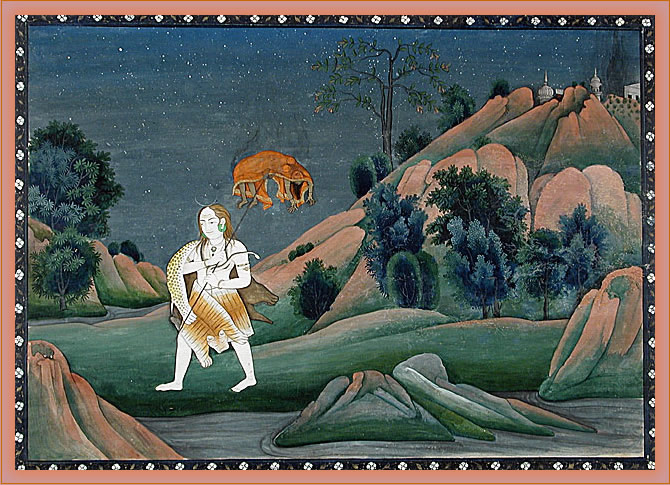
The painting is
titled: 'Shiva Carrying Sati on His Trident',
India, Himachal Pradesh, Kangra, circa 1800. Courtesy
LACMA.
Production: Filognostic
Association
of The
Order of Time

Feed-back | Links | Downloads | Music | Pictures | What's New | Search | Donations