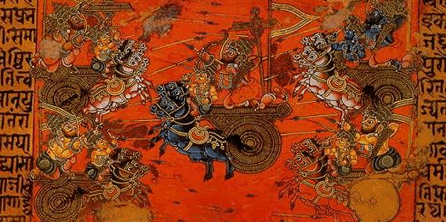
Introduction:
Dear
reader, who am I to present to you this great Song of God? I can give
you my name, but this book is exactly about answering this question
properly. It is about Lord Krishna explaining to His friend Arjuna who
he and He Himself really is. That knowledge would give Arjuna the
strength and the resolve to know and to defeat his enemies. The crisis
of Arjuna is that of identity: Who am I, what am I to do, how am I to
see things, what is my nature, what is the right attitude? How to
attain peace ànd the victory? We as readers are that Arjuna, and
I as a translator/interpreter/concatenator was in the same position. I
was faced with many Bhagavad Gîtâs that I, honestly, truly
couldn't read all properly. First of all it is a heavy piece of
philosophy actually, with which it is difficult to identify oneself.
Second of all were most Gîtâs available cut into an
enormous heap of philosophical fragments in studies of detail, from
which the original course of reasoning became completely obscure. It
was not difficult to understand what the preaching was all about, but
what did the book say itself? How could I listen to the original
speaker and pick it up from the heart as one usually does, following
the reasoning in a book? In a book I normally want to listen to what
the speaker has to say, anything in the way between me and the speaker
is a hindrance. Thus can all the culture of belief and interpretation
be experienced as a hindrance, or a problem of the purity of the medium
between oneself and the Lord of Wisdom. I could ask myself: Am I
listening to Vyâsadeva, the writer, to Sañjaya, the
reporter of this discussion Vyâsa introduces as a speaker, or to
Krishna, the one that is speaking to us actually? Am I listening to the
spiritual teacher introducing me into this knowledge, interpreting and
translating it to me and his understanding and to me and his social and
personal ego-interest, to the religion of social convention keeping up
the good attitude or am I just studying a medium on itself, like a
material book or a modern internetpage that depends on its own material
conditions managed by a publisher or webmaster?
Thus this
presentation of the Gîtâ is an effort to reconstruct what
actually was said by Lord Krishna. I kept, translating, as close to the
Sanskrit as possible trying not to add, nor to omit a single word, so
that the words Vyâsadeva, the original author, used, can be
appreciated as from him. On the battlefield of Kurukshetra just before
the great war of the Mahâbhârata Krishna spoke these to
Arjuna at the end of an era of Vedic culture that left us with the
nature of what we now know as modern time and by Hindus is called
Kali-Yuga, the Iron age of Quarrel. I have called this
Gîtâ, the Gîtâ of Order because that was what I
longed for and that was what my original purpose and belief in God was:
To get everything, everyone, the world and myself in order. So, I
studied what the tradition said, I remembered what I learned from
modern science, philosophy and the spiritual teachings and last but not
least I wanted to see my own modern/postmodern experience reflected too
without falling into the selfhood of ego. From the tradition itself I
learned that its approach of proper reference does not really differ
from the method of modern natural science also founded on proper
reference. Sañjaya could be a pure medium for the words of
Krishna, because he was a loyal pupil of Vyâsadeva. So I too
could be a pure medium if I would follow the same method. Thus this
Gîtâ does not stand on itself but is directly born from a
previous version, a line of disciplic succession, the tradition; nay it
also originated from all the versions and the whole discussion
entertained at the present time. I understood I had to cope with the
whole confusion in this field. I had to choose: There are so many
Gîtâs and thus so many traditions of learning to respect.
There is the Gîtâ of S'ankarâcârya, the
Gîtâ of Maharishi Yogi, the Gîtâ of S'rî
Yukteswar, the Gîtâ of the American Gîtâ
Society, the Gîtâ of W.Q. Judge of Theosophy, the
Gîtâ of the internet-site for it, the Gîtâ of
the Hare Krishnas and even a Gîtâ presented on television.
I
concluded, remembering of what I had understood thus far, that if one
is not of sacrifice, that one hasn't really understood the purport of
what the Lord tries to tell us. Therefore I could skip all
Gîtâs that were not offered on the internet.
Gîtâs not shared with the world cannot be considered as to
be of good will towards the world, I could maintain as a new norm to a
new medium. The knowledge of God is the property of God and not of a
bookseller or institute of learning. So all claims of proprietorship or
slackness in offering, were disqualified. That left me with the only
recently available Gîtâ of Theosophy, the always available
Gîtâ of the American Gîtâ Society, a recently
from the Internet withdrawn version of the Gîtâ from
Vaishnavas in India (at the end of this translation not mentioned in
the reference-links at the bottom of the page anymore), the
Internet-site www.bhagavad-gita.org from another branch of western
Vaishnavas for it and the original Hare Krishna Gîtâ of
Swami Prabhupâda's western ISKCON-math school of Vaishnavism. The
last two Gîtâs became my stronghold of study as they were
the only ones meeting the scientific demand of proper reference to the
original Sanskrit, word for word. From them I could, together with the
Sanskrit dictionary and a basic course in Sanskrit, reconstruct the
original course of reasoning as it is offered here. As such I am a
follower of this Vaishnav' culture and a pupil (of a pupil of) the
âcârya (teacher, guru, by example) that introduced this
method of respect for the tradition in our Western Culture. The other
Gîtâs so became just a second opinion to find out what the
discussions of translation in the world were really all about, while I
meanwhile kept to the siddhânta, or end-conclusion of Vedic study
of the leading acâryâs.
This-end
conclusion was devised by S'rî Krishna-Caitanya (born 1486), a
great devotee and âcârya of Lord Krishna who was recognized
as Bhagavân, an original incarnation of the Supreme Lord. His
descend in the sixteenth century meant a reform of the Vedic culture
that declared an end to the false authorities of religion and the
caste-system. The siddhânta was formulated as
acinthya-bheda-abheda-tattva, meaning: The Lord is the inscrutable
unity in diversity. With this conclusion all differences of age and
vocation were subjected to ones individual devotion to the Lord as the
binding force, as expressed in ones level of transcendence, of
spiritual yogic control and stability of selfrealization over the
material conditioning, and ones mode of commitment, or experience with
the culture of devotion. In other words: one needs to be above the
material motive and one needs a certain experience in Yoga and
devotional service before one can reliably speak of and live with the
contents of e.g. this book. To be merely an expert in Sanskrit or to be
a religious authority from an institute of learning is thus not enough.
One also has to realize oneself independently relating to the Lord,
what the story of God, His story, with this yoga is all about.
So what is
the story about? It is taken from the epic the Mahâbhârata
that is about the great war that ended the so-called Dvâpara Yuga
or era of Vedic culture. The Kurudynasty (see family tree) in conflict meets on the battlefield. The main-characters
speaking, Krishna and Arjuna, are nephews in a long line of Vedic
succession in dynasties of nobility that ruled Bhârata-varsha,
India, with the knowledge of Bhagavân, the Supreme Lord who takes
different forms in different incarnations (called avatâras)
throughout history. Christian readers also should see Lord Jesus Christ
as a type of such an incarnation of the Original Personality of Godhead
that is the Supreme Lord, be it that Lord Jesus does not represent a Vedic
descent of the Supreme Lord, but is an incarnation to the specifics of
the Jewish culture of God. Krishna's father Vasudeva was the brother of
Queen Kuntî also called aunt Prithâ often mentioned in this
Gîtâ. Arjuna, with his four brothers called the
Pândavas, was born from King Pându and Queen Kuntî in
the Kurudynasty. Pându had a blind brother called
Dhritarâshthra who himself had a hundred sons called the
Kauravas. Pându died young and the sons of Pându were
raised by their uncle together with their nephews the Kauravas. This
family bond ran into a terrible fugue over a game of dice with which
the Kauravas denied the Pândavas the right to their piece of the
common heritage. Especially seeing how well they did before the fugue
gave rise to all kinds of bad character. Because of the -prepared- game
of dice they were banned for the wilderness for a thirteen years. When
after that period they were told that they hadn't perfectly performed
according the rules and thus had their exile extended, the limit was
reached: Never would Yudhishthhira, Arjuna, Bhîma, Nakula and
Sahadeva, the Pândavas, get their kingdom back this way. Because
of this injustice they then met at Kurukshetra, a holy place of
pilgrimage, for battle. Arjuna seeing all his nephews, uncles and other
family members on the battlefield collapses: He doesn't want to fight
anymore and calls for his friend and nephew Krishna, who assists him as
his charioteer, for help. Then Krishna manifests His true nature before
Arjuna. He tells him that it is according to his nature as a ruler that
he must fight and then explains to him how to attain to the
transcendental position of selfrealization that is needed to be in
control above the modes of material nature and all the character of man
belonging to it and thus be assured of the victory. Krishna identifies
Himself as Vishnu, the Maintainer, the one of goodness and explains to
Arjuna that he should see Him as the Sun and the Moon; the order of
nature, as the taste of water, the divinities and the Time itself. He
also tells him that this type of knowledge is personal and
confidential. This cannot be told to people adverse to the science of
yoga of Him which Krishna explains in the underlying eighteen chapters
of the Gîtâ.
The yoga of
Krishna is divided in three main portions in this book: Karma- bhakti-
and jñânayoga. First of all there is the karmic point of
view:
Through proper action and analysis one realizes ones connectedness,
realigning oneself (through religion, re-ligare, realigning, called
dharma or proper action) with the original person that is the Lord and
the true self as well as with the objective of the Absolute of the
Truth of the manifest complete of the material universe. This unwinding
of the illusioned state achieved by abandoning profitmotivated labor or
karma is attained by detachment and meditation. Next, in the second
section on Bhakti-yoga, Krishna explains what it means to attain to the
transcendental position: Without developing fortitude in devotional
service or bhakti-yoga one can be enlightened - for a while, but one is
not liberated, one does not attain to the stability of wisdom in good
habits of respect that one is seeking. Krishna then explains Arjuna
about His personal nature and how he should recognize Himself in His
different identities. Arjuna's gates of perception are then, on his own
request, broken open by Krishna who shows him His Universal Form, the
complete of His personal nature. From then on Arjuna does no longer
doubt the divinity of his friend and does he excuse himself for having
treated Him as a normal mortal being in the past. In the last six
chapters on the Yoga of Spiritual knowledge or jñâna yoga
Krishna explains how, with the difference between the knower and the
known, the divisions of nature in three modes lead to different kinds
of sacrificing and personal duty. Explaining the difference between the
divine and the godless nature He then tells Arjuna finally how through renunciation, its threefold nature and its
service with the divisions of society, one attains to the ultimate of
liberation under the condition of respecting Him as the ultimate order
and nature of the Absolute Truth of the soul.
More about
the antecedents of the culture of devotion and spiritual knowledge,
Krishna's life and the reality of our modern lives, is explained in the
S'rîmad Bhâgavatam, also offered by me on the internet at srimadbhagavatam.org, which can be considered the
Krishna-Bible on the life and times of the Lord and His devotees, to
which this sermon of the Lord on the battlefield is the abstract or
introduction.
In delight
of service to the Lord and His devotees, I wish you and all of your
relatives a sound progress on the spiritual path and all the happiness
and glory of selfrealization that is possible within this human life.
With all
respects, Anand Aadhar Prabhu, March 2001