
Canto 10
Canto 10
Chapter 65: Lord Balarâma in Vrindâvana and the Stream Divided
(1) S'rî S'uka said: 'Oh best of the Kurus, [one day] the Supreme Lord Balarâma mounted His chariot eager to see His friends, and traveled to Nanda's cowherd village. (2) Râma was embraced by the gopas and gopîs, who indeed for a long time had missed Him. After offering His respects to His parents He was joyfully greeted with prayers: (3) 'Oh descendant of Das'ârha, Lord of the Universe, may You and Your younger brother [Krishna] always protect us.' Having said this they pulled Him close on their laps and embraced Him, wetting Him with the water from their eyes. (4-6) In accordance with the scriptures He headed for the elder gopas, following which He was welcomed by the younger ones. Next He approached the cowherds whom He, according to each his age, friendship and family relationship, greeted with smiles and taking their hands into His. After having offered Him a comfortable seat, so that He could rest a while and such, they, who had dedicated their all and everything to the service of their lotus-eyed Krishna, gathered around Him and asked Him, with voices faltering because of their love, questions relating to the welfare of their loved ones [in Dvârakâ]. (7) 'Oh Balarâma are all our relatives faring well? Are all Your wives and children still remembering us, oh Râma? (8) To our great fortune sinful Kamsa was killed and our relatives were freed! Luckily, they took shelter in a fortress [Dvârakâ] and managed to kill and conquer our enemies!' (9) Honored to see Balarâma in their midst, the gopîs asked with a smile: 'Is Krishna, the darling of the city women, living happily? (10) Is He still thinking of His people, His [foster] father and His mother? Will He ever come to see His mother personally and does He with the mighty arms remember our enduring service? (11-12) For His sake, oh Lord, we have detached ourselves from those who are so difficult to give up: our mothers, fathers, brothers, husbands, children and sisters, oh descendant of Das'ârha. Suddenly rejecting us and leaving us, He broke with the friendship, but which woman would not trust His words [that He would return]? (13) How can those smart city women, who are attracted by His eloquence, nice smiles and the lust He raises in their hearts, put faith in the words of Him who, so ungrateful, has His heart easily elsewhere and breaks off contact? (14) But why would we dilate about Him any longer, oh gopîs? Let us talk about something else. If He wants to pass His time without us, we will do the same [and try to live without His presence. See also 10.47: 47].'
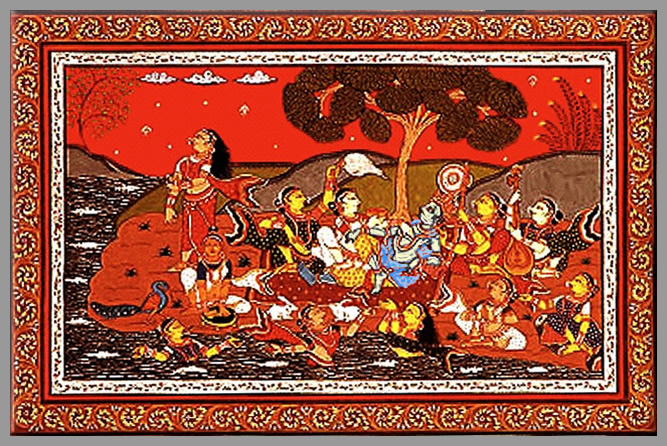
(15) Thus speaking together the women remembered S'auri's laughing, conversations, attractive glances, gait and loving embrace, and that made them cry. (16) Sankarshana, the Supreme Lord, being an expert in different kinds of conciliation, consoled them with Krishna's confidential messages which touched their hearts. (17) Râma resided there during the two months Madhu and Mâdhava [the first two of the vernal equinox] and also at night brought [amorous] delight to the gopîs [see also 10.15: 8]. (18) In a grove near the Yamunâ [known as S'rîrâma-ghaththa] where the wind carried the fragrance of kumuda [night-blooming] lotuses and the full moon bathed the place in its light, He enjoyed it to be served in the company of the many women. (19) From the hollow of a tree the divine [intoxicating liquor] vârunî flowed that was brought by Varuna and, with its aroma, made the entire forest even more fragrant. (20) Balarâma, smelling the fragrance of that honey flow carried by the wind, sought the place where it could be found and drank from it together with the women. (21) As the singers of heaven sang His glory He, beautified by the circle of young women, enjoyed just like Indra's bull elephant with a herd of females. (22) Kettledrums resounded in the sky, the Gandharvas joyfully rained down flowers and the sages praised Balarâma for His heroic deeds. (23) While His pastimes were sung by the women, Halâyudha [Balarâma as 'armed with the plow'], inebriated, with His eyes heavy from the intoxication, wandered through the forest.
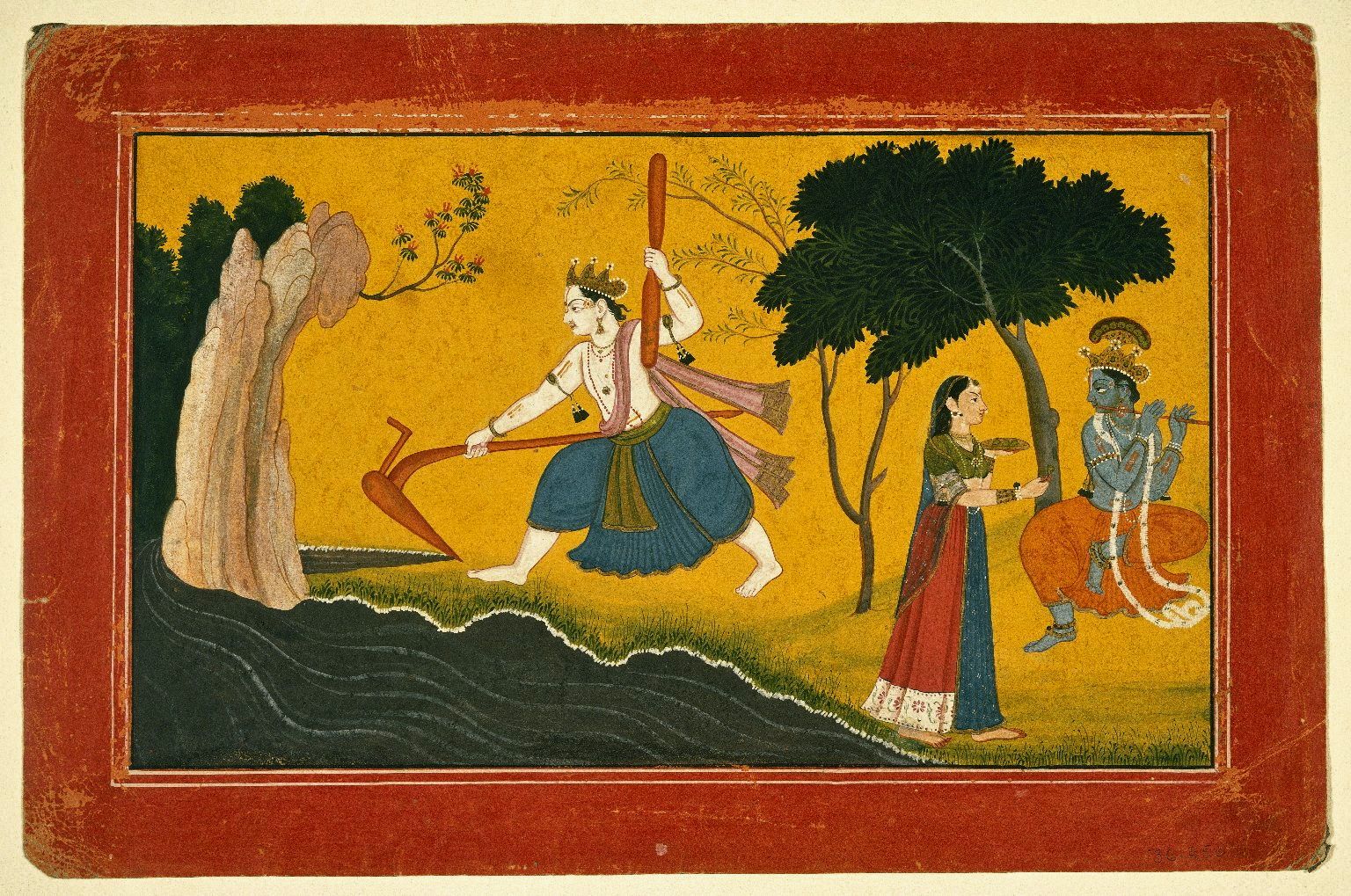
(24-25) He with His flowers, with a single earring, mad with joy, carrying His Vaijayantî garland and with His smiling lotuslike face covered by beads of perspiration like it were snowflakes, then called for the Yamunâ with the purpose to play in the water. But when the river thereupon ignored His drunken words and did not come, she was by Him angrily dragged with the tip of His plow. (26) 'Being called by Me, oh sinful one, you did not come. Because you, in disregard of Me, are moving about as you like, I shall bring you here with the tip of My plow in a hundred little streams!'
(27) The [goddess of the] Yamunâ thus being chided, fell afraid at His feet, oh King, and spoke trembling the following words to the Yadu descendant [*]: (28) 'Râma, Balarâma, oh mighty armed soul, what do I know about Your prowess, oh Master of the Universe who with a single portion of Yourself [S'esha] upholds the earth? (29) Please, Supreme Lord, let me go, I surrender myself to You. I was not aware of Your status as the Supreme Personality, oh Soul of the Universe taking care of the devotees!'
(30) Balarâma, the Supreme Lord, being entreated by the Yamunâ, then released her and together with the women entered the water, like He was the king of the elephants with his wives. (31) After having played to His heart's content He came out of the water, whereupon Kânti ['the female beauty, the brightness of the moon', a name of Lakshmî] presented Him a set of blue garments, most valuable ornaments and a splendid necklace. (32) He put on the blue clothes and hung the golden necklace around His neck. Excellently being ornamented and anointed, He looked as resplendent as the elephant of the great Lord Indra. (33) Oh King, even today the currents of the Yamunâ, the way they were drawn by the unlimitedly powerful Balarâma, are considered a proof of His prowess. (34) This is how for Balarâma, with His mind enchanted by the charm and love of the women of the cow community, the nights He enjoyed in Vraja passed like a single one.'


Third revised edition, loaded July 19, 2021.
Previous Aadhar edition and Vedabase links:
S'rî S'uka said: 'Oh best of the Kurus, [one day] the Supreme Lord Balarâma mounted His chariot eager to see His friends, and traveled to Nanda's cowherd village.S'rî S'uka said: 'O best of the Kurus, the Supreme Lord Balarâma mounted [one day] His chariot eager to see His friends and traveled to Nanda's cowherd village. (Vedabase)
Râma was embraced by the gopas and gopîs, who indeed for a long time had missed Him. After offering His respects to His parents He was joyfully greeted with prayers:
By the gopas and gopîs, who for a long time had missed Him indeed, was Râma embraced and offering His respects to His parents was He joyfully greeted with prayers: (Vedabase)
'Oh descendant of Das'ârha, Lord of the Universe, may You and Your younger brother [Krishna] always protect us.' Having said this they pulled Him close on their laps and embraced Him, wetting Him with the water from their eyes.
'O descendant of Das'ârha, please always protect us together with Your younger brother, the Lord of the Universe', and saying this pulling Him close on their laps embraced they Him wetting Him with the water from their eyes. (Vedabase)
In accordance with the scriptures He headed for the elder gopas, following which He was welcomed by the younger ones. Next He approached the cowherds whom He, according to each his age, friendship and family relationship, greeted with smiles and taking their hands into His. After having offered Him a comfortable seat, so that He could rest a while and such, they, who had dedicated their all and everything to the service of their lotus-eyed Krishna, gathered around Him and asked Him, with voices faltering because of their love, questions relating to the welfare of their loved ones [in Dvârakâ].
Next He headed for the elderly cowherds whom He, taking their hands, greeted with smiles. After having offered Him a comfortable seat so that He could rest a bit and such, gathered they, who had dedicated their all and everything to the service of their lotus-eyed Krishna, around Him and asked they Him, with voices faltering of their love, questions relating to the welfare of their beloved ones. (Vedabase)
'Oh Balarâma are all our relatives faring well? Are all Your wives and children still remembering us, oh Râma?
'O Balarâma are all our relatives well? Do all of You, wives, children and all, still remember us, o Râma? (Vedabase)
To our great fortune sinful Kamsa was killed and our relatives were freed! Luckily, they took shelter in a fortress [Dvârakâ] and managed to kill and conquer our enemies!'
To our fortune was the sinful Kamsa killed and were our relatives freed; thank God found they shelter in a fortress [Dvârakâ] and were our enemies killed and conquered!' (Vedabase)
Honored to see Balarâma in their midst, the gopîs asked with a smile: 'Is Krishna, the darling of the city women, living happily?
Honored to see Râma in their midst asked the gopîs with a smile: 'Is Krishna, the darling of the city women, living happily? (Vedabase)
Is He still thinking of His people, His [foster] father and His mother? Will He ever come to see His mother personally and does He with the mighty arms remember our enduring service?
Does He still think of His folk, His [foster] father and His mother; will He ever come to visit His mother Himself and does He with His mighty arms remember our enduring service? (Vedabase)
For His sake oh Lord, we have detached ourselves from those who are so difficult to give up: our mothers, fathers, brothers, husbands, children and sisters, oh descendant of Das'ârha. Suddenly rejecting us and leaving us, He broke with the friendship, but which woman would not trust His words [that He would return]?
For His sake have we, o Lord, detached ourselves from those who are so difficult to give up: our mothers, fathers, brothers, husbands, children and sisters, o descendant of Das'ârha. With Him suddenly rejecting us and leaving, has He broken with the friendship, but what woman wouldn't believe in Him now she's again being addressed? (Vedabase)
How can those smart city women, who are attracted by His eloquence, nice smiles and the lust He raises in their hearts, put faith in the words of Him who, so ungrateful, has His heart easily elsewhere and breaks off contact?
In what way could those smart city women put faith in the words of Him who so easily has His heart elsewhere and breaks off the contact? They are mistaken about His eloquence and nice smiles because they factually are motivated by lust! (Vedabase)
But why would we dilate about Him any longer, oh gopîs? Let us talk about something else. If He wants to pass His time without us, we will do the same [and try to live without His presence. See also 10.47: 47].'
But why woud we dilate about Him any longer o gopîs, let's talk about other things; if He wants to pass His time without us, will we do likewise [in trying to live without Him being present. See also [see also 10.47: 47].' (Vedabase)
Thus speaking together the women remembered S'auri's laughing, conversations, attractive glances, gait and loving embrace, and that made them cry.
Thus speaking of the laughter, the conversations, the attractive glances and remembering the gait and the loving embrace of S'auri, the women cried. (Vedabase)
Sankarshana, the Supreme Lord, being an expert in different kinds of conciliation, consoled them with Krishna's confidential messages which touched their hearts.
Sankarshana, the Supreme Lord, being an expert in different kinds of conciliation, consoled them with Krishna's confidential messages that touched their hearts. (Vedabase)
Râma resided there during the two months Madhu and Mâdhava [the first two of the vernal equinox] and also at night brought [amorous] delight to the gopîs [see also 10.15: 8].
Râma then resided there for the two months of Madhu and Mâdhava [the first two of the vernal equinox], during which He also during the nights brought [amorous] delight to the gopîs [see also 10.15: 8]. (Vedabase)
In a grove near the Yamunâ [known as S'rîrâma-ghaththa] where the wind carried the fragrance of kumuda [night-blooming] lotuses and the full moon bathed the place in its light, He enjoyed it to be served in the company of the many women.
In a grove near the Yamunâ [known as S'rîrâma-ghaththa] with by the wind carried the fragrance of kumuda [night-blooming] lotuses, enjoyed He it, bathing in the light of the full moon, to be served by the many women. (Vedabase)
From the hollow of a tree the divine [intoxicating liquor] vârunî flowed that was brought by Varuna and, with its aroma, made the entire forest even more fragrant.
Sent by Varuna flowed from the hollow of a tree the divine [intoxicating spirit] Vârunî that with its aroma made the entire forest even more fragrant. (Vedabase)
Balarâma, smelling the fragrance of that honey flow carried by the wind, sought the place where it could be found and drank from it together with the women.
Balarâma, smelling the fragrance of that honey flow carried over by the wind, sought the place where it could be found and drank from it together with the women. (Vedabase)
As the singers of heaven sang His glory He, beautified by the circle of young women, enjoyed just like Indra's bull elephant with a herd of females.
Kettledrums resounded in the sky, the Gandharvas with joy rained down flowers and the sages praised Râma for His heroic deeds. (Vedabase)
Kettledrums resounded in the sky, the Gandharvas joyfully rained down flowers and the sages praised Balarâma for His heroic deeds.
As the singers of heaven sang the glory enjoyed He, beautified by the circle of young women, just like Indra's bull elephant in a herd of females. (Vedabase)
While His pastimes were sung by the women, Halâyudha [Balarâma as 'armed with the plow'], inebriated, with His eyes heavy from the intoxication, wandered through the forest.
With His pastimes being sung by the women wandered Halâyudha [Balarâma as 'armed with the plow'] through the forest inebriated with his eyes heavy of the intoxication. (Vedabase)
He with His flowers, with a single earring, mad with joy, carrying His Vaijayantî garland and with His smiling lotuslike face covered by beads of perspiration like it were snowflakes, then called for the Yamunâ with the purpose to play in the water. But when the river thereupon ignored His drunken words and did not come, she was by Him angrily dragged with the tip of His plow.
With flowers, with one earring, mad with joy and carrying His Vaijayantî garland and with His smiling, lotuslike face covered by beads of perspiration like it were snowflakes, called He for the Yamunâ with the purpose to play in the water, but when the river thereupon ignored His drunken words, was she by Him angrily with the tip of His plow dragged because she didn't come: (Vedabase)
'Being called by Me, oh sinful one, you did not come. Because you, in disregard of Me, are moving about as you like, I shall bring you here with the tip of My plow in a hundred little streams!'
'You sinful one do not come, being called by Me, and because you, in disrespect of Me, are moving about as you like, will I, dividing you with My plow in a hundred little streams, make you come!' (Vedabase)
The [goddess of the] Yamunâ thus being chided, fell afraid at His feet, oh King, and spoke trembling the following words to the Yadu descendant [*]:
Yamunâ thus chided, afraid fallen at His feet, o King, spoke trembling to the Yadu descendant the words [*]: (Vedabase)
'Râma, Balarâma, oh mighty armed soul, what do I know about Your prowess, oh Master of the Universe who with a single portion of Yourself [S'esha] upholds the earth?
'Râma, Râma, o mighty armed one, what do I know about the prowess of You by whose single portion [of S'esha] the earth is sustained, o Master of the Universe? (Vedabase)
Please, Supreme Lord, let me go, I surrender myself to You. I was not aware of Your status as the Supreme Personality, oh Soul of the Universe taking care of the devotees!'
Please, o Lord Supreme, let me go, I have surrendered, I wasn't aware of Your status as the Supreme Personality, o Soul of the Universe so compassionate with Your devotees!' (Vedabase)
Balarâma, the Supreme Lord, being entreated by the Yamunâ, then released her and together with the women entered the water, like He was the king of the elephants with his wives.
Thus entreated released Balarâma, the Supreme Lord, the Yamunâ and then submerged Himself with the women in the water like He was the king of the elephants with his wives. (Vedabase)
After having played to His heart's content He came out of the water, whereupon Kânti ['the female beauty, the brightness of the moon', a name of Lakshmî] presented Him a set of blue garments, most valuable ornaments and a splendid necklace.
Having played as He wanted emerging from the water presented Kânti ['the female beauty, the brightness of the moon', a name of Lakshmî] Him a set of blue garments, most valuable ornaments and a splendid necklace. (Vedabase)
He put on the blue clothes and hung the golden necklace around His neck. Excellently being ornamented and anointed, He looked as resplendent as the elephant of the great Lord Indra.
Dressing up with the blue clothes and putting on the golden necklace appeared He, excellently ornamented and anointed, as resplendent as great lord Indra's elephant. (Vedabase)
Oh King, even today the currents of the Yamunâ, the way they were drawn by the unlimitedly powerful Balarâma, are considered a proof of His prowess.
Even today are, o King, the currents of the Yamunâ the way they are drawn by Balarâma in His unlimited potency, seen as evidence of His prowess. (Vedabase)
This is how for Balarâma, with His mind enchanted by the charm and love of the women of the cow community, the nights He enjoyed in Vraja passed like a single one.'
Thus passed for Râma, who in His mind was enchanted by the exquisite women of the cow-community, all the nights that He enjoyed in Vraja, like a single one.' (Vedabase)
*: The paramparâ comments: 'According to S'rîla Jîva Gosvâmî, the goddess who appeared before Lord Balarâma is an expansion of S'rîmatî Kâlindî, one of Lord Krishna's queens in Dvârakâ. S'rîla Jîva Gosvâmî calls her a "shadow" of Kâlindî, and S'rîla Vis'vanâtha Cakravartî confirms that she is an expansion of Kâlindî, not Kâlindî herself. S'rîla Jîva Gosvâmî also gives evidence from S'rî Hari-vams'a - in the statement pratyuvâcârnava-vadhûm - that Goddess Yamunâ is the wife of the ocean. The Hari-vams'a therefore also refers to her as Sâgarânganâ.'


Feed-back | Links | Downloads | Music | Pictures | What's New | Search | Donations



 Text 1