

Canto 10

Canto 10
Chapter 36: The Bull Arishthâsura Defeated and Akrûra Sent by Kamsa
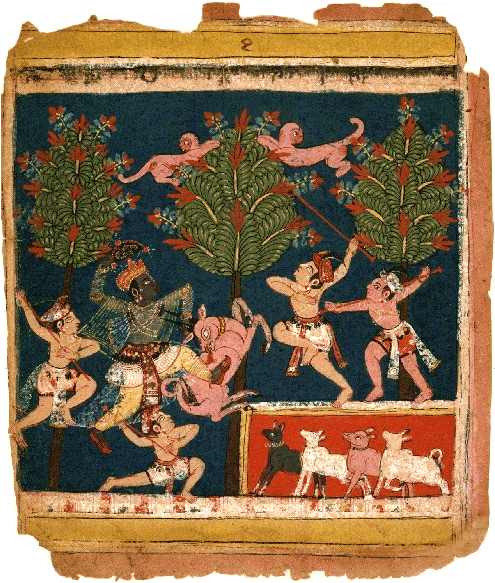
(1) The son of Vyâsa said: 'Some time later the bull demon named Arishtha, who had a huge hump, came to the cowherd village. The earth trembled because of his body as he ripped open the soil with his hooves. (2) Bellowing very loudly and scraping the ground with his hooves he, with his tail upward and with the tips of his horns tearing up the mud walls and throwing up clods, with glaring eyes released little bits of urine and stool. (3-4) The harsh sound he produced and the frightening sight of his pointed horns and his hump, which looked like a mountain with amassing clouds, so terrified the gopas and gopîs, my best one, that the women and the cows in their fear untimely lost their fetuses in miscarriages. (5) The animals panicked and fled from the pasture, oh King, while all the people cried 'Krishna, Krishna!', seeking Govinda for shelter. (6) The Supreme Lord, seeing the entire cow-community distraught fleeing in fear, pacified them with the words 'do not fear' and called out to the bull demon: (7) 'You dull-witted, bad creature, how dare you in the presence of Me, the chastiser of foul miscreants like you, to frighten these gopas and their animals?!'
(8) Acyuta, the Lord, thus speaking, slapped His arms to anger Arishtha with the sound of His palms and assumed a posture thereto in which He threw His serpentine arm over a friend's shoulder. (9) He indeed managed that way to enrage Arishtha who furiously scratched the earth with his hoof and with his tail raised to the wandering clouds attacked Krishna. (10) Bloodthirsty staring from the corners of his eyes, he pointed his horns straight ahead and ran full speed toward Acyuta, like he was a thunderbolt released by Indra. (11) The Supreme Lord though, seized him by the horns and threw him back eighteen feet, like he was an elephant with a rival. (12) Warded off he quickly restored to charge again in blind anger, to which he, sweating all over, breathed heavily. (13) Attacking Him he was [by the Lord] seized by his horns and made to trip by His foot, so that he slapped down to the ground like a wet garment. The Lord thereupon struck him with his horn [broken off] until he lay flat. (14) Vomiting blood, excreting a mass of urine and stool, and throwing his legs about, he in pain rolling with his eyes left for the abode of Death. The demigods thereupon scattered flowers upon the Lord in worship. (15) After thus having killed the demon with the big hump, He, that feast for the eyes of the gopîs, together with Balarâma entered the cowherd village while being praised by the twice-born souls.
(16) With the demon Arishtha being killed by the Worker of Miracles, Krishna, the powerful sage Nârada, who has the vision of God, said to Kamsa: [see 1.6: 25-29] (17) 'Devakî's daughter actually was Yas'odâ's girl, Balarâma was the son of Rohinî and Krishna was also born from Devakî. Vasudeva out of fear placed Them in charge of his friend Nanda, They [Krishna and Balarâma] were the two who killed your men.'
(18) The lord of Bhoja hearing that, raging with anger, took up a sharp sword to kill Vasudeva. (19) Nârada withheld Kamsa [by saying] that Vasudeva's two sons would bring about his death. With that in mind he then chained him and his wife up with iron shackles [see also 10.1: 64-69]. (20) After the devarishi had left, Kamsa spoke with the demon Kes'î and told him: 'You are the one to kill Râma and Kes'ava.'
(21) Then he called together Mushthika, Cânûra, S'ala, Tos'ala and others, as also his ministers and his elephant keepers. The king of Bhoja said to them: (22-23) 'Mushthika and Cânûra, dear mates, please listen to what I have to say, oh heroes. The two sons of Ânakadundubhi are living in the cowherd village of Nanda. It was foretold that Krishna and Balarâma would cause my death. If we manage to get Them here for the sake of a wrestling match, you can kill Them. (24) Build a ring with various stages around it. Let all subjects from inside and outside the city witness an open competition. (25) Dear elephant-keeper, you my good man, should take the elephant Kuvalayâpîda to the entrance of the arena and destroy there my enemies. (26) It has to commence on the fourteenth [Caturdas'î] of the month with the bow-sacrifice performed according to the injunctions. For the Lord of the Spirits [S'iva], the graceful one, the proper kind of animals should be offered in sacrifice.'
(27) Thus having issued his orders he, well versed in the art of securing one's personal interest, called for Akrûra ['the one not cruel'], the most eminent Yadu. He took his hand into his own and then said: (28) 'Dear master of charity, please do me a favor. With all respect, there is no one among the Bhojas and Vrishnis to be found who is as merciful as you are. (29) The way Indra, the mighty king of heaven achieved his goals by taking shelter of Lord Vishnu, I have taken shelter of you, oh kind one, for you always carry out your duties respectfully. (30) Go to Nanda's cowherd village where the two sons of Ânakadundubhi live and bring Them without delay here on this chariot. (31) These Two have been sent by the gods, under the protection of Vishnu, for the sake of my death. Bring Them together with the gopas headed by Nanda over here, and tell them to take along gifts of tribute. (32) When you have brought Them here I will have Them killed by the elephant, that is as mighty as time itself. And if They manage to escape that, my wrestlers, who are as strong as lightning, will put an end to Them. (33) After the two of Them are dead I will next kill the pained relatives whose leader is Vasudeva: the Vrishnis, Bhojas and the Das'ârhas [see again 10.1: 67]. (34) And my old father Ugrasena, so greedy for the kingdom, I will give the same treatment, as also his brother Devaka and my other opponents. (35) The thorns of this earth, oh friend, will thus be destroyed. (36) Together with my elder relative [my father-in-law] Jarâsandha and my dear friend Dvivida, as also with determined comrades like S'ambara, Naraka and Bâna, I will enjoy this earth, killing all those kings who side with the demigods. (37) And now, with this knowledge, bring me quickly the young boys Râma and Krishna, to attend the bow-sacrifice here and to respect the glory of the Yadu capital [of Mathurâ].'
(38) S'rî Akrûra said: 'Oh King, there is nothing wrong with your approach to free yourself from unwanted elements. One should act irrespective failure or success, destiny after all determines the end result. (39) Even though providence foils his plans, the common man fervently acts to his desires and is confronted with happiness and distress. Nonetheless I will execute your order.'
(40) S'rî S'uka said: 'After Kamsa thus had instructed Akrûra and dismissed his ministers, he entered his quarters, and Akrûra returned home.'


Third revised edition, loaded December 16, 2020.
Previous Aadhar edition and Vedabase links:
The son of Vyâsa said: 'Some time later the bull demon named Arishtha, who had a huge hump, came to the cowherd village. The earth trembled because of his body as he ripped open the soil with his hooves.The son of Vyâsa said: 'Some time later came to the cowherd village the bull demon named Arishtha who had a huge hump. Ripping open the soil with his hooves trembled the earth of his body. (Vedabase)
Bellowing very loudly and scraping the ground with his hooves he, with his tail upward and with the tips of his horns tearing up the mud walls and throwing up clods, with glaring eyes released little bits of urine and stool.
Bellowing very loudly and scraping the ground with his hooves, with his tail upward and with the tips of his horns digging the earth and throwing up clods, was he, with glaring eyes, releasing little bits of urine and stool. (Vedabase)
The harsh sound he produced and the frightening sight of his pointed horns and his hump, which looked like a mountain with amassing clouds, so terrified the gopas and gopîs, my best one, that the women and the cows in their fear untimely lost their fetuses in miscarriages.
The fearful sight of his sharp horns and his hump, which looked like a mountain with clouds amassing, terrified the gopas and gopîs that much, my best, that the women and the cows untimely in fear lost their fetuses in miscarriages. (Vedabase)
The animals panicked and fled from the pasture, oh King, while all the people cried 'Krishna, Krishna!', seeking Govinda for shelter.
The animals panicking ran away from the pasture, o King, while the people all [crying] 'Krishna Krishna!' sought Govinda for shelter. (Vedabase)
The Supreme Lord, seeing the entire cow-community distraught fleeing in fear, pacified them with the words 'do not fear' and called out to the bull demon:
The Supreme Lord, seeing how the entire cow-community distraught fled in fear, pacified them with the words 'do not fear' and called out to the bull demon: (Vedabase)
'You dull-witted, bad creature, how dare you in the presence of Me, the chastiser of foul miscreants like you, to frighten these gopas and their animals?!'
'You dull-witted bad creature, how dare you in the presence of Me, the chastiser of foul miscreants like you, to frighten these cowherd people and their animals?!' (Vedabase)
Acyuta, the Lord, thus speaking, slapped His arms to anger Arishtha with the sound of His palms and assumed a posture thereto in which He threw His serpentine arm over a friend's shoulder.
Acyuta, the Lord, thus speaking slapped His arms to anger Arishtha with the sound of His palms and assumed a posture thereto in which He threw His serpentine arm over a friend's shoulder. (Vedabase)
He indeed managed that way to enrage Arishtha who furiously scratched the earth with his hoof and with his tail raised to the wandering clouds attacked Krishna.
And indeed managed He that way to enrage Arishtha who furiously scratched the earth with his hoof and [then] with his tail raised to the clouds attacked Krishna. (Vedabase)
Bloodthirsty staring from the corners of his eyes, he pointed his horns straight ahead and ran full speed toward Acyuta, like he was a thunderbolt released by Indra.
Pointing his horns straight ahead staring bloodthirsty from the corners of his eyes at Krishna, ran he full speed like a thunderbolt released by Indra. (Vedabase)
The Supreme Lord though, seized him by the horns and threw him back eighteen feet, like he was an elephant with a rival.
The Supreme Lord though like a rival elephant seized him by the horns and threw him eighteen feet to the back. (Vedabase)
Warded off he quickly restored to charge again in blind anger, to which he, sweating all over, breathed heavily.
Warded off he quickly restored to charge again sweating all over while he mindless in his anger breathed heavily. (Vedabase)
Attacking Him he was [by the Lord] seized by his horns and made to trip by His foot, so that he slapped down to the ground like a wet garment. The Lord thereupon struck him with his horn [broken off] until he lay flat.
In his attack was he seized by the horns and made to trip by His foot so that he slapped down to the ground like a wet garment. Next was he struck by the Lord with his own horn [broken off] till he fell flat. (Vedabase)
Vomiting blood, excreting a mass of urine and stool, and throwing his legs about, he in pain rolling with his eyes left for the abode of Death. The demigods thereupon scattered flowers upon the Lord in worship.
Vomiting blood, excreting a mass of urine and stool and throwing his legs about went he then in pain rolling with his eyes to the abode of Death. The gods then scattered flowers upon Krishna in worship. (Vedabase)
After thus having killed the demon with the big hump, He, that feast for the eyes of the gopîs, together with Balarâma entered the cowherd village while being praised by the twice-born souls.
After thus having killed the one with the big hump entered He, that feast to the eyes of the gopîs, while being praised by the twice-born, the cowherd village together with Balarâma. (Vedabase)
With the demon Arishtha being killed by the Worker of Miracles, Krishna, the powerful sage Nârada, who has the vision of God, said to Kamsa: [see 1.6: 25-29]
With the demon Arishtha being killed by the Worker of Miracles, Krishna, spoke then to Kamsa the powerful sage Nârada who had the vision of God: [see 1.6: 25-29] (Vedabase)
'Devakî's daughter actually was Yas'odâ's girl, Balarâma was the son of Rohinî and Krishna was also born from Devakî. Vasudeva out of fear placed Them in charge of his friend Nanda, They [Krishna and Balarâma] were the two who killed your men.'
'The girl of Devakî is Yas'odâ's daughter and Krishna and also Balarâma, the son of Rohinî, are from Vasudeva, who fearfully placed them in charge of his friend Nanda; they were the two who actually have killed your men.' (Vedabase)
The lord of Bhoja hearing that, raging with anger, took up a sharp sword to kill Vasudeva.
Hearing that did the lord of Bhoja, in his senses disturbed of anger, take up a sharp sword to kill Vasudeva. (Vedabase)
Nârada withheld Kamsa [by saying ] that Vasudeva's two sons would bring about his death. With that in mind he then chained him and his wife up with iron shackles [see also 10.1: 64-69].
Nârada withheld Kamsa [thus in saying ] that Vasudeva's two sons would bring about his death and with that in mind put he him and his wife in iron shackles [see also 10.1: 64-69]. (Vedabase)
After the devarishi had left, Kamsa spoke with the demon Kes'î and told him: 'You are the one to kill Râma and Kes'ava.'
After the deva-rishi had left addressed Kamsa the demon Kes'î in order to send him after Them: 'You're the one to kill the two of Râma and Kes'ava'. (Vedabase)
Then he called together Mushthika, Cânûra, S'ala, Tos'ala and others, as also his ministers and his elephant keepers. The king of Bhoja said to them:
Then he summoned for Mushthika, Cânûra, S'ala, Tos'ala and such, his ministers and his elephant keepers, to whom the king of Bhoja said: (Vedabase)
'Mushthika and Cânûra, dear mates, please listen to what I have to say, oh heroes. The two sons of Ânakadundubhi are living in the cowherd village of Nanda. It was foretold that Krishna and Balarâma would cause my death. If we manage to get Them here for the sake of a wrestling match, you can kill Them.
'Dear mates, Mushthika and Cânûra, please listen to this o heroes. It turns out that the cowherd village of Nanda is where the two sons of Ânakadundubhi are living. My death was predicted to happen by [the hands of] Krishna and Balarâma. If we get Them to come over here for a game of wrestling you have to kill Them. (Vedabase)
Build a ring with various stages around it. Let all subjects from inside and outside the city witness an open competition.
Build a ring and various stages surrounding it - all subjects in and outside the city should witness how They voluntarily participated in the competition. (Vedabase)
Dear elephant-keeper, you my good man, should take the elephant Kuvalayâpîda to the entrance of the arena and destroy there my enemies.
O elephant-keeper, by you my good man, should the elephant Kuvalayâpîda be taken to the entrance of the arena where my enemies are to be destroyed. (Vedabase)
It has to commence on the fourteenth [Caturdas'î] of the month with the bow-sacrifice performed according to the injunctions. For the Lord of the Spirits [S'iva], the graceful one, the proper kind of animals should be offered in sacrifice.'
Commence according the injunctions the bow-sacrifice on the fourteenth [Caturdas'î] of the month and offer in sacrifice the right kind of animals to the Lord of the Spirits [S'iva], the graceful one.' (Vedabase)
Thus having issued his orders he, well versed in the art of securing one's personal interest, called for Akrûra ['the one not cruel'], the most eminent Yadu. He took his hand into his own and then said:
Thus having issued his orders called he, cunning as he was in the art of securing his personal interest, for Akrûra ['the one not cruel'], the most eminent Yadu. He took his hand into his own and said: (Vedabase)
'Dear master of charity, please do me a favor. With all respect, there is no one among the Bhojas and Vrishnis to be found who is as merciful as you are.
'Dear master of charity please do me a favor. With all respect, there is no one among the Bhojas and Vrishnis to be found who is as merciful as you. (Vedabase)
The way Indra, the mighty king of heaven achieved his goals by taking shelter of Lord Vishnu, I have taken shelter of you, oh kind one, for you always carry out your duties respectfully.
Therefore I depend on you, o kindness, who always carries out his duties soberly, just like Indra, the mighty king of heaven, who achieved his goals by taking shelter of Lord Vishnu. (Vedabase)
Go to Nanda's cowherd village where the two sons of Ânakadundubhi live and bring Them without delay here on this chariot.
Go to Nanda's cowherd village where the two sons of Ânakadundubhi live and bring Them without delay here on this chariot. (Vedabase)
These Two have been sent by the gods, under the protection of Vishnu, for the sake of my death. Bring Them together with the gopas headed by Nanda over here, and tell them to take along gifts of tribute.
The two of Them have, by the gods under the protection of Vishnu, been sent to bring about my death; bring Them together with the gopas headed by Nanda over here, and tell them to take gifts of tribute with them. (Vedabase)
When you have brought Them here I will have Them killed by the elephant, that is as mighty as time itself. And if They manage to escape that, my wrestlers, who are as strong as lightning, will put an end to Them.
Brought here I'll have Them killed by the elephant that is as mighty as the time itself, and if They escape from that, will my wrestlers as strong as lightning put an end to Them. (Vedabase)
After the two of Them are dead I will next kill the pained relatives whose leader is Vasudeva: the Vrishnis, Bhojas and the Das'ârhas [see again 10.1: 67].
And with the two of Them dead will I next kill the pained relatives of whom Vasudeva is the leader: the Vrishnis, Bhojas, and the Das'ârhas [see again 10.1: 67]. (Vedabase)
And my old father Ugrasena, so greedy for the kingdom, I will give the same treatment, as also his brother Devaka and my other opponents.
With my old father Ugrasena I will deal the same way, he who is so greedy for the kingdom and his brother Devaka and my other enemies. (Vedabase)
The thorns of this earth, oh friend, will thus be destroyed.
And thus, o friend, will those thorns in this world be destroyed. (Vedabase)
Together with my elder relative [my father-in-law] Jarâsandha and my dear friend Dvivida, as also with determined comrades like S'ambara, Naraka and Bâna, I will enjoy this earth, killing all those kings who side with the demigods.
With my elder relative [father-in-law] Jarâsandha and my dear friend Dvivida and S'ambara, Naraka and Bâna, who indeed are of a strong friendship for me, will I, killing all those conspiring sura kings, enjoy this earth. (Vedabase)
And now, with this knowledge, bring me quickly the young boys Râma and Krishna, to attend the bow-sacrifice here and to respect the glory of the Yadu capital [of Mathurâ].'
And now, with this knowledge, bring me quickly the young boys Râma and Krishna to attend here to the bow-sacrifice and to respect the glory of the Yadu capital [of Mathurâ].' (Vedabase)
S'rî Akrûra said: 'Oh King, there is nothing wrong with your approach to free yourself from unwanted elements. One should act irrespective failure or success, destiny after all determines the end result.
S'rî Akrûra said: 'O King, your way of thinking to clear out the disagreeable is conclusive; one should act with an equal attitude in respect of the perfect and the imperfect, it is destiny after all that produces the results. (Vedabase)
Even though providence foils his plans, the common man fervently acts to his desires and is confronted with happiness and distress. Nonetheless I will execute your order.'
The common man, even though struck by providence, fervently acts to his desires and is confronted with happiness and distress, nonetheless will I do as you ordered.' (Vedabase)
S'rî S'uka said: 'After Kamsa thus had instructed Akrûra and dismissed his ministers, he entered his quarters, and Akrûra returned home.'
S'rî S'uka said: 'Thus instructing Akrûra and also sending off his ministers entered Kamsa his quarters and returned Akrûra to his own residence.' (Vedabase)


The text and audio are offered under the conditions of
the
Creative
Commons Attribution-Noncommercial-Share Alike 3.0 Unported
License.
The first
painting is titled: 'Krishna Slays Arishta, the Bull Demon'.
Page from a dispersed series of the Rasikapriya (Connoisseur's
Delights) of Keshavadasa. Madhya Pradesh, India c. 1640
Source: Philadelphia
Museum of Art.
The second painting is called: 'Kamsa Receiving His Minister',
Folio from a Bhagavata Purana (Ancient Stories of the Lord)
India, Rajasthan, Kota, South Asia, circa 1640
Courtesy
LACMA.
Production: Filognostic
Association of The Order of Time.

Feed-back | Links | Downloads | Music | Pictures | What's New | Search | Donations


 Text 1