Canto 4 |
|
Chapter 28: Purañjana Becomes a Woman in his Next Life
(1) Nârada said: 'Oh King Prâcînabarhi, all the forces of Bhaya, the representatives of death [who are alike the troubles of old age], roamed this earth together with Prajvâra and Kâlakanyâ. (2) But when they one day full of wrath laid siege to the city of Purañjana, which was so full of sensual pleasure, oh King, they discovered it was protected by the old serpent. (3) The daughter of Kâla then also participated in the violence to take hold of Purañjana's city. Overwhelmed by her someone immediately realizes how insignificant he is. (4) With her attack the Yavanas from all sides entered the gates and created severe trouble all over the city. (5) Purañjana, who as an all too eager householder was overly attached to his family, was thereupon in the troubled city plagued by all kinds of distress. (6) Embraced by the Daughter of Time he lost his beauty and because he in being addicted to sensual pleasures was a miser lacking in intelligence, he was by the Gandharvas and Yavanas [the meat-eaters] by force bereft of his opulence. (7) He saw his town fall apart in opposing fractions, that his sons and grandsons, servants and ministers were disrespectful and that his wife was indifferent. (8) With Pañcâla being infested with insurmountable enemies, he grew very anxious, but because he himself was seized by Kâlakanyâ, he could not take any counteraction. (9) In his emotional preference for his sons and wife he had lost the real purpose of life and, because of Kâlakanyâ, everything the poor man had lusted for in his life had become stale. (10) Against his will the king had to abandon his town that was overrun by the Gandharvas and Yavanas and was smashed by the Daughter of Time. (11) For the sole purpose of pleasing his elder brother Bhaya [called 'the fear'], Prajvâra [being 'the fever'], present at the spot, set fire to the city. (12) When the city with all the citizens, servants and followers was ablaze, Purañjana, the head of the big family, along with his wife and descendants had to suffer the heat.
(13) With the city being attacked by the Yavanas and seized by Kâlakanyâ as also with the problems caused by Prajvâra, the guardian of the city [the snake] got very aggrieved. (14) He could not protect the city [against the fire] and had great difficulty trying to get out of there. It was as if he had to escape from a hollow tree thrown in the flames. (15) With his physical strength defeated by the Gandharvas and the hostile Yavanas, oh King, he, being frustrated, had to cry aloud. (16) What fate would now befall the daughters, sons, grandsons, daughters- and sons-in-law and associates, what would become of the kingdom and the palace with all its wealth and goods?
(17) At his separation the householder turned his attention to the 'I' and 'mine' of his home and it thus happened that he, with a mind full of obnoxious thoughts, felt sorry for his wife. (18) 'When I have left for another life, how must this woman exist being bereft of a husband and lamenting with all the children of the family around her? (19) I never ate when she did not eat, I never missed a bath when she would bathe. She was always devoted to me and fearfully kept silent when I was angry, however afraid she was when I reprimanded her. (20) She gave me good counsel when I was foolish and she was saddened and became thin when I was away. Will she be able to hold on to the path of her household duties, being the mother of such great heroes? (21) How will my poor sons and daughters, who have no one else to depend on, live when I have disappeared from this world? They will be like a broken boat in the ocean!'(22) While he thus with an inadequate intelligence was lamenting pointlessly, the king of the Yavanas called Fear approached to arrest him. (23) Purañjana was by the Yavanas restrained like an animal and taken to their abode, being followed by his deeply aggrieved attendants who were lost in tears. (24) As soon as the serpent, that had to give up the city, was arrested and following him had left, the city fell apart and turned into dust. (25) Forcibly dragged along by the mighty Yavana, Purañjana, covered by the darkness of his ignorance, could not remember his friend and well-wisher [the Supersoul within] who had been there from the beginning. (26) All the animals of sacrifice that he most unkind had killed with axes and had cut to pieces, most angrily remembered that sinful activity of him. (27) For an endless number of years he in the beyond was absorbed in darkness and, bereft of all intelligence, practically endless had to experience the misery of an impure life of being focussed on women. (28) Because he [till the very end] had kept her in mind, he after his death became a well situated woman [a daughter] in the house of the most powerful king Vidarbha [see also B.G. 8: 5]. (29) As the daughter of Vidarbha she [he] was given in marriage as a prize of valor to Malayadhvaja ['as firm as the Malaya hill'] who as the best of the learned [a Pândya ruler] in his fights had defeated many princes and was the conqueror of their cities. (30) He begot a daughter in her with dark eyes as also seven younger mighty sons* who became the kings of the seven provinces of the south of India [Dravida]. (31) From each of them, oh King, millions and millions of descendants were born who ruled the world for the time of a manvantara and longer [see 3.11: 24]. (32) Agastya [the sage; 'he who was born from a pot'] married the first daughter, who was vowed to the Lord, and from her was born a son called Dridhacyuta ['the infallible fortress'] who in his turn had the great sage Idhmavâha ['he who carries the wood'] for his son.
(33) Having divided the entire world among his sons, the pious king called Malayadhvaja went to Kulâcala in a desire to worship Lord Krishna. (34) Giving up her home, children and material happiness, the daughter of Vidarbha with her enchanting eyes followed her lord of wisdom like the moonshine accompanying the moon. (35-36) There he cleansed himself daily both inside and outside with the holy waters of the rivers named the Candravasâ, the Tâmraparnî and the Vathodakâ. Subsisting on bulbs, seeds, roots and fruits, flowers, leaves, grasses and water, his body undergoing the austerity gradually grew thin. (37) Equipoised he thus conquered the dualities of cold and heat, wind and rain, hunger and thirst, the pleasant and the unpleasant and happiness and distress. (38) With vows [yama] and by regulation [niyama] fixing himself in his spiritual [yoga] realization, he subdued his senses, life and consciousness and thus, by means of the science of his austerities, all his impurities were burned [in the fire of his devotion, compare 4.22: 24, 3.29: 17]. (39) Sitting immovable like [a stump] in one place for a hundred demigod years [see 3.11: 12], he, steady in relation to Vâsudeva, the Supreme Lord, knew nothing besides that attraction. (40) Like in a dream he, by the all-pervasive Supersoul, could distinguish himself in perfect awareness: as the self-aware witness feeling certain in his [divine] indifference ['the glad hero']. (41) Under the direct prompting of the Supreme Lord, of the spiritual master Hari [the so-called caitya guru or the guru from within], oh King, he found the pure light of the spiritual knowledge that enlightens all perspectives [see also the six darshanas]. (42) He who thus saw himself in the transcendental Absolute and the Absolute Self within himself, with this before his mind's eye, gave up his considerations and withdrew himself [from life].
(43) Vaidarbhî, the daughter of Vidarbha, who served her husband Malayadhvaja with love and devotion, accepted her husband as her godhead, as the supreme knower of the principles, and gave up on her sense enjoyment. (44) In old rags, lean because of her vows and with her hair matted, she radiated, next to her husband, as peaceful as the flame of a fire. (45) With him sitting there fixed in his meditation posture, the woman continued to serve him as she was used to, until she, after he had passed away, no longer could detect any sign of life from her beloved husband. (46) Serving him no longer feeling the warmth of his feet, she became as anxious at heart as a doe separated from her partner. (47) Lamenting the misery of her fate to be without a friend, she broken-hearted began to cry loudly in the forest, wetting her breasts with her tears. (48) 'Get up, please, get up!, oh wise King. This world that, surrounded by the ocean, is so very afraid of rogues and false rulers, you ought to protect!' (49) Sobbing like this, the innocent faithful woman in that lonely place fell at the feet of her husband with tears running down her cheeks. (50) She built a funeral pyre of wood for her husband's body and placed him on top of it. After igniting it, she, lamenting, focussed her mind to die [saha-marana] together with him.
(51) Someone she knew there, a friend of hers, a brahmin, a very learned scholar, pacified her so full of tears very nicely with mitigating words, speaking to her about her master. (52) The brahmin said: 'Who are you? To whom do you belong and who is this man lying there over whom you are lamenting? Do you not recognize Me as the friend whom you in the past have consulted? (53) Oh friend, do you remember how you, not familiar with the Supersoul, gave Me up as your friend? Desiring security you then got attached to material pleasures. (54) You and I, oh great soul, are two swans, two friends who for thousands of years in succession walked the same path of the spirit [of devotion] and then got separated from their safe haven [that Mânasa lake of the pure spirit]. (55) You who as that swan had left me, oh friend, thereupon traveled the earth and acquired a materialistic mentality. You then saw a city that was the love of some woman. (56) [In that abode you had] five gardens, nine gates, one protector, three store rooms, six [mercantile] families, five market places and five material elements with one woman running the place. (57) The gardens are the five objects of the senses, the gates My friend are the nine apertures of the senses, the three store rooms stand for fire, water and food and the families are the five senses. (58) The five market places represent the power of action [the five working senses] and the five elements are the fundamental elements of the material world. Man is an eternal controller of the forces, but having entered that city he is out of touch with the [original] intelligence. (59) In that situation you, under the influence of the outer splendor, in her company enjoying it, then had to live without the remembrance of the inexhaustible source [of your spiritual existence]. And thus you attained a state that was full of troubles and misery, My best one. (60) In fact you are not Vidarbha's daughter, nor is this hero of yours [Malayadhvaja] your well-wishing husband. Neither were you the husband of Purañjanî by whom you were captured in the body with its nine gates. (61) In reality it is so that you, by this deluding energy that I created, considered yourself either a man, a woman or a nonsexual being, and forgot about the two of us as [being united in the pure spirit of the] swans. (62) You and I are not different [in quality]. Look at yourself, you are just like Me, My friend. The imaginary distinction between the two of us is by the advanced scholars not even in the smallest degree ever acknowledged. (63) The two of us do not differ more from each other than the body, that one sees of oneself in a mirror or in the eyes of someone else, differs from one's own [compare 3.28: 40]. (64) An individual soul who thus like a swan lives together in the heart is, being instructed by the other swan, situated in self-realization, because he then regained the memory that was lost in the being separated from Him [in a material life].'
(65) 'Oh Prâcînabarhi, I have imparted this spiritual instruction in figures of speech, because the Supreme Personality our Lord, the Cause of All Causes, loves to be mysterious.'



Previous Aadhar edition and Vedabase links:
Nârada said: 'Oh King Prâcînabarhi, all the forces of Bhaya, the representatives of death [who are alike the troubles of old age], roamed this earth together with Prajvâra and Kâlakanyâ.
Nârada said: 'O King Prâcînabarhishat, all of them, the soldiers, the order carriers of death of Bhaya [that are like the troubles of old age] and Prajvâra and Kâlakanyâ, together roamed this earth. (Vedabase)
But when they one day full of wrath laid siege to the city of Purañjana, which was so full of sensual pleasure, oh King, they discovered it was protected by the old serpent.
When they once then laid siege on the city of Purañjana which, o King, was so full of sensual pleasure, they found it protected by the old serpent. (Vedabase)
The daughter of Kâla then also participated in the violence to take hold of Purañjana's city. Overwhelmed by her, someone immediately realizes how insignificant he is.
The daughter of Kâla then also by force took possession of the city of Purañjana; overwhelmed by her does a person immediately find his uselessness. (Vedabase)
With her attack the Yavanas from all sides entered the gates and created severe trouble all over the city.
With her taking hold and the Yavanas from all sides entering the gates, was severe trouble caused all over the city. (Vedabase)
Purañjana, who as an all too eager householder was overly attached to his family, was thereupon in the troubled city plagued by all kinds of distress.
The city being put in all kinds of difficulties made him Purañjana, as an all to eager, overly attached family man, run into a great variety of pains. (Vedabase)
Embraced by the Daughter of Time he lost his beauty and because he in being addicted to sensual pleasures was a miser lacking in intelligence, he was by the Gandharvas and Yavanas [the meat-eaters] by force bereft of his opulence.
Embraced by the daughter of Time was he bereft of all beauty; of his addiction to sensual pleasure being a miser lacking in intelligence was he by force bereft of his opulence by the Gandharvas and Yavanas [the indwellers of heaven and the meat-eaters]. (Vedabase)
He saw his town fall apart in opposing fractions, that his sons and grandsons, servants and ministers were disrespectful and that his wife was indifferent.
He saw his own town scattered in opposing elements, that he had disrespectful sons and grandsons, servants and ministers, and that his wife had become indifferent. (Vedabase)
With Pañcâla being infested with insurmountable enemies, he grew very anxious, but because he himself was seized by Kâlakanyâ, he could not take any counteraction.
With himself being taken by Kâlakanyâ and with Pañcâla infested with insurmountable enemies, he grew very anxious and so it was not possible for him, to take any counteraction. (Vedabase)
In his emotional preference for his sons and wife he had lost the real purpose of life and, because of Kâlakanyâ, everything the poor man had lusted for in his life had become stale.
The things he always lusted after became all stale to the poor man who also because of Kâlakanyâ had lost the real purpose of life in the affectionate defense of his attachment to his sons and wife. (Vedabase)
Against his will the king had to abandon his town that was overrun by the Gandharvas and Yavanas and was smashed by the Daughter of Time.
The King, who had to give up the city that was smashed by the Daughter of Time and had been overrun by the Gandharvas and Yavanas, was against his will driven out of it. (Vedabase)
For the sole purpose of pleasing his elder brother Bhaya [called 'the fear'], Prajvâra [being 'the fever'], present at the spot, set fire to the city.
Prajvâra, the elder brother of Bhaya present at the spot, set fire to that city [as fever to the body] for the sole purpose of pleasing his brother [called fear]. (Vedabase)
When the city with all the citizens, servants and followers was ablaze, Purañjana, the head of the big family, along with his wife and descendants had to suffer the heat.
When the city along with all the citizens, servants and followers was ablaze had he, Purañjana, the head of the big family along with his wife and descendants, to suffer from its heat. (Vedabase)
With the city being attacked by the Yavanas and seized by Kâlakanyâ as also with the problems caused by Prajvâra, the guardian of the city [the snake] got very aggrieved.
In his abode attacked by the Yavanas, being seized by Kâlakanyâ and now also thus being approached by Prajvâra, became also the guardian of the city [the snake] very aggrieved. (Vedabase)
He could not protect the city [against the fire] and had great difficulty trying to get out of there. It was as if he had to escape from a hollow tree thrown in the flames.
It was not able to do much for its protection and suffered great difficulties in its desire to get out of there; it was as if it had to escape from a hollow tree that is thrown into the flames. (Vedabase)
With his physical strength defeated by the Gandharvas and the hostile Yavanas, oh King, he, being frustrated, had to cry aloud.
Its parts were slackened as its bodily strength was defeated by the Gandharvas and the enemy Yavanas, o King, and frustrated it [by the voice of Purañjana] cried out aloud indeed: (Vedabase)
What fate would now befall the daughters, sons, grandsons, daughters- and sons-in-law and associates, what would become of the kingdom and the palace with all its wealth and goods?
'O my daughters, sons, grandsons and daughters- and sons-in-law, o my associates, what has become of my property and my home with all its wealth and goods?' (Vedabase)
At his separation the householder turned his attention to the 'I' and 'mine' of his home and it thus happened that he, with a mind full of obnoxious thoughts, felt sorry for his wife.
At his separation turned the householder his attention to the 'I' and 'mine' of his home and thus happened it to be that he, with a mind full of obnoxious thoughts, had a hard time with his wife. (Vedabase)
Text 18
'When I have left for another life, how must this woman exist being bereft of a husband and lamenting with all the children of the family around her?
'When I have left for another life, how then will this woman, bereft of a husband, lamenting with all those children of the family around her, exist?' (Vedabase)
I never ate when she did not eat, I never missed a bath when she would bathe. She was always devoted to me and fearfully kept silent when I was angry, however afraid she was when I reprimanded her.
Never I ate when she didn't eat, never I missed a bath when she would bathe; she always remained loyal fearfully keeping silent when I was angry, however afraid she was with me chastising her. (Vedabase)
She gave me good counsel when I was foolish and she was saddened and became thin when I was away. Will she be able to hold on to the path of her household duties, being the mother of such great heroes?
She gave me good counsel when I was a fool, she was saddened and put off when I was away. Will she, despite of being the mother of such great heroes, be able to hold on to the path of her household duties? (Vedabase)
How will my poor sons and daughters, who have no one else to depend on, live when I have disappeared from this world? They will be like a broken boat in the ocean!'
How indeed will my poor sons and daughters, who have no one else to depend on, live when I have disappeared from this world like a boat broken in the ocean?' (Vedabase)
While he thus with an inadequate intelligence was lamenting pointlessly, the king of the Yavanas called Fear approached to arrest him.
Thus of his miserly intelligence lamenting what should not be lamented, drew the master of the show called Fear near to arrest him without delay. (Vedabase)
Purañjana was by the Yavanas restrained like an animal and taken to their abode, being followed by his deeply aggrieved attendants who were lost in tears.
Restrained like an animal was Purañjana by the Yavanas taken to their own abode followed by the stream of his attendants who deeply aggrieved were lamenting. (Vedabase)
As soon as the serpent, that had to give up the city, was arrested and following him had left, the city fell apart and turned into dust.
As soon as the serpent that had to give up had left and following him behind was arrested, was the city sure to fall apart. (Vedabase)
Forcibly dragged along by the mighty Yavana, Purañjana, covered by the darkness of his ignorance, could not remember his friend and well-wisher [the Supersoul within] who had been there from the beginning.
Forcibly dragged by the Yavana that was so powerful, couldn't he, covered by the darkness of his ignorance, remember his friend and well-wisher that had been there from the beginning. (Vedabase)
All the animals of sacrifice that he most unkind had killed with axes and had cut to pieces, most angrily remembered that sinful activity of him.
All the animals of sacrifice by him most unkind killed with axes and cut to pieces, very angrily remembered that sinful activity of him. (Vedabase)
For an endless number of years he in the beyond was absorbed in darkness and, bereft of all intelligence, practically endless had to experience the misery of an impure life of being focussed on women.
Contaminated by attachment to women, without an end living on in the midst of darkness and being bereft of all intelligence, one has to experience for many years, if not for an eternity, the pain. (Vedabase)
Because he [till the very end] had kept her in mind, he after his death became a well situated woman [a daughter] in the house of the most powerful king Vidarbha [see also B.G. 8: 5].
With keeping her constantly in his mind became he, after his death, a well situated woman [a daughter] in the house of the most powerful King Vidarbha. (Vedabase)
As the daughter of Vidarbha she [he] was given in marriage as a prize of valor to Malayadhvaja ['as firm as the Malaya hill'] who as the best of the learned [a Pândya ruler] in his fights had defeated many princes and was the conqueror of their cities.
As the prize of valor was that daughter of Vidarbha married to Malayadhvaja ['as firm as the Malaya hill'] who as the best of the learned in the fight, after defeating many other princes, was the conqueror of the supreme city. (Vedabase)
He begot a daughter in her with dark eyes as also seven younger mighty sons* who became the kings of the seven provinces of the south of India [Dravida].
From her he got a daughter with dark eyes and seven younger mighty sons* who became the kings over the seven provinces of the South of India [Dravida]. (Vedabase)
From each of them, oh King, millions and millions of descendants were born who ruled the world for the time of a manvantara and longer [see 3.11: 24].
Of each of them, o King, there became millions and millions of descendants by whom the world up to the time of a Manu and longer was ruled [see 3.11: 24]. (Vedabase)
Agastya [the sage; 'he who was born from a pot'] married the first daughter, who was vowed to the Lord, and from her was born a son called Dridhacyuta ['the infallible fortress'] who in his turn had the great sage Idhmavâha ['he who carries the wood'] for his son.
Âgastya [the sage; 'he who was born from a pot'] married the avowed first daughter and from her was born a son called Dridhacyuta ['the infallible fortress'] who on his turn got the great sage Idhmavâha ['he who carries the sacrificial wood'] as a son. (Vedabase)
Having divided the entire world among his sons, the pious king called Malayadhvaja went to Kulâcala in a desire to worship Lord Krishna.
Having divided the entire world among his sons, went the pious king called Malayadhvaja to Kulâcala desiring to worship Lord Krishna. (Vedabase)
Giving up her home, children and material happiness, the daughter of Vidarbha with her enchanting eyes followed her lord of wisdom like the moonshine accompanying the moon.
Giving up his home, children and material happiness followed the daughter of Vidarbha with the enchanting eyes, her lord of wisdom like the moonshine accompanying the moon. (Vedabase)
There he cleansed himself daily both inside and outside with the holy waters of the rivers named the Candravasâ, the Tâmraparnî and the Vathodakâ. Subsisting on bulbs, seeds, roots and fruits, flowers, leaves, grasses and water, his body undergoing the austerity gradually grew thin.
There at the rivers named the Candravasâ, the Tâmraparnî and the Vathodakâ he cleansed himself daily both inside and outside with the holy waters and feeding on bulbs, seeds, roots and fruits, flowers, leaves, grasses and water, became his body gradually lean undergoing the austerity. (Vedabase)
Equipoised he thus conquered the dualities of cold and heat, wind and rain, hunger and thirst, the pleasant and the unpleasant and happiness and distress.
Equipoised he thus conquered the dualities of cold and heat, wind and rain, hunger and thirst, the pleasant and the unpleasant and happiness and distress. (Vedabase)
With vows [yama] and by regulation [niyama] fixing himself in his spiritual [yoga] realization, he subdued his senses, life and consciousness and thus, by means of the science of his austerities, all his impurities were burned [in the fire of his devotion, compare 4.22: 24, 3.29: 17].
By austerity and discipline he burnt up all the impurities; through the regulative principles [niyama] and selfcontrol [yama] he, in complete control over the senses, his life and his consciousness, fixed himself in spiritual realization [compare: 4.22: 24, 3.29: 17]. (Vedabase)
Sitting immovable like [a stump] in one place for a hundred demigod years [see 3.11: 12], he, steady in relation to Vâsudeva, the Supreme Lord, knew nothing besides that attraction.
Remaining as immovable as having the same place for a hundred years of the demigods [see 3.11: 12] did he, steady unto Vâsudeva, the Supreme Lord, not know of anything else but to be of that attraction. (Vedabase)
Like in a dream he, by the all-pervasive Supersoul, could distinguish himself in perfect awareness: as the self-aware witness feeling certain in his [divine] indifference ['the glad hero'].
He, by the all-pervasiveness of the Supersoul could distinguish himself in perfect knowledge like being in a dream: as the deliberate witness that was sure to have become indifferent ['the glad hero']. (Vedabase)
Under the direct prompting of the Supreme Lord, of the spiritual master Hari [the so-called caitya guru or the guru from within], oh King, he found the pure light of the spiritual knowledge that enlightens all perspectives [see also the six darshanas].
Under the direct prompting of the Supreme Lord, by the spiritual master Hari [the so called caitya guru or the guru from within], o King, he found the pure light of spiritual knowledge enlightening all perspectives. (Vedabase)
He who thus saw himself in the transcendental Absolute and the Absolute Self within himself, with this before his mind's eye, gave up his considerations and withdrew himself [from life].
Thus observing himself in the transcendental Absolute and the Supersoul of the Absolute also within himself, he, from this process, gave up his reservation and withdrew himself determined. (Vedabase)
Vaidarbhî, the daughter of Vidarbha, who served her husband Malayadhvaja with love and devotion, accepted her husband as her godhead, as the supreme knower of the principles, and gave up on her sense enjoyment.
Accepting her husband as her God, the supreme knower of the principles, served Vaidarbhî, the daughter of Vidarbha, her husband Malayadhvaja with love and devotion and gave she up on her sense enjoyment. (Vedabase)
In old rags, lean because of her vows and with her hair matted, she radiated, next to her husband, as peaceful as the flame of a fire.
In old rags, lean and thin and with her hair matted, she shone next to her husband as peaceful as the flame of a fire. (Vedabase)
With him sitting there fixed in his meditation posture, the woman continued to serve him as she was used to, until she, after he had passed away, no longer could detect any sign of life from her beloved husband.
She, as she was used to, went on serving him, who sat there fixed in his sitting posture, until she, with him having passed away, couldn't detect any sign of life anymore from her beloved husband. (Vedabase)
Serving him no longer feeling the warmth of his feet, she became as anxious at heart as a doe separated from her partner.
When she no longer felt the warmth of his feet serving him, she became as anxious at heart as a deer on being separated from its partner. (Vedabase)
Lamenting the misery of her fate to be without a friend, she broken-hearted began to cry loudly in the forest, wetting her breasts with her tears.
Lamenting to herself how wretched it is to be without a friend she, brokenhearted, began to cry out aloud, wetting her breasts with her tears. (Vedabase)
'Get up, please, get up!, oh wise King. This world that, surrounded by the ocean, is so very afraid of rogues and false rulers, you ought to protect!'
'Get up, please, get up!, o saintly King. This world in the middle of the ocean so very much afraid of rogues and rulers full of attachment, you ought to protect!' (Vedabase)
Sobbing like this, the innocent faithful woman in that lonely place fell at the feet of her husband with tears running down her cheeks.
Thus lamenting fell the innocent woman in that solitary place down at the feet of her husband, shedding tears crying. (Vedabase)
She built a funeral pyre of wood for her husband's body and placed him on top of it. After igniting it, she, lamenting, focussed her mind to die [saha-marana] together with him.
On top of her husband's body she built a funeral pyre of wood and after igniting it she, with her mind fixed in the lamentation, died [saha-marana] along with him. (Vedabase)
Someone she knew there, a friend of hers, a brahmin, a very learned scholar, pacified her so full of tears very nicely with mitigating words, speaking to her about her master.
Before that happened there, pacified some friend, a brahmin, a very learned scholar, her very nicely with mitigating words, speaking to her about her master while she was crying. (Vedabase)
The brahmin said: 'Who are you? To whom do you belong and who is this man lying there over whom you are lamenting? Do you not recognize Me as the friend whom you in the past have consulted?
The brahmin said: 'Who are you? To whom do you belong and who is this man lying here over whom you are lamenting? Don't you recognize Me as the friend that you in the past have consulted? (Vedabase)
Oh friend, do you remember how you, not familiar with the Supersoul, gave Me up as your friend? Desiring security you then got attached to material pleasures.
Do you remember how, o friend, unfamiliar with the Supersoul, you gave up on Me as being your friend, in attachment to a position of desiring material enjoyment? (Vedabase)
You and I, oh great soul, are two swans, two friends who for thousands of years in succession walked the same path of the spirit [of devotion] and then got separated from their safe haven [that Mânasa lake of the pure spirit].
You and I, o great soul, are two swans, two friends who, for thousands of years in succession living together in the Mânasa lake [a holy reservoir in the Himalayas representing the pure mind], became separated from their original home. (Vedabase)
You who as that swan had left me, oh friend, thereupon traveled the earth and aquired a materialistic mentality. You then saw a city that was the love of some woman.
You as that swan having left me, o friend, moved as someone of a material consciousness toward the earth, going there to find yourself in positions created by some woman. (Vedabase)
[In that abode you had] five gardens, nine gates, one protector, three store rooms, six [mercantile] families, five market places and five material elements with one woman running the place.
With five gardens, nine gates, one protector, three apartments, six families, five stores and five material elements does it [that material position of having a body] have one woman as its master. (Vedabase)
The gardens are the five objects of the senses, the gates My friend are the nine apertures of the senses, the three store rooms stand for fire, water and food and the families are the five senses.
The gardens are the five objects of the senses, the gates o protector are the nine apertures of the senses, the vital power [fire], water and food [earth] are the three apartments and the families are the five senses themselves and the mind. (Vedabase)
The five market places represent the power of action [the five working senses] and the five elements are the fundamental elements of the material world. Man is an eternal controller of the forces, but having entered that city he is out of touch with the [original] intelligence.
The five stores make for the power of action [the five working senses] by which man is the [feminine] controller of the energy of the eternal of the five elements of gross matter to which having entered its domain one is devoid of knowledge. (Vedabase)
In that situation you, under the influence of the outer splendor, in her company enjoying it, then had to live without the remembrance of the inexhaustible source [of your spiritual existence]. And thus you attained a state that was full of troubles and misery, My best one.
You in that situation being in contact with the splendor are then, enjoying it in her association, without the remembrance of the inexhaustible [of your spiritual existence], and this way you have attained a state that is full of sin, my dear. (Vedabase)
In fact you are not Vidarbha's daughter, nor is this hero of yours [Malayadhvaja] your well-wishing husband. Neither were you the husband of Purañjanî by whom you were captured in the body with its nine gates.
In fact you are not Vidarbha's daughter, nor is this hero of yours [Malayadhvaja] your well-wishing husband, nor were you Purañjana the husband; you've all that time in the body with its nine gates simply been captivated by the material energy. (Vedabase)
In reality it is so that you, by this deluding energy that I created, considered yourself either a man, a woman or a nonsexual being, and forgot about the two of us as [being united in the pure spirit of the] swans.
Just see our factual position; from this illusory energy of Mine you no doubt found an existence thinking yourself to be a male, a female or a non-sexual one, but you forgot about the both of us as joined in the pure of the spiritual swanlike. (Vedabase)
You and I are not different [in quality]. Look at yourself, you are just like Me, My friend. The imaginary distinction between the two of us is by the advanced scholars not even in the smallest degree ever acknowledged.
You and I are not different [in quality] because you, the way you are, are for sure as I am. My friend, the imaginary distinction between the two of us is by the advanced scholars not even in the smallest degree acknowledged whenever. (Vedabase)
The two of us do not differ more from each other than the body, that one sees of oneself in a mirror or in the eyes of someone else, differs from one's own [compare 3.28: 40].
The way someone sees his one body in a mirror, or through the eyes of others, existing as two bodies, is similarly the difference between the two of us described [compare 3.28: 40]. (Vedabase)
An individual soul who thus like a swan lives together in the heart is, being instructed by the other swan, situated in self-realization, because he then regained the memory that was lost in the being separated from Him [in a material life].'
The individual soul thus like a swan living together in the heart is, being instructed by the other swan, situated in self-realization for then is the real memory regained that was lost in the being separated from the original self.' (Vedabase)
Oh Prâcînabarhi, I have imparted this spiritual instruction in figures of speech, because the Supreme Personality our Lord, the Cause of All Causes, loves to be mysterious.'
'Oh Prâcînabarhi, I gave you this analogy of selfrealization, to raise your interest in the Supreme Lord our God, the cause of all causes, in an indirect manner.' (Vedabase)
*: These seven sons would stand for the initial seven processes of vidhi marga devotional service of hearing, chanting, remembering, offering worship, offering prayers, rendering transcendental loving service and serving the lotus feet of the Lord. Later on were added the raga marga processes of the balance-friendship and surrendering of everything.


The text and audio are offered under the
conditions of the
Creative Commons
Attribution-Noncommercial-Share Alike 3.0 Unported License.
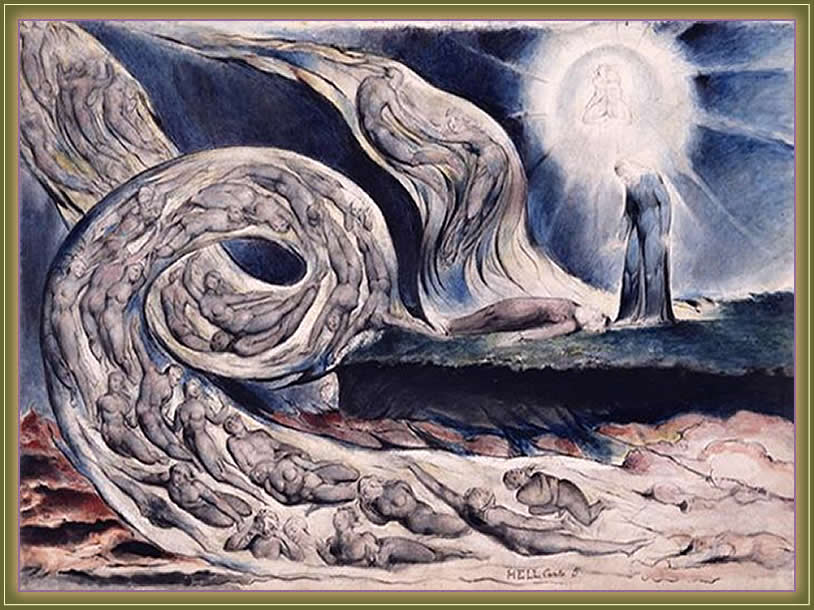
The painting by William Blake is titled: 'The Lover's
Whirlwind',
it illustrates Hell in Canto V of Dante's Inferno 1824.
Source: City Museum
and Art Gallery, Birmingham (Museum).
Production: Filognostic Association of The Order of Time

Feed-back | Links | Downloads | Music | Pictures | What's New | Search | Donations