
Canto 9 |
Chapter 18: King Yayâti Regains his Youth
(1) S'rî S'uka said: 'Just like an embodied soul having six senses [with the mind as the sixth] there were from king Nahusha [another son of Purûravâ's son Âyu] six sons: Yati, Yayâti, Samyâti, Âyati, Viyati and Kriti. (2) The eldest son Yati did not accept the kingdom offered by his father, for he knew what that entails. A person who enters such a position cannot seriously engage in self-realization. (3) When his father by the brahmins was forced to abdicate, for having offended Indra's wife S'acî and he hence had degraded to the level of a python [a 'goat-swallower'], Yayâti became the king. (4) He allowed his four younger brothers to rule the different directions. Yayâti, thus ruling the world, married the daughters [Devayânî] of S'ukrâcârya and [S'armishthhâ of] Vrishaparvâ.'
(5) The king said: 'The mighty seer S'ukrâcârya was a brahmin, while Yayâti belonged to the kshatriya class. How could there, against the customs, be a [pratiloma] marriage of a brahmin [daughter] with a kshatriya?' [anuloma, the other way around, was more common].
(6-7) S'rî S'uka said: 'One day Vrishaparvâ's daughter named S'armishthhâ, an innocent girl with a passionate character, was together with the daughter of the guru Devayânî and with thousands of friends. They walked in the palace garden full of blossoming trees where sand banks were found with lotus flowers buzzing with the sweet sounds of bumblebees. (8) When the lotus-eyed girls arrived at the side of the lake situated there, they gave up their dresses on the bank and began sporting in the water by splashing one another. (9) They [suddenly] saw Lord S'iva, passing by seated on his bull together with the goddess [Pârvatî]. The young girls quickly got out of the water and full of shame covered themselves with their garments. (10) Without noticing it S'armishthhâ put on the clothes of the guru's daughter, as if they were her own, whereupon Devayânî irritated said this: (11) 'Now look how she, like a maid-servant, acts without any manners. She, just like a dog going for the ghee meant for a sacrifice, has put on the garment that was meant for me! (12-14) Of us descendants of Bhrigu better than the rest, by whose austerity this entire world was created, of us who are the face of the Personality of Transcendence and by whose piety the light of the right path is known, of us unto whom the masters of the world, the enlightened souls of control and even the Supreme Lord, the Purifying Supersoul and Husband of the Goddess, are offering prayers, she, whose demoniac father is a disciple of our father, has put on what was meant to be worn by us. It is like an unchaste s'udra trying to master the Vedas!'
(15) S'armishthhâ thus being rebuked breathed heavily, like a trampled serpent, and very angrily biting her lip said to the guru's daughter: (16) 'What a nonsense, you beggar! You do not know your place. Is it not you who waits outside our house [for food] like the crows do?'
(17) With these harsh words rebuking her S'armishthhâ angrily took the garments away from the virtuous daughter of the spiritual teacher and pushed her into a well. (18) As she went home Yayâti, who wandered around for a hunt, happened to arrive at the spot and, thirsty for water, discovered her in the well. (19) Because she sat there completely naked, the king gave her his upper garment and most kindly put his hand into hers to pull her out. (20-21) The daughter of Us'anâ [or S'ukrâcârya, see also B.G. 10: 37] with words full of love and kindness said to the hero: 'Oh King, with you taking my hand, oh conqueror of the cities of the enemy, you have accepted my hand! May it not be touched by anyone else but by you, because the relationship between you and me that we have now, was arranged by providence, oh hero, and not by man! (22) Having landed in this well I learned about your goodness. [Please know that] no qualified brahmin can become my husband, oh strong-armed one, because Kaca, the son of Brihaspati whom I have cursed in the past, pronounced a curse against it [*].'
(23) Yayâti did not like what had been arranged by providence, however, thinking for himself he, being attracted to her, agreed to her proposal. (24) After the king had left she, having returned home, in tears wisely told everything to her father, recounting all that S'armishthhâ had done and what had happened thereafter. (25) The mighty thinker was most unhappy about it. He condemned the priesthood, praised the activity of collecting grains [uñcha-vritti, see 7.11: 16 and 7.12: 17-19] and left his residence together with his daughter. (26) King Vrishaparvâ understanding that his spiritual master acted out of protest, propitiated him by prostrating on the road with his head at his feet. (27) The mighty son of Bhrigu, who could not be angry for longer than a minute, then said to his disciple: 'I cannot ignore her, please fulfill her desire, oh King!'
(28) With his consent to settle matters [as demanded] Devayânî expressed her desire: 'To whomever my father gives me away in marriage, she [S'armishthhâ] must accompany me as my follower.'
(29) S'armishthhâ, who together with her friends by the father was given to Devayânî, understood the danger [of the âcârya leaving] and also what the benefit was of his respectability, and therefore served her together with the thousands of other women as a maidservant. (30) When he gave his daughter [Devayânî] to [Yayâti] the descendant of Nahusha, S'ukrâcârya said to him: 'Oh King, never ever allow S'armishthhâ into your bed!'
(31) S'armishthhâ [however] who [later on] saw that Us'anâ's daughter had nice children, asked him at an opportune moment in a secluded place, whether he as the husband of her girlfriend would not like her as a faithful wife. (32) [Even though] remembering what S'ukra had said when he gave his advice for a situation like this, he who by this princess was requested to have children with her, then decided, from his sense of duty [as a ruler] and respect for the principles of religion [in support of that], to give in to her [compare B.G. 7: 11]. (33) Devayânî gave birth to Yadu and Turvasu. S'armishthhâ, the daughter of Vrishaparvâ, had Druhyu, Anu and Pûru. (34) When Devayânî was informed that S'armishthhâ was pregnant of her protector she, boiling with anger, proudly returned to her father's house. (35) Following his sweetheart, his great desire, he tried to appease her with meaningful words and by massaging her feet, but it was in vain. (36) S'ukra said angrily to him: 'You womanizing, deceitful man. May you, oh fool, be afflicted by disfigurement of your body because of old age.'
(37) S'rî Yayâti said: 'As yet my lust with your daughter has not been satisfied, oh brahmin!'
[S'ukra replied:] 'For as long as you are lusty you may exchange your old age for the youth of someone willing to accept that.'
(38) He thus got the opportunity to change places with his eldest son. He asked him: 'Oh Yadu, beloved son, please give me your youth in exchange for this old age! (39) I am not yet satisfied in my sensual needs, my dear son. When you take upon yourself the burden of old age that your grandfather [S'ukra] wished me, I can enjoy life a few years more [see also 7.5: 30].'
(40) S'rî Yadu said: 'I am not happy to accept your old age while you remain youthful. A person [like me] will never become free from material desires without [having had] the experience of bodily happiness [see also 7.12: 9-11 and B.G. 4: 13]!'
(41) The father requested Turvasu, Druhyu and Anu, oh son of Bharata, but they refused to accept because they, not conversant with the true nature [of the soul], took their temporality for something permanent. (42) He asked Pûru who was younger but better qualified. He said to him: 'You, my dear son, would not turn me down like your older brothers did, would you?'
(43) S'rî Pûru said: 'Who, oh King, oh best among the people, gets in this world the chance to repay his father for the body that he gave? It is by his mercy that one may enjoy a higher life. (44) He who acts in respect of his father's wishes is the best one, he who acts on his command is but mediocre, and low-class is he who acts irreverently. But he who defies his father's words is like his stool.'
(45) Pûru was thus pleased to accept the burden of old age of his father, while his father was pleased with the satisfaction of the youthful desires of his son he had asked for, oh ruler of man. (46) He [Yayâti], as the master of the seven continents, ruled like a father over his subjects and enjoyed to his heart's content the material happiness without any frustration of his senses. (47) Devayânî as his sweetheart, on top of that provided her beloved husband in private, twenty-four hours a day, divine bliss with all her body, mind and words and everything belonging to it. (48) With different rituals worshiping Hari, the Personality of Sacrifice, the Godhead and Reservoir of all Divinity and Object of all Vedic knowledge, Yayâti was of an abundant charity. (49) In Him the complete of creation appears in all its diversity - just like a mass of clouds appears in the sky - and then again there is no manifestation at all, like it concerned an illusion created by the mind in a dream [see also B.G. 7: 24-25]. (50) Placing only Him in his heart, Lord Vâsudeva, the One Nârâyana who exists within each but is visible to no one, he worshiped free from desire the Supreme Master. (51) Even though he this way for a thousand years with his mind and his five senses was engaged in a notion of worldly happiness he, the master of the entire world, because of his devious senses could not find satisfaction.'
Third revised edition, loaded February 10, 2020.
Previous Aadhar edition and Vedabase links:
S'rî S'uka said: 'Just like an embodied soul having six senses [with the mind as the sixth] there were from king Nahusha [another son of Purûravâ's son Âyu] six sons: Yati, Yayâti, Samyâti, Âyati, Viyati and Kriti.S'rî S'uka said: 'Of king Nahusha [another son of Purûravâ's son Âyu] were there just like the six senses [the mind as the sixth] of an embodied soul, the six of Yati, Yayâti, Samyâti, Âyati, Viyati and Kriti. (Vedabase)
The eldest son Yati did not accept the kingdom offered by his father, for he knew what that entails. A person who enters such a position cannot seriously engage in self-realization.
The eldest son Yati, knowing what assuming power entails, did not accept the kingdom offered by his father, [with the argument that] the person who enters such a position cannot be serious in self-realization. (Vedabase)
When his father by the brahmins was forced to abdicate, for having offended Indra's wife S'acî and he hence had degraded to the level of a python [a 'goat-swallower'], Yayâti became the king.
When his father by the brahmins was forced to leave his elevated position because of having offended Indra's wife S'acî and he had degraded to the life of a snake, became Yayâti the king. (Vedabase)
He allowed his four younger brothers to rule the different directions. Yayâti, thus ruling the world, married the daughters [Devayânî] of S'ukrâcârya and [S'armishthhâ of] Vrishaparvâ.'
The four brothers younger than him he allowed to rule the different directions. Yayâti so ruling the world married with the daughters [Devayânî] of S'ukrâcârya and [S'armishthhâ of] Vrishaparvâ.' (Vedabase)
The king said: 'The mighty seer S'ukrâcârya was a brahmin, while Yayâti belonged to the kshatriya class. How could there, against the customs, be a [pratiloma] marriage of a brahmin [daughter] with a kshatriya?' [anuloma, the other way around, was more common].
The king said: 'The mighty seer S'ukrâcârya was a brahmin while Yayâti belonged to the kshatriya class; how could there against the customs be a [pratiloma] marriage of a brahmin [daughter] with a kshatriya?' [anuloma, the other way around, was more common]. (Vedabase)
S'rî S'uka said: 'One day Vrishaparvâ's daughter named S'armishthhâ, an innocent girl with a passionate character, was together with the daughter of the guru Devayânî, and with thousands of friends. They walked in the palace garden full of blossoming trees where sand banks were found with lotus flowers buzzing with the sweet sounds of bumblebees.
S'rî S'uka said: 'One day was Vrishaparvâ's daughter named S'armishthhâ, a girl with a high-strung character, together with thousands of friends and the daughter of the guru Devayânî, as innocent as she was, walking in the palace garden that, full of lotus flowers and crammed with blossoming trees, nicely buzzed of the bumblebees. (Vedabase)
When the lotus-eyed girls arrived at the side of the lake situated there, they gave up their dresses on the bank and began sporting in the water by splashing one another.
All the lotus-eyed girls arriving at the side of the lake there gave their dresses up on the bank and began sporting in the water splashing one another. (Vedabase)
They [suddenly] saw Lord S'iva, passing by seated on his bull together with the goddess [Pârvatî]. The young girls quickly got out of the water and full of shame covered themselves with their garments.
Seeing Lord S'iva pass by with the goddess [Pârvatî] seated on his bull got the young girls quickly out of the water ashamed covering themselves with their garments. (Vedabase)
Without noticing it S'armishthhâ put on the clothes of the guru's daughter, as if they were her own, whereupon Devayânî irritated said this:
S'armishthhâ unknowingly put on as her own the dress of the guru's daughter upon which Devayânî irritated said this: (Vedabase)
'Now look how she, like a maid-servant, acts without any manners. She, just like a dog going for the ghee meant for a sacrifice, has put on the garment that was meant for me!
'Alas see how she, like a maid-servant, acts against the etiquette. Just like a dog after the ghee for a sacrifice has she put on the garment that was meant for me! (Vedabase)
Of us descendants of Bhrigu better than the rest, by whose austerity this entire world was created, of us who are the face of the Personality of Transcendence and by whose piety the light of the right path is known, of us unto whom the masters of the world, the enlightened souls of control and even the Supreme Lord, the Purifying Supersoul and Husband of the Goddess, are offering prayers, she, whose demoniac father is a disciple of our father, has put on what was meant to be worn by us. It is like an unchaste s'udra trying to master the Vedas!'
Of those by whose austerity this entire world was created, of those who are the face of the Personality of Transcendence and of whose piety the light of the right path is known, of those unto whom the masters of the world, the enlightened of control and even the Supreme Lord, the Purifying Supersoul and Husband of the Goddess are offering prayers, of us descendants of Bhrigu better than the rest has she, whose cloudy father is a disciple of our father, like a low-class laborer put on what was meant to be worn by us - it is alike someone unchaste who tries to master the Vedas!' (Vedabase)
S'armishthhâ thus being rebuked breathed heavily, like a trampled serpent, and very angrily biting her lip said to the guru's daughter:
S'armishthhâ thus rebuked breathed heavily like a trampled serpent and said very angry biting her lip to the guru's daughter: (Vedabase)
'What a nonsense, you beggar! You do not know your place. Is it not you who waits outside our house [for food] like the crows do?'
'What a nonsense, you beggar! You don't know your place. Isn't it you who waits outside our house [for food] like the crows do?' (Vedabase)
With these harsh words rebuking her S'armishthhâ angrily took the garments away from the virtuous daughter of the spiritual teacher and pushed her into a well.
With these unkind words took S'armishthhâ after her reprimand angrily the garments of the virtuous daughter of the spiritual teacher away and threw she her into a well. (Vedabase)
As she went home Yayâti, who wandered around for a hunt, happened to arrive at the spot and, thirsty for water, discovered her in the well.
As she went home happened Yayâti, wandering around for a hunt, to arrive there and discovered he, thursting for water, her in the well. (Vedabase)
Because she sat there completely naked, the king gave her his upper garment and most kindly put his hand into hers to pull her out.
Untying his upper garment reached the king down to her being naked and put he his hand into hers in his kindness to pull her out. (Vedabase)
The daughter of Us'anâ [or S'ukrâcârya, see also B.G. 10: 37] with words full of love and kindness said to the hero: 'Oh King, with you taking my hand, oh conqueror of the cities of the enemy, you have accepted my hand! May it not be touched by anyone else but by you, because the relationship between you and me that we have now, was arranged by providence, oh hero, and not by man!
Unto him, the hero, said the daughter of the thinker of the heat [Us'anâ or S'ukrâcârya, see also B.G. 10: 37] with words full of love and kindness: 'O King by your taking my hand have you, o conqueror of all other kingdoms, accepted my hand! May it not be touched by anyone else but by you because the relationship between you and me, that what we by providence now have o hero, is not something arranged by man! (Vedabase)
Having landed in this well I learned about your goodness. [Please know that] no qualified brahmin can become my husband, oh strong-armed one, because Kaca, the son of Brihaspati whom I have cursed in the past, pronounced a curse against it [*].'
Because of me having landed in this well have I learned to know your goodness; [please know that] no qualified brahmin can become my husband o stong-armed one, because Kaca, the son of Brihaspati, in the past pronounced a curse against it because I had cursed him [*].' (Vedabase)
Yayâti did not like what had been arranged by providence, however, thinking for himself he, being attracted to her, agreed to her proposal.
Yayâti did not like what by God had been arranged, but thinking for himself however abided he, attracted to her, by what she told him. (Vedabase)
After the king had left she, having returned home, in tears wisely told everything to her father, recounting all that S'armishthhâ had done and what had happened thereafter.
After the king had left submitted she, having returned home, in tears everything to her father, recounting everything that S'armishthhâ had done and what was said thereafter. (Vedabase)
The mighty thinker was most unhappy about it. He condemned the priesthood, praised the activity of collecting grains [uñcha-vritti, see 7.11: 16 and 7.12: 17-19] and left his residence together with his daughter.
The mighty thinker was very unhappy about it and condemning the priesthood and praising the business of collecting the grains [uñcha-vritti, see 7.11: 16 and 7.12: 17-19] left he with his daughter his residence. (Vedabase)
King Vrishaparvâ understanding that his spiritual master acted out of protest, propitiated him by prostrating on the road with his head at his feet.
Vrishaparvâ understanding that his spiritual master did so for chiding or cursing him, propitiated him by meeting him halfway and prostrating at the feet. (Vedabase)
The mighty son of Bhrigu, who could not be angry for longer than a minute, then said to his disciple: 'I cannot ignore her, please fulfill her desire, oh King!'
The mighty son of Bhrigu, whose anger wouldn't last but for a minute, then said to his disciple: 'Please fulfill her desire, o King, for as long as I live I'll not be able to give up on this girl!' (Vedabase)
With his consent to settle matters [as demanded] Devayânî expressed her desire: 'To whomever my father gives me away in marriage, she [S'armishthhâ] must accompany me as my follower.'
With his consent to settle matters expressed Devayânî her desire: 'To whomever my father gives me, I will go, with my servant [S'armishthhâ] and her friends.' (Vedabase)
S'armishthhâ, who together with her friends by the father was given to Devayânî, understood the danger [of the âcârya leaving] and also what the benefit was of his respectability, and therefore served her together with the thousands of other women as a maidservant.
At the time wisely understanding the danger as well as the benefit of the greatness of him [his âcârya], gave the father S'armishthhâ along with her friends to Devayânî so that she with the thousands of other women would take care of Devayânî as her servant. (Vedabase)
When he gave his daughter [Devayânî] to [Yayâti] the descendant of Nahusha, S'ukrâcârya said to him: 'Oh King, never ever allow S'armishthhâ into your bed!'
Giving the descendant of Nahusha his daughter in marriage together with S'armishthhâ said Us'anâ to him: 'O King, never ever allow S'armishthhâ into your bed!' (Vedabase)
S'armishthhâ [however] who [later on] saw that Us'anâ's daughter had nice children, asked him at an opportune moment in a secluded place, whether he as the husband of her girlfriend would not like her as a faithful wife.
When S'armishthhâ [however later on] saw Us'anâ's daughter having nice children, asked she him at an opportune moment in a secluded place, whether he as the husband of her girl-friend wouldn't like her as a faithful wife. (Vedabase)
[Even though] remembering what S'ukra had said when he gave his advice for a situation like this, he who by this princess was requested to have children with her, then decided, from his sense of duty [as a ruler] and respect for the principles of religion [in support of that], to give in to her [compare B.G. 7: 11].
Remembering what S'ukra had said in his direction for a time like this, decided he, on the request of that princess to have a son with her, from his own sense of duty and the general principles of religion to give in to her [compare B.G. 7: 11]. (Vedabase)
Devayânî gave birth to Yadu and Turvasu. S'armishthhâ, the daughter of Vrishaparvâ, had Druhyu, Anu and Pûru.
Yadu and Turvasu as well were the ones who Devayânî gave birth to and Druhyu, Anu and Pûru were there from S'armishthhâ, the daughter of Vrishaparvâ. (Vedabase)
When Devayânî was informed that S'armishthhâ was pregnant of her protector she, boiling with anger, proudly returned to her father's house.
Finding out that S'armishthhâ was pregnant from him left Devayânî, boiling with anger, proud as she was for her father's house. (Vedabase)
Following his sweetheart, his great desire, he tried to appease her with meaningful words and by massaging her feet, but it was in vain.
Following his sweetheart, his great desire, tried he to propitiate her with meaningful words but he couldn't even appease her massaging her feet. (Vedabase)
S'ukra said angrily to him: 'You womanizing, deceitful man. May you, oh fool, be afflicted by disfigurement of your body because of old age.'
S'ukra angry with him said: 'You womanizing, deceitful man, may you fool enter the old of age that disfigures the human body.' (Vedabase)
S'rî Yayâti said: 'As yet my lust with your daughter has not been satisfied, oh brahmin!'
[S'ukra replied:] 'For as long as you are lusty you may exchange your old age for the youth of someone willing to accept that.'
S'rî Yayâti said: 'As yet has my lust not been satisfied with your daughter, o brahmin!'[S'ukra replied:] 'For as long as you are lusty may you exchange the memorable of you with the youth of someone willing to take your place.' (Vedabase)
He thus got the opportunity to change places with his eldest son. He asked him: 'Oh Yadu, beloved son, please give me your youth in exchange for this old age!
Thus took he the opportunity to change place requesting the eldest son: 'O Yadu, beloved son, please give me your youth in exchange for this old age! (Vedabase)
I am not yet satisfied in my sensual needs, my dear son. When you take upon yourself the burden of old age that your grandfather [S'ukra] wished me, I can enjoy life a few years more [see also 7.5: 30].'
With what the father of your mother gave me, my dear son, am I not satisfied in my sensual needs, let me by the good of your age enjoy life for a few more years!' [see also 7.5: 30] (Vedabase)
S'rî Yadu said: 'I am not happy to accept your old age while you remain youthful. A person [like me] will never become free from material desires without [having had] the experience of bodily happiness [see also 7.12: 9-11 and B.G. 4: 13]!'
S'rî Yadu said: 'I'm not happy with accepting your old age while you remain in youth. Without [having had] the experience of bodily happiness will a person [like me] never become indifferent about material pleasures!' [see also: 7.12: 9-11 and B.G 4: 13] (Vedabase)
The father requested Turvasu, Druhyu and Anu, oh son of Bharata, but they refused to accept because they, not conversant with the true nature [of the soul], took their temporality for something permanent.
The father requested Turvasu, Druhyu and Anu, o son of Bharata, but they refused to accept because they, not knowing the true nature [of the soul], took their temporality for something permanent. (Vedabase)
He asked Pûru who was younger but better qualified. He said to him: 'You, my dear son, would not turn me down like your older brothers did, would you?'
He asked Pûru even though he was a younger son, saying to him: 'You my dear son, are of a better fiber, you wouldn't, like your older brothers did, refuse me.' (Vedabase)
S'rî Pûru said: 'Who, oh King, oh best among the people, gets in this world the chance to repay his father for the body that he gave? It is by his mercy that one may enjoy a higher life.
S'rî Pûru said: 'Who o King, best among the people, has in this world the chance to repay the father who gave him his body, for it is by his mercy that he may enjoy a higher life. (Vedabase)
He who acts in respect of his father's wishes is the best one, he who acts on his command is but mediocre, and low-class is he who acts irreverently. But he who defies his father's words is like his stool.'
He who acts in respect of his father's wishes is the best, he who acts on his command is but mediocre and low class is he who acts without faith, but like stool is he who defies his father's words.' (Vedabase)
Pûru was thus pleased to accept the burden of old age of his father, while his father was pleased with the satisfaction of the youthful desires of his son he had asked for, oh ruler of man.
This way was it entirely Pûru's pleasure to accept the burden of old age of his father, the father who was most contented with all the desires belonging to the youth of his son that he had asked for, o ruler of man. (Vedabase)
He [Yayâti], as the master of the seven continents, ruled like a father over his subjects and enjoyed to his heart's content the material happiness without any frustration of his senses.
As the master of the entirety of the seven continents ruled he like a father over his subjects, enjoying as much as he wanted the material happiness without any impairment of his senses. (Vedabase)
Devayânî as his sweetheart, on top of that provided her beloved husband in private, twenty-four hours a day, divine bliss with all her body, mind and words and everything belonging to it.
Devayânî also served for twenty-four hours a day as the dearest of her beloved in all privacy him with all her body, mind and words and everything thereto to bring him divine bliss. (Vedabase)
With different rituals worshiping Hari, the Personality of Sacrifice, the Godhead and Reservoir of All Divinity and Object of All Vedic knowledge, Yayâti was of an abundant charity.
Worshiping with different rituals Hari, the Personality of Sacrifice, the God and Reservoir of All Divinity and Object of All Vedic knowledge, was Yayâti of an abundant charity. (Vedabase)
In Him the complete of creation appears in all its diversity - just like a mass of clouds appears in the sky - and then again there is no manifestation at all, like it concerned an illusion created by the mind in a dream [see also B.G. 7: 24-25].
Like a mass of clouds in the sky appears the entire, in Himself, created world at one time as a diversity of life forms, and then at other times is it of no manifestation, like it was a creation of the mind as in a dream [see also B.G. 7: 24-25]. (Vedabase)
Placing only Him in his heart, Lord Vâsudeva, the One Nârâyana who exists within each but is visible to no one, he worshiped free from desire the Supreme Master.
Certain of Him, Lord Vâsudeva in his heart, the One Nârâyana existing within each but visible to no one, worshiped he free from desire the Supreme Master. (Vedabase)
Even though he this way for a thousand years with his mind and his five senses was engaged in a notion of worldly happiness he, the master of the entire world, because of his devious senses could not find satisfaction.'
Although he thus for a period of thousand years proceeded with the mind and the five senses in an idea of worldy happiness, could he, impure in his sensuality, not be satisfied, even though he was the ruler of all.' (Vedabase)*: Swâmi Prabhupâda explains: 'Kaca, the son of the learned celestial priest Brihaspati, had been a student of S'ukrâcarya, from whom he had learned the art of reviving a man who has died untimely. This art, called mrita-sañjîvanî, was especially used during wartime. When there was a war, soldiers would certainly die untimely, but if a soldier's body was intact, he could be brought back to life again by this art of mrita-sañjîvanî. This art was known to S'ukrâcârya and many others, and Kaca, the son of Brihaspati, became S'ukrâcârya's student to learn it. Devayânî desired to have Kaca as her husband, but Kaca, out of regard for S'ukrâcarya, looked upon the guru's daughter as a respectable superior and therefore refused to marry her. Devayânî angrily cursed Kaca by saying that although he had learned the art of mrita-sañjîvanî from her father, it would be useless. When cursed in this way, Kaca retaliated by cursing Devayânî never to have a husband who was a brâhmana.'

The
text and audio are offered under the conditions of the
Creative
Commons Attribution-Noncommercial-Share Alike
3.0
Unported License.
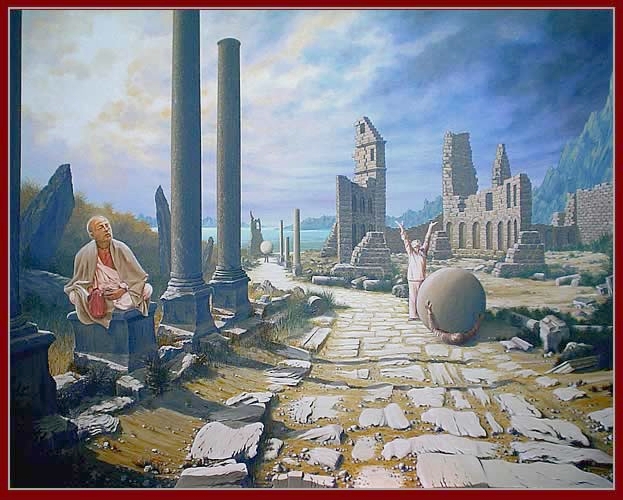
The painting
is
titled 'Karma' and is © of Wim
Kuenen,
used
with
permission.
Production: Filognostic
Association
of The
Order of Time

Feed-back | Links | Downloads | Music | Pictures | What's New | Search | Donations





 Text
1
Text
1