
Canto
10
Canto
10
Chapter 53: Krishna Kidnaps Rukminî
(1) S'rî S'uka said: 'When [Krishna] the descendant of Yadu heard the confidential message of the princess of Vidarbha, He took the hand of the messenger into His own and addressed him with a smile. (2) The Supreme Lord said: 'I as well have to think of her constantly and cannot sleep at night. I know that Rukmî in his enmity is against My marriage with her. (3) I will bring her, that indisputable beauty who deems Me the best, over here and crush in battle that half-breed royalty, the way one ignites a fire from firewood!'
(4) S'rî S'uka said: 'Knowing the exact [astronomical] time of Rukminî's marriage, Madhusûdana told His charioteer: 'Dâruka, get the chariot immediately ready.' (5) He brought the chariot yoked with the horses S'aibya, Sugrîva, Meghapushpa and Balâhaka [*], and stood with folded palms before Him. (6) S'auri mounted His chariot together with the brahmin and drove swiftly with His horses in a single night to the Vidarbha kingdom. (7) King Bhîshmaka, who out of affection for his son [Rukmî] obeyed his control, was about to give his daughter away to S'is'upâla and saw to it that the required duties were performed. (8-9) The city was thoroughly cleansed and its avenues, streets and intersections were abundantly sprinkled with water. It was decorated with banners on flagpoles and with archways. The women and men of the city in their opulent homes aromatic with aguru, arrayed in spotless clothing, wearing their jewels, having smeared their bodies with fragrant substances and having decorated themselves with flowers and other ornaments. (10) He [Bhîshmaka] saw to it that the forefathers, the demigods and the brahmins were worshiped according to the rules, oh King, that they were properly fed and that the auspicious mantras were recited. (11) The bride properly bathed, cleaned her teeth, put on her auspicious marriage necklace as also a brand-new set of clothes and adorned herself with the most excellent jewels. (12) For the protection of the bride, the best among the brahmins recited mantras from the Sâma, Rig and Yajur Veda, and the priests expert in the Atharva mantras poured oblations of ghee to pacify the ruling planets. (13) The king, very well versed in the vidhi, donated gold, silver, clothing and sesame seeds mixed with raw sugar to the brahmins. (14) King Damaghosha, the lord of Cedi, the same way arranged for the knowers of the mantras to perform for his son [the bridegroom] everything that was conducive to his prosperity. (15) He traveled to Kundina [Bhîshmaka's capital] accompanied by hordes of elephants dripping with mada, golden chariots decorated with garlands and many regiments infantry and cavalry. (16) The master of Vidarbha met him half way to prove his respects, and with pleasure settled him in a specially constructed residence. (17) S'âlva, Jarâsandha, Dantavakra and Vidûratha, who all sided with S'is'upâla, came together with Paundraka and thousands of others. (18-19) Those who were inimical towards Krishna and Râma had decided on the following: 'When Krishna together with Râma and the other Yadus comes to steal S'is'upâla's bride we, in order to secure her, together will join to fight Him.' All the kings thus had arrived with a complete contingent of troops and vehicles.
(20-21) When Lord Balarâma heard about these preparations of the hostile kings and that Krishna had set off alone to steal the bride, He, fearing a fight, filled with love for His brother swiftly went to Kundina together with a mighty force of elephants, horses, chariots and soldiers on foot. (22) The daughter of Bhîshmaka with her lovely hips who awaited the arrival of Krishna, did not see the brahmin return and then wondered: (23) 'Alas, only three yamas [nine hours] remain before I will marry. How unlucky I am, the Lotus-eyed One does not come and I do not know why, nor has as yet the brahmin carrying my message returned. (24) Perhaps the One Faultless in Mind and Body, despite His initial willingness saw something contemptible in me, so that He does not come to take my hand. (25) What a misfortune! The creator is not favorably disposed towards me, nor is the great Lord S'iva... or maybe Devî has turned against me, his consort [known as] Gaurî, Rudrânî, Girijâ or Satî.'
(26) Ruminating this way the young girl, whose mind had been stolen by Krishna, closed her eyes brimming with tears, aware of the time [that was left]. (27) While the bride thus was waiting for Govinda's arrival, oh King, her left thigh, arm and eye twitched, foretelling something desirable. (28) That very moment the purest one among the brahmins appeared, following the command of Krishna, to see the divine princess who stayed in the inner chambers of the palace. (29) Noticing his joyful face and the relaxed movements of his body she, as an expert in telling signs, inquired with a pure smile. (30) He told her about the arrival of Yadunandana [the 'Child of the Yadus'] and related the words He had said to assure her that He would marry with her. (31) Realizing that He had come, the mind of Vaidarbhî cleared, whereupon she gladdened knew no better answer than to bow down to the dear brahmin. (32) [The king] hearing that Râma and Krishna had arrived eager to witness his daughter's marriage, accompanied by the sounds of instruments came to welcome Them with abundant offerings. (33) As was prescribed he performed worship with desirables like honey-milk [madhu-parka], and brought new clothes. (34) Generously arranging for an opulent place to stay he afforded Them, Their soldiers and associates, proper hospitality. (35) With all that was wanted he was thus of respect for the kings who had assembled, according to each his power, age, strength and wealth. (36) The residents of Vidarbha-pura hearing that Krishna had arrived, all came to drink in His lotus face with the cupped palms of their eyes [and said]: (37) 'He who also possesses such a perfect body, is the only one to deserve Rukminî as a wife. He is the most suitable husband for princess Bhaishmî! (38) May Acyuta, the Cause of the Three Worlds, be pleased with whichever of our good deeds and be as merciful to accept the hand of Rukminî.' (39) This is what the citizens bound to their increasing pure love said.
The bride protected by guards left the inner palace and went to the temple of Ambikâ [see also 10.52: 42]. (40-41) Going there on foot to see the lotus petal feet of Bhavânî, she, totally absorbed in meditating on Krishna's lotus feet, kept silent in de midst of her mothers and female companions. She was guarded by the valiant, armed soldiers of the king, and while they stood prepared with their weapons raised, cymbals and mridangas, conch shells, horns and other wind instruments were played. (42-43) The bride was accompanied by the well ornamented wives of the brahmins, thousands of prominent courtesans carrying various items of worship and presents, flowergarlands, fragrances, clothing and jewelry, as also by singers who sang and offered prayers, by musicians and bards and by chroniclers and heralds. (44) Reaching the temple of the goddess she washed her feet and lotuslike hands, sipped water for purification and entered, sanctified and peaceful, the place where Ambikâ resided. (45) The so very young girl was by the elderly wives of the brahmins, who were well acquainted with the injunctions, accompanied in offering her respects to Bhavânî, who was there together with her consort Lord Bhava [S'iva]. (46) [She prayed:] 'Again and again, oh Ambikâ, I offer you and also your children [Ganes'a and Kârtikeya] my obeisances. Please allow Krishna, the Supreme Lord, to be my husband.'
(47-48) With different offerings of water, fragrant substances, whole grains and incense, gifts of clothing, garlands, necklaces and ornaments, and an array of lamps, she offered worship, as also did the wives of the brahmins with savories, cakes, prepared betel nut, sacred threads, fruits and sugar cane. (49) The women gave her what remained of the offering as also their blessings, whereupon the bride bowed down to them and to the deity and ate some of the food that was sacrificed. (50) Then she ended her vow of silence and left the temple of Ambikâ, while she with her hand, beautified by a jeweled ring, held on to a maidservant. (51-55) With her well-formed waist, the earrings decorating her face, her pure beauty, the gem-studded belt on her hips and her budding breasts, she was just like the illusory potency of the Lord which bewilders even the sober souls [Mâyâdevî, see also 8.12: 38-40; 10.2***]. Seeing her pure smile, her bimba red lips reflected in her jasmine-bud teeth, her gait like a royal swan as she walked her feet which were tinkling and were beautified by the effulgence of her finely crafted ankle bells, the assembled and respectable heroes were bewildered and distressed by the lust she generated. With her, on the pretext of the procession, offering her beauty to Lord Krishna, the minds of the kings, who saw her broad smiles and shy glances, were stolen, and their weapons dropped to the ground as they fainted and fell from their horses, elephants and the chariots on which they were seated. Slowly walking, she put the two whorls of her lotus flower feet one before the other, meanwhile eagerly expecting the arrival of the Supreme Personality. Throwing aside her hair with the nails of her hand she, coyly looking at the kings present, from the corners of her eyes that very moment spotted Acyuta. Straight in front of the eyes of His enemies Krishna then seized the king's daughter who stood prepared to mount His chariot. (56) He lifted her onto His chariot which was marked with [the flag of] Garuda, drove back the circle of kings and slowly left the place with Balarâma in front, just like a lion would do removing his prey from the midst of jackals. (57) The adversaries headed by Jarâsandha, could in their conceit, with their honor ruined, not bear the defeat: 'We archers are damned with those cowherds, like a bunch of puny animals, stealing the honor of us, the lions!'


Third revised edition, loaded April 24, 2021.
Previous Aadhar edition and Vedabase links:
S'rî S'uka said: 'When [Krishna] the descendant of Yadu heard the confidential message of the princess of Vidarbha, He took the hand of the messenger into His own and addressed him with a smile.S'rî S'uka said: 'The Descendant of Yadu [Krishna] at that moment hearing the confidential message of the princess of Vidarbha, took the hand of the messenger into His and said smiling the following. (Vedabase)
The Supreme Lord said: 'I as well have to think of her constantly and cannot sleep at night. I know that Rukmî in his enmity is against My marriage with her.
The Supreme Lord said: 'I also am the same way in My mind fixed on her and cannot sleep at night; I know that Rukmî in his enmity is against Me marrying her. (Vedabase)
I will bring her, that indisputable beauty who deems Me the best, over here and crush in battle that half-breed royalty, the way one ignites a fire from firewood!'
I'll bring her, that indisputable beauty deeming Me the best, over here and crush in battle that half-breed royalty, the way one ignites a fire from firewood!' (Vedabase)
S'rî S'uka said: 'Knowing the exact [astronomical] time of Rukminî's marriage, Madhusûdana told His charioteer: 'Dâruka, get the chariot immediately ready.'
S'rî S'uka said: 'And known with the exact time of Rukminî's marriage told Madhusûdana His charioteer: 'Dâruka, immediately get the chariot ready'. (Vedabase)
He brought the chariot yoked with the horses S'aibya, Sugrîva, Meghapushpa and Balâhaka [*], and stood with folded palms before Him.
He accordingly bringing the chariot with the horses named S'aibya, Sugrîva, Meghapushpa and Balâhaka [*], next stood before Him with folded palms. (Vedabase)
S'auri mounted His chariot together with the brahmin and drove swiftly with His horses in a single night to the Vidarbha kingdom.
S'auri together with the brahmin mounting His chariot drove swiftly with His horses in a single night to the Vidarbha kingdom. (Vedabase)
King Bhîshmaka, who out of affection for his son [Rukmî] obeyed his control, was about to give his daughter away to S'is'upâla and saw to it that the required duties were performed.
King Bhîshmaka who in his affection answered to the wishes of his son [Rukmî] was prepared to give his daughter away to S'is'upâla and saw to it that the required duties were performed. (Vedabase)
The city was thoroughly cleansed and its avenues, streets and intersections were abundantly sprinkled with water. It was decorated with banners on flagpoles and with archways. The women and men of the city in their opulent homes aromatic with aguru, arrayed in spotless clothing, wearing their jewels, having smeared their bodies with fragrant substances and having decorated themselves with flowers and other ornaments.
The city thoroughly cleansed and with its avenues, streets and intersections abundantly sprinkled with water, was decorated with banners on flagpoles and with archways. With their homes aromatic of aguru arrayed the women and men of the city in spotless clothing, hung with jewels, fragrant and decorated with flowers and other ornaments. (Vedabase)
He [Bhîshmaka] saw to it that the forefathers, the demigods and the brahmins were worshiped according to the rules oh King, that they were properly fed and that the auspicious mantras were recited.
To the rules correctly worshiping the forefathers and the demigods, o King, and feeding the scholars as was proper, had he [Bhîshmaka] chanted auspicious mantras. (Vedabase)
The bride properly bathed, cleaned her teeth, put on her auspicious marriage necklace as also a brand-new set of clothes and adorned herself with the most excellent jewels.
The bride properly bathed and with her teeth washed put on her auspicious marriage-thread, as also a brand-new set of clothes and adorned herself with the most excellent jewels. (Vedabase)
For the protection of the bride, the best among the brahmins recited mantras from the Sâma, Rig and Yajur Veda, and the priests expert in the Atharva mantras poured oblations of ghee to pacify the ruling planets.
For the protection of the bride were, by the best of the twiceborn, mantras chanted from the Sâma, Rig and Yajur Veda and poured the priest expert in the Atharva mantras justly oblations of ghee for the peace of the ruling planets. (Vedabase)
The king, very well versed in the vidhi, donated gold, silver, clothing and sesame seeds mixed with raw sugar to the brahmins.
As the best of the ones known with the vidhi donated the king gold, silver, clothing and sesame seeds mixed with raw sugar to the brahmins. (Vedabase)
King Damaghosha, the lord of Cedi, the same way arranged for the knowers of the mantras to perform for his son [the bridegroom] everything that was conducive to his prosperity.
The same way arranged the lord of Cedi, king Damaghosha, for his son [the bridegroom] that by the knowers of the mantras everything was done that was conducive to his prosperity. (Vedabase)
He traveled to Kundina [Bhîshmaka's capital] accompanied by hordes of elephants dripping with mada, golden chariots decorated with garlands and many regiments infantry and cavalry.
He traveled to Kundina [Bhîshmaka's capital] accompanied by hordes of elephants dripping of the mada and arrays of golden chariots decorated with garlands and crowded by armies of foot soldiers and horses. (Vedabase)
The master of Vidarbha met him half way to prove his respects, and with pleasure settled him in a specially constructed residence.
The master of Vidarbha half way meeting him with pleasure arranged for him honorably a specially constructed place to stay. (Vedabase)
S'âlva, Jarâsandha, Dantavakra and Vidûratha, who all sided with S'is'upâla, came together with Paundraka and thousands of others.
S'âlva, Jarâsandha, Dantavakra and Vidûratha taking to the side of S'is'upâla, came along with Paundraka and thousands of others. (Vedabase)
Those who were inimical towards Krishna and Râma had decided on the following: 'When Krishna together with Râma and the other Yadus comes to steal S'is'upâla's bride we, in order to secure her, together will join to fight Him.' All the kings thus had arrived with a complete contingent of troops and vehicles.
Those inimical towards Krishna and Râma were thus prepared: 'In order to secure the bride for S'is'upâla will we join to fight Him together, should Krishna accompanied by Râma and other Yadus come to steal her', and thus decided had all the kings come complete with a contingent of troops. (Vedabase)
When Lord Balarâma heard about these preparations of the hostile kings and that Krishna had set off alone to steal the bride, He, fearing a fight, filled with love for His brother swiftly went to Kundina together with a mighty force of elephants, horses, chariots and soldiers on foot.
When Lord Balarâma heard of these hostile preparations of the kings and that Krishna had set off alone to steal the bride, went He, fearing a fight, filled with love for His brother swiftly to Kundina together with a mighty force of elephants, horses, chariots and soldiers on foot. (Vedabase)
The daughter of Bhîshmaka with her lovely hips who awaited the arrival of Krishna, did not see the brahmin return and then wondered:
The daughter of Bhîshmaka with her lovely hips awaiting the arrival of Krishna, not seeing the brahmin return, then wondered: (Vedabase)
'Alas, only three yamas [nine hours] remain before I will marry. How unlucky I am, the Lotus-eyed One does not come and I do not know why, nor has as yet the brahmin carrying my message returned.
'Alas, three yamas [nine hours] are left before I, without the taste of happiness, will marry; the Lotus-eyed One does not come and I don't know for what reason, nor has as yet the carrier of my message returned. (Vedabase)
Perhaps the One Faultless in Mind and Body, despite His initial willingness saw something contemptible in me, so that He does not come to take my hand.
Perhaps sees the One Faultless in Mind and Body, prepared as He for sure originally is, something contemptible in me, not having come to take my hand. (Vedabase)
What a misfortune! The creator is not favorably disposed towards me, nor is the great Lord S'iva... or maybe Devî has turned against me, his consort [known as] Gaurî, Rudrânî, Girijâ or Satî.'
How unfortunate, the creator is not favorably disposed towards me, nor is the great Lord S'iva, or maybe has Devî his consort, [known as] Gaurî, Rudrânî, Girijâ or Satî turned against me.' (Vedabase)
Ruminating this way the young girl, whose mind had been stolen by Krishna, closed her eyes brimming with tears, aware of the time [that was left].
Ruminating thus did the young girl, whose mind had been stolen by Krishna, close her eyes brimming with tears, knowing the time [that was left]. (Vedabase)
While the bride thus was waiting for Govinda's arrival, oh King, her left thigh, arm and eye twitched, foretelling something desirable.
As the bride was thus awaiting Govinda's arrival, o King, twitched her left thigh, arm and eye foretelling something desirable. (Vedabase)
That very moment the purest one among the brahmins appeared, following the command of Krishna, to see the divine princess who stayed in the inner chambers of the palace.
Just then came that purest of the twiceborn to the command of Krishna, to see the divine daughter of the king staying in the inner chambers of the palace. (Vedabase)
Noticing his joyful face and the relaxed movements of his body she, as an expert in telling signs, inquired with a pure smile.
Noticing his joyful face and the relaxed movements of his body did she, as an expert in the signs, inquire with a pure smile. (Vedabase)
He told her about the arrival of Yadunandana [the 'Child of the Yadus'] and related the words He had said to assure her that He would marry with her.
He told her of the arrival of that Child of the Yadus and related the words He had said in assurance of Him getting married to her. (Vedabase)
Realizing that He had come, the mind of Vaidarbhî cleared, whereupon she gladdened knew no better answer than to bow down to the dear brahmin.
Concluding that He had arrived, gladdened the mind of Vaidarbhî, upon which she knew no other answer than to bow down to the dear brahmin. (Vedabase)
[The king] hearing that Râma and Krishna had arrived eager to witness his daughter's marriage, accompanied by the sounds of instruments came to welcome Them with abundant offerings.
Hearing that He, eager to witness his daughter's marriage, had arrived came he [king Bhîshmaka] with the sounds of instruments and with abundant offerings to welcome Râma and Krishna. (Vedabase)
As was prescribed he performed worship with desirables like honey-milk [madhu-parka], and brought new clothes.
As prescribed performed he worship with desirables as honey-milk [madhu-parka] and brought he new clothes. (Vedabase)
Generously arranging for an opulent place to stay he afforded Them, Their soldiers and associates, proper hospitality.
Generously arranging for an opulent place to stay afforded he Them, together with their soldiers and associates, proper hospitality. (Vedabase)
With all that was wanted he was thus of respect for the kings who had assembled, according to each his power, age, strength and wealth.
Thus was he according each his power, age, strength and wealth with all that was wanted of respect for the kings who had assembled. (Vedabase)
The residents of Vidarbha-pura hearing that Krishna had arrived, all came to drink in His lotus face with the cupped palms of their eyes [and said]:
The residents of Vidarbha-pura hearing that Krishna had come, all came to drink in His lotus face with the cupped palms of their eyes [and said]: (Vedabase)
'He who also possesses such a perfect body, is the only one to deserve Rukminî as a wife. He is the most suitable husband for princess Bhaishmî!
'He, whose body is just as flawless, alone deserves Rukminî as a wife, and no one else; He's the most suitable husband for princess Bhaishmî! (Vedabase)
May Acyuta, the Cause of the Three Worlds, be pleased with whichever of our good deeds and be as merciful to accept the hand of Rukminî.'
May, with whatever of all our good deeds, the Creator of the Three Worlds be as merciful, that Acyuta takes the hand of Rukminî.' (Vedabase)
This is what the citizens bound to their increasing pure love said.
The bride protected by guards left the inner palace and went to the temple of Ambikâ [see also 10.52: 42].Thus overflowing with love spoke the citizens in fascination and left the bride protected by guards the inner palace for the temple of Ambikâ [see also 10.52: 42]. (Vedabase)
Going there on foot to see the lotus petal feet of Bhavânî, she, totally absorbed in meditating on Krishna's lotus feet, kept silent in de midst of her mothers and female companions. She was guarded by the valiant, armed soldiers of the king, and while they stood prepared with their weapons raised, cymbals and mridangas, conch shells, horns and other wind instruments were played.
And she, going there on foot to see the lotuspetal feet of Bhavânî, kept, totally absorbed in meditating Krishna's lotus feet, silent in de midst of her mothers and female companions. Guarded by the valiant, armed soldiers of the king, who stood prepared with their weapons raised, were cymbals and mridangas, conchshells, horns and other wind instruments played. (Vedabase)
The bride was accompanied by the well ornamented wives of the brahmins, thousands of prominent courtesans carrying various items of worship and presents, flowergarlands, fragrances, clothing and jewelry, as also by singers who sang and offered prayers, by musicians and bards and by chroniclers and heralds.
Accompanying the bride were there the wives of the twice-born, well ornamented, thousands of prominent chosen ones with various items of worship and presents, flowergarlands, fragrances, clothing and jewelry, as also singers singing and offering prayers, musicians and bards, chroniclers and heralds. (Vedabase)
Reaching the temple of the goddess she washed her feet and lotuslike hands, sipped water for purification and entered, sanctified and peaceful, the place where Ambikâ resided.
Reaching the temple of the goddess washed she her feet and lotuslike hands, sipped she water for purification and entered she sanctified and peaceful the place where Ambikâ resided. (Vedabase)
The so very young girl was by the elderly wives of the brahmins, who were well acquainted with the injunctions, accompanied in offering her respects to Bhavânî, who was there together with her consort Lord Bhava [S'iva].
The so very young girl was by the elderly wives of the brahmins, who were well acquainted with the injunctions, led in offering respects to Bhavânî who was here together with her consort Lord Bhava [S'iva]: (Vedabase)
[She prayed:] 'Again and again, oh Ambikâ, I offer you and also your children [Ganes'a and Kârtikeya] my obeisances. Please allow Krishna, the Supreme Lord, to be my husband.'
'I along with your children repeatedly offer my obeisances to you o Ambikâ, please allow Krishna, the Supreme Lord, to be my husband.' (Vedabase)
With different offerings of water, fragrant substances, whole grains and incense, gifts of clothing, garlands, necklaces and ornaments, and an array of lamps, she offered worship, as also did the wives of the brahmins with savories, cakes, prepared betel nut, sacred threads, fruits and sugar cane.
With various offerings and gifts of water, fragrant substances, whole grains, incense, clothing, garlands, necklaces, ornaments and an array of lamps, performed each of the brahmin ladies worship equipped with these articles as also with savories, cakes, prepared betel nut, sacred threads, fruits and sugar cane. (Vedabase)
The women gave her what remained of the offering as also their blessings, whereupon the bride bowed down to them and to the deity and ate some of the food that was sacrificed.
After they gave her what remained of the offering as also their blessings, bowed the bride down to them and to the deity and accepted she the remnants. (Vedabase)
Then she ended her vow of silence and left the temple of Ambikâ, while she with her hand, beautified by a jeweled ring, held on to a maidservant.
Then, ending her vow of silence, left she the temple of Ambikâ, with her hand, that was beautified by a jeweled ring, holding on to a maidservant. (Vedabase)
With her well-formed waist, the earrings decorating her face, her pure beauty, the gem-studded belt on her hips and her budding breasts, she was just like the illusory potency of the Lord which bewilders even the sober souls [Mâyâdevî, see also 8.12: 38-40; 10.2***]. Seeing her pure smile, her bimba red lips reflected in her jasmine-bud teeth, her gait like a royal swan as she walked her feet which were tinkling and were beautified by the effulgence of her finely crafted ankle bells, the assembled and respectable heroes were bewildered and distressed by the lust she generated. With her, on the pretext of the procession, offering her beauty to Lord Krishna, the minds of the kings, who saw her broad smiles and shy glances, were stolen, and their weapons dropped to the ground as they fainted and fell from their horses, elephants and the chariots on which they were seated. Slowly walking, she put the two whorls of her lotus flower feet one before the other, meanwhile eagerly expecting the arrival of the Supreme Personality. Throwing aside her hair with the nails of her hand she, coyly looking at the kings present, from the corners of her eyes that very moment spotted Acyuta. Straight in front of the eyes of His enemies Krishna then seized the king's daughter who stood prepared to mount His chariot.
As if she were the illusory potency [Mâyâdevî, zie ook 8.12: 38-40; 10.2***] of the Lord herself that even bewilders the sober ones, entranced she the entire gathering of the respectable heroes with the vision of her wearing the earrings that decorated the virginal beauty of her face, with her jewel-studded belt around her hips, her budding breasts, her eyes shy to the locks of her hair, her pure smile and teeth reddened by the glow from her bimba lips, her jasmine-bud feet walking, her gait gracious as a royal swan and the tinkling of her skillfully fashioned anklebells beautifying [her feet] with their effulgence. The kings all rose to their feet upon the sight of her broad smiles, shyness and mindboggling glances that was a lust to them of which being distressed their hearts were torn apart and their weapons dropped to the ground. Sitting on their horses, elephants and chariots fell they, loosing their grip, down to the ground as she on the pretext of the procession was offering her beauty to Lord Hari. Slowly walking, put she one before the other the two whorls of her lotus flower feet, meanwhile eagerly expecting the arrival of the Supreme Personality. Throwing aside her hair with the nails of her hand spotted she, coyly looking from the corners of her eyes at those present, that instant Acyuta. Right before the eyes of His enemies seized Krishna the king's daughter who stood prepared to mount the chariot. (Vedabase)
He lifted her onto His chariot which was marked with [the flag of] Garuda, drove back the circle of kings and slowly left the place with Balarâma in front, just like a lion would do removing his prey from the midst of jackals.
Lifting her onto His chariot marked with [the flag of] Garuda drove He back the circle of kings and left He, with Balarâma in front, from there as slowly as a lion would remove his prey from the midst of jackals. (Vedabase)
The adversaries headed by Jarâsandha, could in their conceit, with their honor ruined, not bear the defeat: 'We archers are damned with those cowherds, like a bunch of puny animals, stealing the honor of us, the lions!'
The adversaries headed by Jarâsandha, conceited as they were, could with their honor ruined not bear the defeat: 'Damn us archers, with those cowherds stealing the honor from us lions, like they are a bunch of puny animals!' (Vedabase)*: S'rîla Vis'vanâtha Cakravartî quotes the following text of the Padma Purâna describing Lord Krishna's chariot horses: "S'aibya was green like a parrot's wings, Sugrîva yellow-gold, Meghapushpa the color of a cloud, and Balâhaka whitish."

The text and audio are offered under the conditions of
the
Creative
Commons Attribution-Noncommercial-Share Alike 3.0 Unported
License.
The first image is titled: 'Jarasandha's army besieges Mathura'
folio from a Bhagavata Purana. India, mca. 1775-1800'.
Source: Smithsonian
Museum, Freer Sackler gallery.
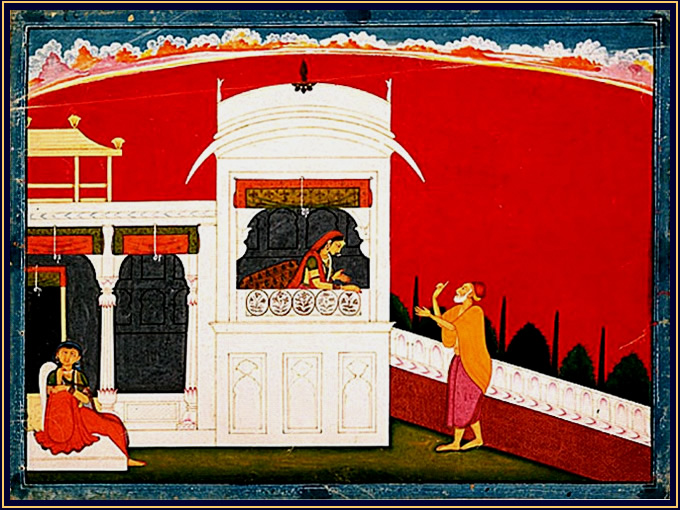
The first picture is called: 'princess Rukmini Receives
Krishna's Message',
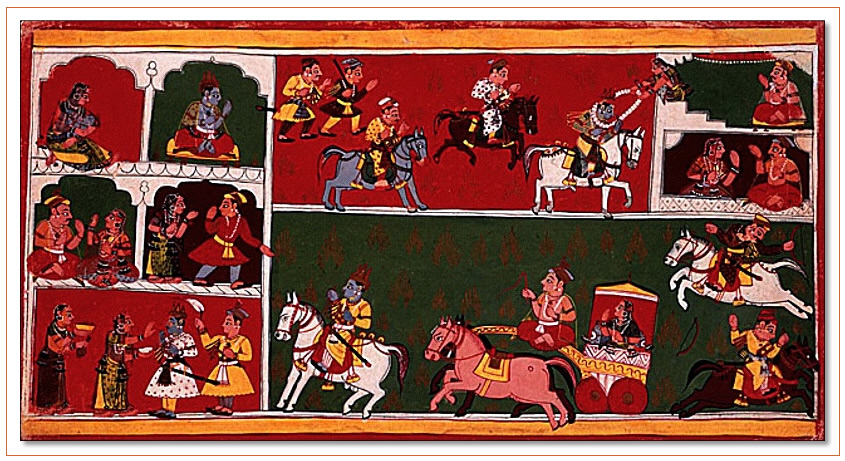
The second picture is titeled: 'Krishna abducts princess
Rukmini',
Folios from a Rukmini-Harana (Abduction of Rukmini) India,
Himachal Pradesh, Guler, South Asia, circa 1800.
Courtesy of LACMA.
Production: Filognostic Association of The Order of Time.

Feed-back | Links | Downloads | Music | Pictures | What's New | Search | Donations



 Text 1