

Canto 9
Chapter 10: The Pastimes of Lord Râmacandra
(1) S'rî S'uka said: 'From Khathvânga there was Dîrghabâhu, from him the renown and dexterous Raghu was born, from whose son Aja the great king Das'aratha was born. (2) Upon the prayers of the God-conscious souls the Absolute Truth took birth from his loins in four forms: the Supreme Lord in person along with three of His expansions. They, appearing as four sons, were known as Râma, Lakshmana, Bharata and S'atrughna.(3) Oh King, you heard again and again the descriptions by many seers and knowers of the truth of His transcendental exploits as the husband of Sîtâ [*, compare B.G. 4: 34]. (4-5) Obedient to His father He left the kingdom behind and wandered together with His beloved [Sîtâ] from forest to forest on His two lotus feet that were as tender as the palm of a hand. This He did in the company of Hanumân and Lakshmana who took away the pain of His path. He was separated from His sweetheart Sîtâ [by Râvana] because He had disfigured S'ûrpanakhâ [the sister of Râvana]. Over the ocean that was afraid of His eyebrows He raised in anger, a bridge was built [to Lankâ, the residence of Râvana], after which He, the king of Ayodhyâ, like a forest fire destroyed the envious ones. May the mercy be upon us of Him who in sage Vis'vâmitra's arena of sacrifice, in the presence of Lakshmana, killed the great chiefs of the Râkshasas who headed by Mârîca wandered in the dark.
(6-7) It was He who, among all the heroes in the world who were gathered in the hall where Sîtâ would select her husband, took up the mighty bow of S'iva that had to be carried by three hundred men. Fastening the string, oh King, and bending it, He broke the bow in two the way a baby elephant breaks a stick of sugarcane. By that victory he won the divine girl named Sîtâ who with her qualities, behavior, age and limbs was a perfect match for Him, she, the Goddess of Fortune, who had acquired a position on His chest. On His way home with her, He met and defeated the deep-rooted pride of Bhrigupati [Paras'urâma] who three times [seven, thus twenty one times] had rid the earth of the seed of the [burden of unrighteous] rulers [see 9.16]. (8) Bowing His head to the command of His father, who in his attachment had made a promise to his wife that Râma had to abandon the kingdom, residence, opulence, His relatives and friends, He with his wife left to live in the forest like a liberated soul [**]. (9) Living there He, as He wandered around, met with great difficulties. He maimed the body of the sister of the Râkshasa [Râvana] because she had a [by lust] spoiled mind. Thereupon He, with His invincible bow and arrows in His hands, had to kill the fourteen-thousand of her many friends headed by Khara, Tris'ira and Dûshana.
(10) Oh king, when the ten-headed Râvana heard the stories about Sîtâ, it stirred his heart and made him lust after seeing her. [The demon] Mârîca then lured Râma away from their stay in the form of a golden deer that was killed by Him with a sharp arrow, just as S'iva killed Daksha [with an ax, see 4.5: 22]. (11) While He and His brother were in the forest, the unprotected daughter of the king of Videha [or Janaka] was kidnapped by the most wicked Râkshasa, like he was a tiger. Râma then wandering around like a man who, attracted to women, is in distress over being separated from his wife, thus gave an example [in this s'ringâra rasa] of where attachment all leads to. (12) After having performed the funeral rites for him who had died for His sake [the eagle Jathâyu], He killed Kabandha [a headless monster] and became friends with the leaders of the monkey hordes so that He, informed by them about Sîtâ, could deliver her. He whose feet are worshiped by Brahmâ and S'iva, but appeared as a normal man, next killed Vâli [a wicked brother of Sugrîva]. Then He, accompanied by the monkey soldiers, proceeded to the shore of the ocean. (13) The [god of the] ocean, silent with fear because of His angry glance - from which all the crocodiles and sharks were agitated -, carried, in assuming a personal form, on his head all that was needed to worship Him and said, upon reaching the lotus feet, the following: (14) 'We, the dull-minded, are truly not capable, oh Supreme One, to know You as the one Original Person and Supreme Master of all Universes who resides in the core of the heart. For the God-conscious souls are the result of Your goodness, the controllers of the people have resulted from Your passion, while the rulers of the material elements sprang from Your mode of ignorance. But You, oh Lord, are the Master over all these modes. (15) You may cross [my waters] as You like! Just conquer that son of Vis'ravâ called Râvana who is like urine to the three worlds and thus regain Your wife, oh hero. Build a bridge here and Your fame will spread. In the future the great kings and heroes from all directions will glorify You for it.'
(16) After the Master of the Raghu dynasty with all sorts of mountain peaks complete with trees and plants, that were transported by hand by the mighty monkeys, had constructed a bridge in the ocean [***], He, helped by the directions of Vibhîshana [a virtuous brother of Râvana], together with the soldiers led by Sugrîva, Nîla and Hanumân, set foot on [the island of] Lankâ that just before had been set afire [by Hanumân's tail]. (17) There the houses of pleasure, granaries, treasuries, palace doors and city gates, assembly houses, turrets and [even the] pigeon houses were taken by force and dismantled by the Vânara [monkey] leaders who, just like an elephant herd, turned the squares and crossroads with all their flags and golden water pots on the rooftops, into one swirling river. (18) When the master of the Râkshasas saw that, he summoned Nikumbha, Kumbha, Dhûmrâksha, Durmukha, Surântaka, Narântaka and others to fight, and also called for his son Indrajit, his followers Prahasta, Atikâya, Vikampana and finally for Kumbhakarna [his mighty brother, see 4.1: 37, 7.1: 44 and 7.10: 36]. (19) All the Râkshasa soldiers with their hard to defeat swords, lances, bows, barbed missiles and spears, firebrands, javelins and scimitars [a curved sword], lined up in front of Him who was surrounded by Sugrîva, Lakshmana, Hanumân, Gandhamâda, Nîla, Angada, Riksha, Panasa and others.
(20) The commanders of the soldiers of the Ruler of the Raghu dynasty [Râma], together hurried forward to fight the enemy followers of Râvana, moving on foot and seated on elephants, chariots and horses, who, condemned by the anger of mother Sîtâ, were out of luck in the battle. With trees, mountain peaks, clubs and arrows they were all killed by the [monkey] warriors lead by Angada and others. (21) The Râkshasa leader seeing that his forces were defeated, thereupon fuming with anger drove his vehicle towards the brilliantly radiating Râma who, seated on the shining chariot of Indra that Mâtali [the driver] had brought, struck him with the sharpest arrows. (22) Râma said to him: 'You scum of the earth, since you, oh criminal, like a dog have kidnapped My helpless wife, I, as Time itself, as someone not failing in His heroism, will personally punish you today for that shameless act, you abominable evildoer [see also B.G. 16: 6-18]!'
(23) Thus rebuking him He released the arrow He had fixed on His bow, and that arrow pierced his heart like a thunderbolt. Vomiting blood from his ten mouths he fell down from his heavenly vehicle. His men then roared: 'Alas, what has happened to us?', just like pious people do when they fall down [see also B.G. 9: 21]. (24) Thereafter the many thousands of wives of the demons, headed by Mandodarî [Râvana's wife], came out of Lankâ and lamented upon approaching [their dead husbands]. (25) Embracing their beloved ones and their friends, who were all killed by Lakshmana's arrows, they beat their breasts and cried pitiably, which [to the victors] was pleasant to hear: (26) 'Oh alas, now he has been killed who protected all of us! Oh Râvana, cause of our cries, to whom must the state of Lankâ, bereft of your good self, turn for shelter, now it is defeated by the enemy? (27) Oh greatest patron, under the spell of lusty desires you, not knowing the influence of mother Sîtâ, have arrived at a situation like this. (28) Because of what you did, oh glory of the dynasty, we and the state of Lankâ are now without a protector, your body is there as fodder for the vultures and your soul is destined for hell [compare B.G. 16: 19].'
(29) S'rî S'uka said: 'Vibhîshana with the approval of the King of Kosala [Râma] performed for the family the funeral rites that for a deceased one have to be observed in order to save him from hell. (30) The Supreme Lord thereupon found His sweetheart [Sîtâ] back in an as'oka forest, sitting in a small cottage at the foot of a s'ims'apâ [as'oka] tree. Sick from being separated from Him she was emaciated. (31) Râma, seeing the poor plight of His sweetheart, was filled with compassion. When she saw her beloved, her lotuslike mouth was overwhelmed with a great joy. (32) The Supreme Lord put Vibhîshana in charge of the rule over Lankâ's Râkshasas for the duration of a kalpa. He placed Sîtâ on His vehicle and then Himself ascended together with Hanumân and the brothers [Lakshmana and Sugrîva the commander] to return to His home town [Ayodhyâ] and conclude the period of the vow [that He would stay away for fourteen years]. (33) To celebrate His uncommon activities He on His way was showered with a choice of fragrant flowers offered by the higher class and was joyfully praised by the seer of the Absolute Truth [Brahmâ] and those belonging to him. (34) Lord Râmacandra, the One of Great Compassion, was very sorry to hear that His brother Bharata was lying down on a kus'a mat, had matted locks, ate barley cooked in cow's urine and had covered Himself with tree bark.(35-38) Bharata, hearing about His arrival, took the two sandals on His head [that Râma had left behind on the throne to represent Him] and came, accompanied by all citizens, the ministers and the priests, to welcome His eldest brother. Departing from His camp Nandigrâma, He was accompanied by songs, the sounds of musical instruments, the constant recitation of mantras performed by brahmins, by gold embroidered flags on golden chariots that were pulled by the most beautiful, with gold caparisoned horses, and by soldiers in gold covered armor. Approaching in procession with nicely dressed courtesans and servants, as also with soldiers on foot and everything else that would befit a royal reception, like the wealth of all kinds of jewelry, He fell down at the lotus feet with an ecstatic love that softened the core of His [ascetic] heart and filled His eyes with tears. (39-40) Placing the two slippers before His brother, He stood with folded hands and tears in His eyes. He thereupon was embraced by Râma who, bathing Him with the water from His eyes, held Him in His arms for a long time. Râma, Lakshmana and Sîtâ together offered the scholars and the others worthy of worship personally their obeisances and also received these in return from all the citizens. (41) Seeing their Lord returning after so many years, the citizens of Kosala waved with their upper garments, offered Him garlands and began to dance in great jubilation. (42-43) The sandals were carried by Bharata, the whisk and luxurious fan were carried by Vibhîshana and Sugrîva, a white parasol was carried by the son of the wind god [Hanumân] and the bow and two quivers were carried by S'atrughna. Sîtâ held the waterpot with water from the holy places, Angada held the sword made of gold and the King of the Rikshas [Jâmbavân, the leader of the bears who also participated in the war] held the shield, oh King. (44) Sitting on Kuvera's heavenly chariot [the 'Pushpaka' captured from Râvana] He, the Supreme Lord devotedly being worshiped by the women and the reciters, oh King, appeared as brilliant as the moon risen among the planets.
(45-46) After properly being welcomed by His brother He was festively received in the city of Ayodhyâ. Upon entering the royal palace He paid mother Kaikeyî, His other stepmothers and His own mother [Kaus'alyâ] His respects. The spiritual teachers, friends of their age and the youngsters, were all of worship and their welcome was returned befittingly by Râma, the princess of the Videhas [Sîtâ] and Lakshmana. (47) The mothers reviving like bodies awakening from sleep, while keeping their sons on their lap, wetted them with a continuous flow of tears in letting go of their grief [over having been separated for so long]. (48) According to the vidhi the matted locks were shaven off by the family priest [Vashishthha] and the elders of the family, after which, with the water of the four oceans and other paraphernalia, a bathing ceremony was performed like it was done for King Indra [see 6: 13]. (49) Thus having been fully bathed, nicely dressed, decorated and garlanded, He shone brightly with His brothers and His wife. (50) Pleased with the surrender [of His brother] He accepted the throne offered to Him as also the citizens who, serving according to their nature with their status orientations [varnâs'rama identity, see B.G. 4: 13], all deserved His protection for that quality. Râma was therein just like a father and was by them therefore also accepted as their father.
(51) Although this all happened in Tretâ-yuga, the period became like Satya-yuga because of Râma's presence as the ruling king who with His full respect of dharma made all living beings happy [see also 12.3: 15]. (52) The forests, the rivers, the hills and the mountains, the lands, the islands, the oceans and the seas, offered all the living beings all they could wish for, oh best of the Bharatas. (53) During the period that Râma, the Lord in the Beyond, was king, there was no suffering [due to oneself, others and nature], no disease, old age, bereavement, distress, lamentation, fear and exhaustion, nor an unwanted death. (54) Having sworn that He would not take another woman [for reasons of principle He separated from Sîtâ, see next chapter] He, as a saintly king pure in His character and dharma, by His personal dutifulness was an example, [in particular] for the householders. (55) Sîtâ, in loving service of her husband, was, because of her good character, always humble and submissive. Being chaste and afraid [to make mistakes], she bashfully with understanding for her husband's position captivated His mind.'
Third revised edition, loaded December 15, 2019.
Previous Aadhar edition and Vedabase links:
S'rî S'uka said: 'From Khathvânga there was Dîrghabâhu, from him the renown and dexterous Raghu was born, from whose son Aja the great king Das'aratha was born.S'rî S'uka said: 'From Khathvânga there was Dîrghabâhu, from him was the renown and dexterous Raghu born, from whose son Aja was born the great king Das'aratha. (Vedabase)
Upon the prayers of the God-conscious souls the Absolute Truth took birth from his loins in four forms: the Supreme Lord in person along with three of His expansions. They, appearing as four sons, were known as Râma, Lakshmana, Bharata and S'atrughna.
Upon the prayers of the God-conscious was there from him the Absolute Truth in four forms with the Supreme Lord in person and three expansions of Him; they appearing as four sons were thus known as Râma, Lakshmana, Bharata and S'atrughna. (Vedabase)
Oh King, you heard again and again the descriptions by many seers and knowers of the truth of His transcendental exploits as the husband of Sîtâ [compare B.G. 4: 34].
Of His transcendental exploits as the husband of Sîtâ, o King, have you more than enough [*] heard through the nice descriptions by the many seers and knowers of the Reality [compare B.G. 4: 34]. (Vedabase)
Obedient to His father He left the kingdom behind and wandered together with His beloved [Sîtâ] from forest to forest on His two lotus feet that were as tender as the palm of a hand. This He did in the company of Hanumân and Lakshmana who took away the pain of His path. He was separated from His sweetheart Sîtâ [by Râvana] because He had disfigured S'ûrpanakhâ [the sister of Râvana]. Over the ocean that was afraid of His eyebrows He raised in anger, a bridge was built [to Lankâ, the residence of Râvana], after which He, the king of Ayodhyâ, like a forest fire destroyed the envious ones. May the mercy be upon us of Him who in sage Vis'vâmitra's arena of sacrifice, in the presence of Lakshmana, killed the great chiefs of the Râkshasas who headed by Mârîca wandered in the dark.
Faithful to the teachings [answering to a promise his father made] abandoned He the royal position and wandered He, accompanied by His loved ones [Sîtâ and Lakshmana] who relieved Him of His fatigue on the path, from forest to forest on His bare lotus feet that were as tender to the touch as a hand palm. He was [by Râvana] separated from His sweetheart Sîtâ because of disfiguring S'ûrpanakhâ [the sister of Râvana who got her nose cut off] and found support with the king of the monkeys [Hanumân]. Over the ocean, that was afraid of His eyebrows raised in anger, was a bridge constructed [to Lankâ, the residence of Râvana] and became He, like a forestfire burning the envious ones, the king of Ayodhyâ. May His mercy be upon us. (Vedabase)With a [as'vamedha] sacrifice of Vis'vâmitra was His honor defended of indeed under the supervision of Lakshmana, having killed the wanderers of the dark headed by Mârîca, the great chiefs of the Râkshasas. (Vedabase)
It was He who, among all the heroes in the world who were gathered in the hall where Sîtâ would select her husband, took up the mighty bow of S'iva that had to be carried by three hundred men. Fastening the string, oh King, and bending it, He broke the bow in two the way a baby elephant breaks a stick of sugarcane. By that victory he won the divine girl named Sîtâ who with her qualities, behavior, age and limbs was a perfect match for Him, she, the Goddess of Fortune, who had acquired a position on His chest. On His way home with her, He met and defeated the deep-rooted pride of Bhrigupati [Paras'urâma] who three times [seven, thus twenty one times] had rid the earth of the seed of the [burden of unrighteous] rulers [see 9.16].
It was He who of all the heroes in the world in the hall where Sîtâ would select her husband took up the mighty bow of S'iva that had to be carried by three hundred men. Fastening the string, o King, and bending it broke He the bow in two the way a baby elephant breaks a stick of sugar cane. With first by the victory gaining to His chest the divine girl named Sîtâ, who in her qualities, behavior, age and limbs was a perfect match for Him, met and defeated He on his way home with her the deep-rooted pride of Bhrigupati [Paras'urâma] who three times [seven, thus twenty one times] had rid the earth [of its burden of unrighteous rulers] that now without royalty had Him as the seed [see 9.16]. (Vedabase)
Bowing His head to the command of His father, who in his attachment had made a promise to his wife that Râma had to abandon the kingdom, residence, opulence, His relatives and friends, He with his wife left to live in the forest like a liberated soul [**].
He had indeed to the order on His head of His father, who so very attached had made a promise to his wife [**], to accept that He had to abandon the kingdom, residence, opulence, relatives and friends and go live in the forest like a liberated soul. (Vedabase)
Living there He, as He wandered around, met with great difficulties. He maimed the body of the sister of the Râkshasa [Râvana] because she had a [by lust] spoiled mind. Thereupon He, with His invincible bow and arrows in His hands, had to kill the fourteen-thousand of her many friends headed by Khara, Tris'ira and Dûshana.
With Him, wandering through the forest living a life of hardship, was the body of the Râkshasa [Râvana] his sister maimed because she had a mind foul of lust and were, with in His hands His invincible bow and arrows, the fourteen-thousand of her many friends headed by Khara, Tris'ira and Dûshana, killed by Him. (Vedabase)
Oh king, when the ten-headed Râvana heard the stories about Sîtâ, it stirred his heart and made him lust after seeing her. [The demon] Mârîca then lured Râma away from their stay in the form of a golden deer that was killed by Him with a sharp arrow, just as S'iva killed Daksha [with an ax, see 4.5: 22].
O ruler of man, hearing the stories about Sîtâ, stirred the heart of ten-head Râvana and made him lust to see her. Mârîca in the form of a golden deer then lured Him away from their stay and was, like S'iva did with Daksha [see 4.5: 22], by Him killed on the spot with a sharp arrow. (Vedabase)
While He and His brother were in the forest, the unprotected daughter of the king of Videha [or Janaka] was kidnapped by the most wicked Râkshasa, like he was a tiger. Râma then wandering around like a man who, attracted to women, is in distress over being separated from his wife, thus gave an example [in this s'ringâra rasa] of where attachment all leads to.
With Him together with His brother in the forest, was the unprotected daughter of the king of Videha [Janaka] by the tiger, the most wicked Râkshasa, kidnapped and wandered He around posing as a man who attached to women is in distress over being separated from his dearest wife, thus giving an example [s'ringâra-rasa] of what attachment leads to. (Vedabase)
After having performed the funeral rites for him who had died for His sake [the eagle Jathâyu], He killed Kabandha [a headless monster] and became friends with the leaders of the monkey hordes so that He, informed by them about Sîtâ, could deliver her. He whose feet are worshiped by Brahmâ and S'iva, but appeared as a normal man, next killed Vâli [a wicked brother of Sugrîva]. Then He, accompanied by the monkey soldiers, proceeded to the shore of the ocean.
After cremating the one who had died for His sake [the eagle Jathâyu], killed He Kabandha [a headless monster] and made He friends with the leaders of the monkey hordes in order to free Sîtâ. He whose feet are worshiped by Brahmâ and S'iva, but appeared as a normal man, next in their acquaintance killed Vâli [a wicked brother of Hanumân] and proceeded, accompanied by the monkey soldiers, to the shore of the ocean. (Vedabase)
The [god of the] ocean, silent with fear because of His angry glance - from which all the crocodiles and sharks were agitated -, carried, in assuming a personal form, on his head all that was needed to worship Him and said, upon reaching the lotus feet, the following:
The ocean silent of fear because of His angry glance - of which all the crocodiles and sharks were agitated - carried, assuming a personal form, on its head all that was needed to worship Him and said, reaching the lotus feet, the following: (Vedabase)
'We, the dull-minded, are truly not capable, oh Supreme One, to know You as the one Original Person and Supreme Master of all Universes who resides in the core of the heart. For the God-conscious souls are the result of Your goodness, the controllers of the people have resulted from Your passion, while the rulers of the material elements sprang from Your mode of ignorance. But You, oh Lord, are the Master over all these modes.
'We, the dull-minded, are truly not capable of, o Supreme One, knowing You as residing in the core of the heart as the Original Person and Supreme Master of all Universes; the God-conscious under Your direction fixed in their attention are infatuated with goodness, the controllers of the people are infatuated with passion, while the rulers of the physical existence are [as ghosts] under the influence of slowness, but Your Lordship art in Your position the Master over these modes. (Vedabase)
You may cross [my waters] as You like! Just conquer that son of Vis'ravâ called Râvana who is like urine to the three worlds and thus regain Your wife, oh hero. Build a bridge here and Your fame will spread. In the future the great kings and heroes from all directions will glorify You for it.'
You may cross as you like! Just conquer that son of Vis'ravâ called Râvana, that urine pollution of the three worlds, and regain Your wife o hero. Build a bridge here so that Your fame may spread; the great kings and heroes still to come will all glorify You for it.' (Vedabase)
After the Master of the Raghu dynasty with all sorts of mountain peaks complete with trees and plants, that were transported by hand by the mighty monkeys, had constructed a bridge in the ocean [***], He, helped by the directions of Vibhîshana [a virtuous brother of Râvana], together with the soldiers led by Sugrîva, Nîla and Hanumân, set foot on [the island of] Lankâ that just before had been set afire [by Hanumân's tail].
After the Master of the Raghu dynasty with all sorts of mountain peaks, complete with trees and plants, that were transported by hand by the mighty monkeys, had constructed a bridge in the ocean [***], entered He, helped by the directions of Vibhîshana [a virtuous brother of Râvana], with the soldiers led by Sugrîva, Nîla and Hanumân [the island of] Lankâ that just before had been set afire [by Hanumân's tail]. (Vedabase)
There the houses of pleasure, granaries, treasuries, palace doors and city gates, assembly houses, turrets and [even the] pigeon houses were taken by force and dismantled by the Vânara [monkey] leaders who, just like an elephant herd, turned the squares and crossroads with all their flags and golden water pots on the rooftops, into one swirling river.
Right there were the houses of pleasure, granaries, treasuries, palace doors and city gates, assembly houses, palace frontages and [even the] pigeon houses by force taken in and dismantled by the Vânara [monkey people]-leaders who like an elephant herd turned the squares and crossroads, with all their flags and golden waterpots on the rooftops into one swirling river. (Vedabase)
When the master of the Râkshasas saw that, he summoned Nikumbha, Kumbha, Dhûmrâksha, Durmukha, Surântaka, Narântaka and others to fight, and also called for his son Indrajit, his followers Prahasta, Atikâya, Vikampana and finally for Kumbhakarna [his mighty brother, see 4.1: 37, 7.1: 44 and 7.10: 36].
When the master of the Râkshasas saw that summoned he Nikumbha, Kumbha, Dhûmrâksha, Durmukha, Surântaka, Narântaka and others to fight, and called he as well for his son Indrajit, his followers Prahasta, Atikâya, Vikampana and finally for Kumbhakarna [his mighty brother, see 4.1: 37, 7.1: 44 and 7.10: 36]. (Vedabase)
All the Râkshasa soldiers with their hard to defeat swords, lances, bows, barbed missiles and spears, firebrands, javelins and scimitars [a curved sword], lined up in front of Him who was surrounded by Sugrîva, Lakshmana, Hanumân, Gandhamâda, Nîla, Angada, Riksha, Panasa and others.
All the râkshasa soldiers with hard to defeat swords, lances, bows, barbed missiles and spears, firebrands, javelins and scimitars [a curved sword] came in front of Him who was surrounded by Sugrîva, Lakshmana, Hanumân, Gandhamâda, Nîla, Angada, Riksha, Panasa and others. (Vedabase)
The commanders of the soldiers of the Ruler of the Raghu dynasty [Râma], together hurried forward to fight the enemy followers of Râvana moving on foot and seated on elephants, chariots and horses who, condemned by the anger of mother Sîtâ, were out of luck in the battle. With trees, mountain peaks, clubs and arrows they were all killed by the [monkey] warriors lead by Angada and others.
The commanders of the soldiers of the Ruler of the Raghu dynasty, together out to defeat all the enemies, fought the hordes by elephant, on foot, from chariots and on horseback. By the warriors lead by Angada and others were they with trees, mountain peaks, clubs and arrows all killed as the luck of Râvana's dependents had ran out being condemned by the anger of mother Sîtâ. (Vedabase)
The Râkshasa leader seeing that his forces were defeated, thereupon fuming with anger drove his vehicle towards the brilliantly radiating Râma who, seated on the shining chariot of Indra that Mâtali [the driver] had brought, struck him with the sharpest arrows.
The râkshasa leader fuming of seeing his forces defeated thereupon drove his vehicle forward proceeding towards the effulgent Râma who, glittering on the chariot of Indra that Mâtali [the driver] had brought, struck him with the sharpest arrows. (Vedabase)
Râma said to him: 'You scum of the earth, since you, oh criminal, like a dog have kidnapped My helpless wife, I, as Time itself, as someone not failing in His heroism, will personally punish you today for that shameless act, you abominable evildoer [see also B.G. 16: 6-18]!'
Râma said to him: 'You servant of scum, since you criminal like a dog have kidnapped My helpless wife will I as the Time itself in person, will I unfailing in my heroism, for that shameless act, as a result today punish you, abominable evildoer [see also B.G. 16: 6-18]!' (Vedabase)
Thus rebuking him He released the arrow He had fixed on His bow, and that arrow pierced his heart like a thunderbolt. Vomiting blood from his ten mouths he fell down from his heavenly vehicle. His men then roared: 'Alas, what has happened to us?', just like pious people do when they fall down [see also B.G. 9: 21].
Thus rebuking him released He the arrow He had fixed on His bow and that arrow like a thunderbolt pierced his heart. Vomiting blood from his ten mouths he fell from his heavenly vehicle while all his folk roared: 'Alas, what befell us?', just like the pious do when they fall down [see also B.G. 9: 21]. (Vedabase)
Thereafter the many thousands of wives of the demons, headed by Mandodarî [Râvana's wife], came out of Lankâ and lamented upon approaching [their dead husbands].
Thereafter came the wives of the demons headed by Mandodarî [Râvana's wife] out of Lankâ and lamented they upon approaching [their dead husbands]. (Vedabase)
Embracing their beloved ones and their friends, who were all killed by Lakshmana's arrows, they beat their breasts and cried pitiably, which [to the victors] was pleasant to hear:
Embracing their beloved and friends all killed by Lakshmana's arrows beated they, so poor, their breasts and cried they, [for the victors] pleasant to hear, piteously: (Vedabase)
'Oh alas, now he has been killed who protected all of us! Oh Râvana, cause of our cries, to whom must the state of Lankâ, bereft of your good self, turn for shelter, now it is defeated by the enemy?
'O alas, killed is he who in the past protected us all! O, Râvana, cause of our cries, to whom must the state of Lankâ, overcome by the enemy, turn for shelter, now that it is bereft of your good self? (Vedabase)
Oh greatest patron, under the spell of lusty desires you, not knowing the influence of mother Sîtâ, have arrived at a situation like this.
O greatest patron, as a result of having fallen under the influence of lusty desires, had you really no idea of how mother Sîtâ could put you in a situation like this. (Vedabase)
Because of what you did, oh glory of the dynasty, we and the state of Lankâ are now without a protector, your body is there as fodder for the vultures and your soul is destined for hell [compare B.G. 16: 19].'
O glory of the dynasty, because of what you did are we and the state of Lankâ now without a protector and is your body there as fodder for the vultures and your soul destined for hell [compare B.G. 16: 19].' (Vedabase)
S'rî S'uka said: 'Vibhîshana with the approval of the King of Kosala [Râma] performed for the family the funeral rites that for a deceased one have to be observed in order to save him from hell.
S'rî S'uka said: 'On the approval of the King of Kosala [Râma] performed, of the [Râvana] family, Vibhîshana the funeral rites that for a deceased one have to be observed to save him from hell. (Vedabase)
The Supreme Lord thereupon found His sweetheart [Sîtâ] back in an as'oka forest, sitting in a small cottage at the foot of a s'ims'apâ [as'oka] tree. Sick from being separated from Him she was emaciated.
Next found the Supreme Lord in an as'oka forest His love back taking shelter in a small cottage at the foot of a s'ims'apâ [as'oka] tree, very lean from suffering the separation from Him. (Vedabase)
Râma, seeing the poor plight of His sweetheart, was filled with compassion. When she saw her beloved, her lotuslike mouth was overwhelmed with a great joy.
Râma finding His dearmost wife so poor off became very compassionate with her while her lotus-like mouth, the moment she saw her beloved, was overwhelmed by a great joy. (Vedabase)
The Supreme Lord put Vibhîshana in charge of the rule over Lankâ's Râkshasas for the duration of a kalpa. He placed Sîtâ on His vehicle and then Himself ascended together with Hanumân and the brothers [Lakshmana and Sugrîva the commander] to return to His home town [Ayodhyâ] and conclude the period of the vow [that He would stay away for fourteen years].
The Supreme Lord, putting Vibhîshana in charge of the rule over Lankâ's Râkshasas for the duration of a kalpa, placed her on his vehicle and got in Himself together with Hanumân and the brothers [Lakshmana and Sugrîva the commander] to return to the home town [Ayodhyâ] and to conclude the term of the vow [to stay away for 14 years]. (Vedabase)
To celebrate His uncommon activities He on His way was showered with a choice of fragrant flowers offered by the higher class and was joyfully praised by the seer of the Absolute Truth [Brahmâ] and those belonging to him.
On the road was He showered by a choice of fragrant flowers offered by the higher class to honor His uncommon activities and were the seer of the absolute truth [Brahmâ] and those belonging to him of great jubilation. (Vedabase)
Lord Râmacandra, the One of Great Compassion, was very sorry to hear that His brother Bharata was lying down on a kus'a mat, had matted locks, ate barley cooked in cow's urine and had covered Himself with tree bark.
The One of Great Compassion was very sorry to hear how His brother Bharata with matted locks was lying down on a kus'a mat, ate from barley cooked in cows urine and had covered Himself with tree bark. (Vedabase)
Bharata, hearing about His arrival, took the two sandals on His head [that Râma had left behind on the throne to represent Him] and came, accompanied by all citizens, the ministers and the priests, to welcome His eldest brother. Departing from His camp Nandigrâma, He was accompanied by songs, the sounds of musical instruments, the constant recitation of mantras performed by brahmins, by gold embroidered flags on golden chariots that were pulled by the most beautiful, with gold caparisoned horses, and by soldiers in gold covered armor. Approaching in procession with nicely dressed courtesans and servants, as also with soldiers on foot and everything else that would befit a royal reception, like the wealth of all kinds of jewelry, He fell down at the lotus feet with an ecstatic love that softened the core of His [ascetic] heart and filled His eyes with tears.
Bharata hearing of the arrival took the two sandals on His head [that Râma had left behind on the throne to represent Him] and went, accompanied by all citizens, the ministers and the priests, out to welcome His eldest brother. Departing from His camp Nandigrâma were there songs, the sounds of musical instruments, the constant recitation of mantras by brahmins, with gold embroidered flags on golden chariots pulled by the most beautiful, with gold caparisoned, horses and soldiers in gold-covered armor. In procession with nicely dressed courtesans and servants and also soldiers on foot and everything else that would befit a royal reception, like a wealth of all kinds of jewelry, fell He down at the lotus feet in an ecstatic love that softened the core of His [ascetic] heart and filled His eyes with tears. (Vedabase)
Placing the two slippers before His brother, He stood with folded hands and tears in His eyes. He thereupon was embraced by Râma who, bathing Him with the water from His eyes, held Him in His arms for a long time. Râma, Lakshmana and Sîtâ together offered the scholars and the others worthy of worship personally their obeisances and also received these in return from all the citizens.
Placing the two slippers with folded hands before His golden brother embraced He Him with His cheeks wet, bathing Him in His arms for a long time with the water from His eyes. Râma, together with Lakshmana and Sîtâ, personally offered the learned and the others worthy of worship their obeisances and received them also back from all the citizens. (Vedabase)
Seeing their Lord returning after so many years, the citizens of Kosala waved with their upper garments, offered Him garlands and began to dance in great jubilation.
Seeing their Lord returning after so many years waved the citizens of Kosala with their upper garments, offered they Him garlands and started they to dance in great jubilation. (Vedabase)
The sandals were carried by Bharata, the whisk and luxurious fan were carried by Vibhîshana and Sugrîva, a white parasol was carried by the son of the wind god [Hanumân] and the bow and two quivers were carried by S'atrughna. Sîtâ held the waterpot with water from the holy places, Angada held the sword made of gold and the King of the Rikshas [Jâmbavân, the leader of the bears who also participated in the war] held the shield, oh King.
The sandals were carried by Bharata, the whisk and luxurious fan by Vibhîshana and Sugrîva, a white parasol by the son of the Maruts [Hanumân], the bow and two quivers by S'atrughna, Sîtâ had the waterpot with water from the holy places, Angada had the sword made of gold and the King of the Rikshas [Jâmbavân, leader of the bears that also assisted in the war] held the shield, o King. (Vedabase)
Sitting on Kuvera's heavenly chariot [the 'Pushpaka' captured from Râvana] He, the Supreme Lord devotedly being worshiped by the women and the reciters, oh King, appeared as brilliant as the moon risen among the planets.
To sit on Kuvera's heavenly chariot [the 'Pushpaka' captured from Râvana] made Him, the Supreme Lord, with the worshipful prayers of the women and the reciters, o King, appear as beautiful as the moon risen between the planets. (Vedabase)
After properly being welcomed by His brother He was festively received in the city of Ayodhyâ. Upon entering the royal palace He paid mother Kaikeyî, His other stepmothers and His own mother [Kaus'alyâ] His respects. The spiritual teachers, friends of their age and the youngsters, were all of worship and their welcome was returned befittingly by Râma, the princess of the Videhas [Sîtâ] and Lakshmana.
Properly welcomed by His brother was He thereafter festively received in the city of Ayodhyâ. Upon entering the royal palace paid He mother Kaikeyî, His other stepmothers and His own mother [Kaus'alyâ] His respects. The spiritual teachers, friends of their age and the younger ones were all of worship and befittingly was the welcome returned by Him, the princess of the Videhas [Sîtâ] and Lakshmana. (Vedabase)
The mothers reviving like bodies awakening from sleep, while keeping their sons on their lap, wetted them with a continuous flow of tears in letting go of their grief [over having been separated for so long].
As bodies awakening from sleep rose their mothers to their feet and moistened they, keeping their sons on their lap, them with a continuous flow of tears as they gave up their grief [of being separated for so long from them]. (Vedabase)
According to the vidhi the matted locks were shaven off by the family priest [Vashishthha] and the elders of the family, after which, with the water of the four oceans and other paraphernalia, a bathing ceremony was performed like it was done for King Indra [see 6: 13].
Shaving off the matted locks, was by the family priest and the elders of the family according the vidhi with the water of the four oceans and other paraphernalia a bathing ceremony performed to the like of the purification of King Indra [see 6: 13]. (Vedabase)
Thus having been fully bathed, nicely dressed, decorated and garlanded, He shone brightly with His brothers and His wife.
Thus having been bathed completely, nicely dressed, decorated and garlanded, shone He brightly with His brothers and His wife. (Vedabase)
Pleased with the surrender [of His brother] He accepted the throne offered to Him as also the citizens who, serving according to their nature with their status orientations [varnâs'rama identity, see B.G. 4: 13], all deserved His protection for that quality. Râma was therein just like a father and was by them therefore also accepted as their father.
Pleased with the surrender He accepted the throne submitted to Him by His brother and also the citizens who, engaged in the occupational duties of their status-orientations [varnâs'rama, see B.G. 4: 13], all had become fit for His protection; Râma was therein just like a father and by them was He also considered as being their father. (Vedabase)
Although this all happened in Tretâ-yuga, the period became like Satya-yuga because of Râma's presence as the ruling king who with His full respect of dharma made all living beings happy [see also 12.3: 15].
Although it was Tretâ-yuga became the period equal to Satya-yuga because of Râma's presence as the ruling king in full respect of the dharma that makes all living beings happy [see also 12.3: 15]. (Vedabase)
The forests, the rivers, the hills and the mountains, the lands, the islands, the oceans and the seas, offered all the living beings all they could wish for, oh best of the Bharatas.
The forests, rivers, hills and mountains, the lands, the islands, the oceans and the seas yielded for all the living beings all they could desire for their existence, o best of the Bharatas. (Vedabase)
During the period that Râma, the Lord in the Beyond, was king, there was no suffering [due to oneself, others and nature], no disease, old age, bereavement, distress, lamentation, fear and exhaustion, nor an unwanted death.
There was no suffering [due to oneself, others and nature], no disease, old age, bereavement, distress, lamentation, fear and fatigue or an unwanted death during the period that Lord Râma, the One beyond All, was king. (Vedabase)
Having sworn that He would not take another woman [for reasons of principle He separated from Sîtâ, see next chapter] He, as a saintly king pure in His character and dharma, by His personal dutifulness was an example, [in particular] for the householders.
Vowed not to take another woman [for reasons of principle He separated from Sîtâ, see next Chapter] was He, as a saintly King pure of character in His dharma, especially teaching the householders by the example of His personal dutifulness.(Vedabase)
Sîtâ, in loving service of her husband, was, because of her good character, always humble and submissive. Being chaste and afraid [to make mistakes], she bashfully with understanding for her husband's position captivated His mind.'
In loving service unto her husband was Sîtâ by her good character always submissive and ready to please, and captivated she His mind being chaste and unafraid, bashfully and understanding her husband's position.' (Vedabase)
*: This and the next chapter are a summary of Vâlmîki's Râmâyana, the original scripture describing the st0ry of Râma.
**: Prabhupâda explains: 'Mahârâja Das'aratha had three wives. One of them, Kaikeyî, served him very pleasingly, and he therefore wanted to give her a benediction. Kaikeyî, however, said that she would ask for the benediction when it was necessary. At the time of the coronation of Prince Râmacandra, Kaikeyî requested her husband to enthrone her son Bharata and send Râmacandra to the forest. Mahârâja Das'aratha, being bound by his promise, ordered Râmacandra to go to the forest, according to the dictation of his beloved.'
***: This bridge is today still present in the form of a narrow passage of land close to the surface of the ocean between Lanka and India. It is called the Adam's Bridge and consists of a chain of shoals, c.18 miles (30 km) long [see picture and article].


The text and audio are offered under the conditions of
the
Creative
Commons Attribution-Noncommercial-Share Alike 3.0 Unported
License.
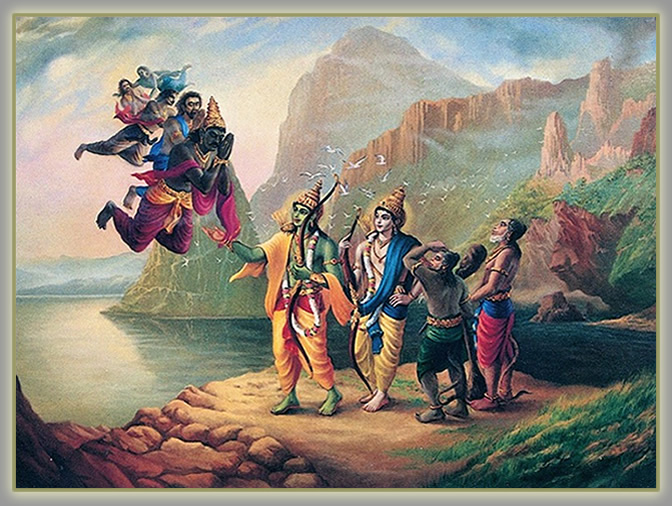
The first
painting on this page shows the meeting of Râma and Lakshmana in
the forest with Hanumân.
The second painting shows the meeting between Râma and
Vibhis'ana. Both are © of Vrindavan das. Used with
permission.
Production: Filognostic
Association of The Order of Time

Feed-back | Links | Downloads | Music | Pictures | What's New | Search | Donations





 Text 1