

Canto 10
Canto 10
Chapter 24: Krishna Defies Indra in Favor of the Brahmins, the Cows and Govardhana Hill
(1) S'rî S'uka said: 'The Supreme Lord staying there [in Vraja] in the company of Baladeva, saw how the gopas were busily engaged in arranging a sacrifice for Lord Indra. (2) Even though the Supreme Lord, the Omniscient Soul of Everyone, knew everything about it [see B.G. 9: 23], He bowed down humbly and inquired of the elderly headed by Nanda [His stepfather]: (3) 'Tell Me, dear father, what is all this goings-on of you about? Where does it lead to, for whom is it done and what are the means by which this sacrifice is accomplished? (4) Please tell Me about it. I have this great desire to hear about it, oh father. Surely it cannot be so that the activities of saintly men, equal towards everyone in this world, being indifferent about mine and thine, and neutral towards friends and foes, are something to be secretive about, is it? (5) A stranger one may avoid like he is an enemy, but a friend one should treat like oneself, so they say. (6) When common people do something in the world, they sometimes engage with knowledge and sometimes they engage without. Engaging with expertise one achieves an optimal result and with ignorant actions that is not the case. (7) With that being said, I ask you whether this combined effort of yours is something that is prescribed [in the scriptures] or just a custom. That you should explain clearly to Me.'
(8) S'rî Nanda said: 'Indra is the great lord of the rain and the clouds are his personal representatives. They provide the rain for all living beings. Rain is the gratifying life force, just like milk. (9) Because of the liquid discharged by this lord and master of the clouds, my dear son, we - and also other people - worship him with fire sacrifices and various paraphernalia. (10) With the remnants of those sacrifices people sustain their lives in three different ways [religiously, economically and sensually]. He is the superhuman being who brings the fruits to those who from their human actions expect a certain yield [like farmers]. (11) Anyone who rejects this dharma [of sacrificing to Indra] that was handed down by tradition, is a person who, because of lust, enmity, fear and greed, cannot find happiness in life [see B.G. 10: 36].'
(12) S'rî S'uka said: 'After having heard Nanda's words and also what the other residents of Vraja had to say, Lord Kes'ava spoke to His father in a way that made Lord Indra angry. (13) The Supreme Lord said: 'It is because of karma that a living entity takes birth and it is by [the force of] his karma alone that he meets his demise. Happiness or unhappiness, security and fear are all the result of one's karma. (14) If there would be some controller who awards others the fruit of their actions, then that ruler still depends on those who engage in action. After all, he cannot be the master of someone who does nothing! (15) Living beings have to face the consequences of their actions, what have they to do with Indra who cannot change what is determined by their own nature? (16) A person is controlled by his nature - he follows his nature. This entire world with its gods, demons and common men, exists on the basis of everyone's personal nature. (17) Living beings as a consequence of their actions obtain and forsake higher and lower evolved bodies. Karma alone is their enemy, friend and impartial judge, their Lord and their teacher [see also B.G. 8: 15 & 16, 4.29: 26-27 and 7.7: 46-47]. (18) One should therefore, keeping to one's duties, exercise respect for the karma of one's own nature [see varnâs'rama]. One lives rightly by that karma, it is no doubt someone's worshipable deity. (19) The way an unfaithful woman, resorting to another living being, does not gain any real benefit with her lover, it is also not to someone's advantage to prefer a thing [or deity] different from the one sustaining one's life. (20) The brâhmanas maintain their life [by teaching and explaining] the Vedas, the kshatriyas by protecting the land, the vaishyas by trading and the s'ûdras by serving the twice-born souls [the former three classes, see also 7.11: 21-24]. (21) The fourfold occupational duty of the vaishya consists of farming, trading, cow protection and banking as the fourth. Among these the constant care for the cows is the duty we are engaged in. (22) [The natural qualities of] goodness, passion and ignorance are the cause of the maintenance, creation and destruction [in the world. See guna]. From the quality of passion this universe is generated and from the mutual [sexual] action therein we find the [biological] diversity of this world. (23) The clouds, impelled by that passion, pour down their water everywhere, and by that water they factually maintain the population. So what would Indra then do? (24) The cities, the cultivated lands and the villages are not the places where we are at home. We are the forest people, dear father, we always live in the forests and the hills. (25) Let us therefore begin with a sacrifice for the cows, the brahmins and the hill [Govardhana], and use for this worship the paraphernalia of Indra's sacrifice [see also footnote 10.8*3]! (26) Let us cook all sorts of preparations and soups, beginning with sweet rice, porridge, buns and cakes, and let us use all kinds of dairy products. (27) Let there be properly prayed before the fires by brahmins versed in the Vedas whom you should feed with well prepared dishes and reward with cows and other gifts. (28) To act appropriately in respect of everyone, also should be thought of others: fallen souls like dogs and outcasts. After next having given grass to the cows the offerings should be presented to the mountain. (29) After having eaten our fill, we in our best clothes, being smeared with sandalwood pulp and nicely adorned, should circumambulate the cows, the brahmins, the fires and the hill [always kept to the right]. (30) This is my view, oh father, may it be done, if you please. This will not only be dear to the brahmins, the cows and the hill, but also to Me.'
(31) S'rî S'uka said: 'When Nanda and the elders heard these words being spoken by the Supreme Lord, by the Time in person, in order to break the pride of Indra, they accepted them as excellent. (32-33) And so they executed everything Madhusûdana had spoken about: they arranged for the auspicious recitations, they all together respectfully paid tribute to the hill and the brahmins with the paraphernalia mentioned, they offered grass to the cows, the bulls and the calves, and next they circumambulated the hill with the animals in front of them. (34) The cowherd women, nicely ornamented and riding wagons that were yoked with oxen, sang the glories of S'rî Krishna, while the twice-born souls chanted their benedictions. (35) To instill faith in the gopas, Krishna thereupon assumed another form. Saying 'I am the hill' He devoured the abundance of offerings with the immensity of His body [see vapu and footnote *]. (36) Together with the people of Vraja He, by means of Himself, offered His obeisances to Himself: 'Oh, just see, how this hill, by assuming its form, has bestowed His mercy upon us!'

Third revised edition, loaded September 20, 2020.
Previous Aadhar edition and Vedabase links:
S'rî S'uka said: 'The Supreme Lord staying there [in Vraja] in the company of Baladeva, saw how the gopas were busily engaged in arranging a sacrifice for Lord Indra.S'rî S'uka said: 'The Supreme Lord staying in that very place [of Vraja] accompanied by Baladeva also, saw how the gopas were very busy arranging for a sacrifice to Indra. (Vedabase)
Even though the Supreme Lord, the Omniscient Soul of Everyone, knew everything about it [see B.G. 9: 23], He bowed down humbly and inquired of the elderly headed of Nanda [His stepfather]:
Even though the Supreme Lord, the Soul of All Seeing All, knew what that meant [see B.G. 9: 23], bowed He down humbly and inquired He with the elders lead by Nanda [His stepfather]: (Vedabase)
'Tell Me, dear father, what is all this goings-on of you about? Where does it lead to, for whom is it done and what are the means by which this sacrifice is accomplished?
'Tell Me, dear father, what all this fuss is you're put up with, were does it lead to, for whom is it done and by what means is this sacrifice to be accomplished? (Vedabase)
Please tell Me about it. I have this great desire to hear about it, oh father. Surely it cannot be so that the activities of saintly men, equal towards everyone in this world, being indifferent about mine and thine, and neutral towards friends and foes, are something to be secretive about, is it?
Please tell Me about it, I have this great desire to hear that from you o father; surely can the activities found here of the saintly equal to all - equal in what is theirs or of others or who is a friend and enemy or neutral - not be something to be secretive about, is it? (Vedabase)
A stranger one may avoid like he is an enemy, but a friend one should treat like oneself, so they say.
An indifferent person is just like an enemy to be avoided while an ally is to be treated like one's own self so they say. (Vedabase)
When common people do something in the world, they sometimes engage with knowledge and sometimes they engage without. Engaging with expertise one achieves an optimal result and with ignorant actions that is not the case.
People perform these activities very well knowing what they do, but also when they have no clue; for those who in wisdom know what they do can the perfection be found with the labor one performs, but for the foolish without any notion is that perfection not in view. (Vedabase)
With that being said, I ask you whether this combined effort of yours is something that is prescribed [in the scriptures] or just a custom. That you should explain clearly to Me.'
That being so, I ask you, whether this conjoint action of yours is something that is prescribed [in the scriptures] or just a custom; that you should explain clearly to Me.' (Vedabase)
S'rî Nanda said: 'Indra is the great lord of the rain and the clouds are his personal representatives. They provide the rain for all living beings. Rain is the gratifying life force, just like milk.
S'rî Nanda said: 'The rain its great lord is Indra, the clouds are his personal representatives, they provide the rain for all living beings which, just like milk, is the gratifying life-force. (Vedabase)
Because of the liquid discharged by this lord and master of the clouds, my dear son, we - and also other people - worship him with fire sacrifices and various paraphernalia.
For his liquid discharged do we and other people too with various items and fire sacrifices worship him, that master controller of the clouds, my dear son. (Vedabase)
With the remnants of those sacrifices people sustain their lives in three different ways [religiously, economically and sensually]. He is the superhuman being who brings the fruits to those who from their human actions expect a certain yield [like farmers].
With the remnants of that sacrificing people sustain their lives the threefold way [religiously, economically and sensually]; he is the superhuman being bringing the fruits to those who in their human actions are after results. (Vedabase)
Anyone who rejects this dharma [of sacrificing to Indra] that was handed down by tradition, is a person who, because of lust, enmity, fear and greed, cannot find happiness in life [see B.G. 10: 36].'
Anyone who rejects this religious duty that was handed down by tradition is a person who because of lust, enmity, fear and greed for certain cannot achieve the splendor [of God, see B.G. 10: 36].' (Vedabase)
S'rî S'uka said: 'After having heard Nanda's words and also what the other residents of Vraja had to say, Lord Kes'ava spoke to His father in a way that made Lord Indra angry.
S'rî S'uka said: 'Hearing Nanda's words and also what the other residents of Vraja said, spoke Lord Kes'ava to His father in a way that made lord Indra angry. (Vedabase)
The Supreme Lord said: 'It is because of karma that a living entity takes birth and it is by [the force of] his karma alone that he meets his demise. Happiness or unhappiness, security and fear are all the result of one's karma.
The Supreme Lord said: 'It is of karma that a living entity takes birth, it is by karma alone that he meets with destruction; happiness or unhappiness, security and fear are all the result of karma. (Vedabase)
If there would be some controller who awards others the fruit of their actions, then that ruler still depends on those who engage in action. After all, he cannot be the master of someone who does nothing!
If there is some controller who awards with the results of the labor performed by others, does that ruler still depend on someone who [out of his karma] performs that sacrifice; after all is there no question of being the master if there is no one who performs productive labor! (Vedabase)
Living beings have to face the consequences of their actions, what have they to do with Indra who cannot change what is determined by their own nature?
So what do living beings, who each follow the path of their own karma, have to do with Indra who himself cannot make any difference in what for people according their natures is ordained? (Vedabase)
A person is controlled by his nature - he follows his nature. This entire world with its gods, demons and common men, exists on the basis of everyone's personal nature.
A person indeed is under the control of his own nature - his nature he follows; this entire world with its gods, demons and common men exists on the basis of each his own nature. (Vedabase)
Living beings as a consequence of their actions obtain and forsake higher and lower evolved bodies. Karma alone is their enemy, friend and impartial judge, their Lord and their teacher [see also B.G. 8: 15 & 16, 4.29: 26-27 and 7.7: 46-47].
The higher and lower evolved bodies that the living beings obtain and give up as a consequence of their actions, prove their karma to be their enemy, friend or impartial judge; that karma alone is their controller, their guru [see also B.G. 8: 15 & 16, 4.29: 26-27 and 7.7: 46-47]. (Vedabase)
One should therefore, keeping to one's duties, exercise respect for the karma of one's own nature [see varnâs'rama]. One lives rightly by that karma, it is no doubt someone's worshipable deity.
Therefore should one, in keeping to one's duties performing effortlessly, exercise respect for the karma of one's own nature [see varnâs'rama]; by that karma one lives, it is that karma no doubt that is someone's worshipable deity. (Vedabase)
The way an unfaithful woman, resorting to another living being, does not gain any real benefit with her lover, it is also not to someone's advantage to prefer a thing [or deity] different from the one sustaining one's life.
Like an unfaithful woman with her lover, does one not gain any real benefit resorting to another entity but the entity [the worshipable deity] one derives one's life from. (Vedabase)
The brâhmanas maintain their life [by teaching and explaining] the Vedas, the kshatriyas by protecting the land, the vaishyas by trading and the s'ûdras by serving the twice-born souls [the former three classes, see also 7.11: 21-24].
The learned live by the Vedas, the ruling class by protecting the earth, the vaishyas live on trade and the s'ûdras on serving the twice-born [the former three, see also 7.11: 21-24]. (Vedabase)
The fourfold occupational duty of the vaishya consists of farming, trading, cow protection and banking as the fourth. Among these the constant care for the cows is the duty we are engaged in.
Farming, trading, cow-protection and the fourth of banking is said to be the fourfold occupational duty [of the vaishya]; among these is the one we are engaged in the constant care for the cows. (Vedabase)
[The natural qualities of] goodness, passion and ignorance are the cause of the maintenance, creation and destruction [in the world. See guna]. From the quality of passion this universe is generated and from the mutual [sexual] action therein we find the [biological] diversity of this world.
Of the goodness, passion and ignorance as caused by maintenance, creation and destruction [see guna] was by the mode of passion [the moving around] this universe generated and is there from the dyadic the world its variety. (Vedabase)
The clouds, impelled by that passion, pour down their water everywhere, and by that water they factually maintain the population. So what would Indra then do?
The clouds impelled by that passion pour down their water everywhere and by that water they simply maintain the population, so what would Indra then do? (Vedabase)
The cities, the cultivated lands and the villages are not the places where we are at home. We are the forest people, dear father, we always live in the forests and the hills.
The cities, the cultured lands and the villages are not the places where we are at home, we are the forest people dear father, we always live in the forests and on the hills. (Vedabase)
Let us therefore begin with a sacrifice for the cows, the brahmins and the hill [Govardhana], and use for this worship the paraphernalia of Indra's sacrifice [see also footnote 10.8*3]!
Let's therefore make a start with a sacrifice for the cows, the brahmins and the hill [Govardhana], and may this be carried out with the ingredients for Indra's sacrifice! [see also footnote 10.8*3] (Vedabase)
Let us cook all sorts of preparations and soups, beginning with sweet rice, porridge, buns and cakes, and let us use all kinds of dairy products.
Let's cook all sorts of preparations and soups, beginning with sweet rice, porridge, rolls and cakes and let's have all sorts of dairy products. (Vedabase)
Let there be properly prayed before the fires by brahmins versed in the Vedas whom you should feed with well prepared dishes and reward with cows and other gifts.
Feed the fires properly with food well prepared by the brahmins versed in the Vedas; them you should reward with cows. (Vedabase)
To act appropriately in respect of everyone, also should be thought of others: fallen souls like dogs and outcasts. After next having given grass to the cows the offerings should be presented to the mountain.
As it is proper in respect of each should also be thought of dogs and outcasts and other fallen souls, grass must be given to the cows and the mountain should be presented offerings. (Vedabase)
After having eaten our fill, we in our best clothes, being smeared with sandalwood pulp and nicely adorned, should circumambulate the cows, the brahmins, the fires and the hill [always kept to the right].
Nicely adorned having eaten our fill should with us in our best clothes and smeared with sandalwood pulp the cows, the brahmins, the fires and the hill [always kept to the right] be circumambulated. (Vedabase)
This is my view, oh father, may it be done. if you please. This will not only be dear to the brahmins, the cows and the hill, but also to Me.'
This is what I think o father, may that be done if you please, because doing this for the cows, the brahmins and the hill is a festival also to My liking.' (Vedabase)
S'rî S'uka said: 'When Nanda and the elders heard these words being spoken by the Supreme Lord, by the Time in person, in order to break the pride of Indra, they accepted them as excellent.
S'rî S'uka said: 'Hearing these words by the Supreme Lord, by the Time in person, spoken with the intent to break the pride of Indra, accepted Nanda and the elder men them as excellent. (Vedabase)
And so they executed everything Madhusûdana had spoken about: they arranged for the auspicious recitations, they all together respectfully paid tribute to the hill and the brahmins with the paraphernalia mentioned, they offered grass to the cows, the bulls and the calves, and next they circumambulated the hill with the animals in front of them.
And so they executed all that Madusûdhana spoke of: they settled for the successful course of reciting with the items available; the hill, the brahmins they all together respectfully paid tribute; the cows, bulls and calves were presented with grass and then was the circumambulation of the hill performed. (Vedabase)
The cowherd women, nicely ornamented and riding wagons that were yoked with oxen, sang the glories of S'rî Krishna, while the twice-born souls chanted their benedictions.
The cowherd women nicely ornamented riding wagons yoked with oxen sang, together with the twice-born chanting their benedictions, the glories of S'rî Krishna. (Vedabase)
To instill faith in the gopas, Krishna thereupon assumed another form. Saying 'I am the hill' He devoured the abundance of offerings with the immensity of His body [see vapu and footnote *].
Then, to instill faith in the gopas, assumed Krishna another form saying 'I am the hill' and devoured He the abundance of offerings with the immensity of His body [see vapu and footnote*]. (Vedabase)
Together with the people of Vraja He, by means of Himself, offered His obeisances to Himself: 'Oh, just see, how this hill, by assuming its form, has bestowed His mercy upon us!'
Unto Him together with the people of Vraja brought He by Himself to Himself His obeisances: 'Oh, just see, how this hill manifest in person has bestowed upon us the mercy!' (Vedabase)
*: S'rîla Prabhupâda writes to this (Krishnabook ch. 24): "The identity of Krishna and Govardhana Hill is still honored, and great devotees take rocks from Govardhana Hill and worship them exactly as they worship the Deity of Krishna in the temples. Devotees therefore collect small rocks or pebbles from Govardhana Hill and worship them at home, because this worship is as good as Deity worship."


The text and audio are offered under the conditions of
the
Creative
Commons Attribution-Noncommercial-Share Alike 3.0 Unported
License.
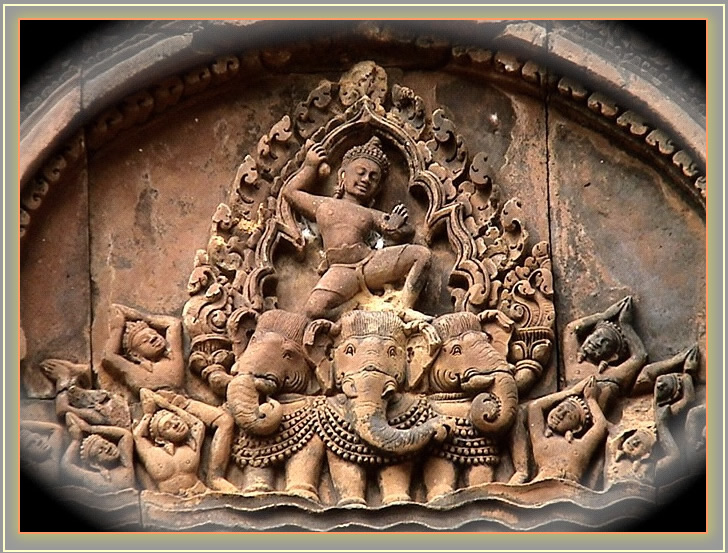
The picture of Indra worshiped is a detail of a temple relief in
Banteay
Srei,
Cambodia. Source.
Production: Filognostic
Association of The Order of Time.

Feed-back | Links | Downloads | Music | Pictures | What's New | Search | Donations




 Text 1