Canto 10
Canto 10
Chapter 50: Krishna Uses Jarâsandha and Establishes the City of Dvârakâ
(1) S'rî S'uka said: 'Asti and Prâpti, the two queens of Kamsa, oh hero of the Bhâratas, were unhappy that their husband had been killed and in distress went to their father's house. (2) They told their father, the king of Magadha named Jarâsandha [see also 1.15: 9, 9.22: 8, 10.2: 1-2, 10.36: 36], everything about the cause of their widowhood. (3) Hearing those bad tidings, oh King, he full of sorrow and indignation embarked upon the extreme endeavor of ridding the earth of the Yâdavas. (4) With twenty-three akshauhinîs he amassed around Mathurâ to besiege the royal capital of the Yadus on all sides. (5-6) When Krishna, the Supreme Lord Hari, saw how his army, like an ocean that overflowed its boundaries, besieged His city and filled His subjects with fear, He as the Ultimate Cause in a Human Form, considered what, to the purpose of His descent into this world, would be the best course of action considering the time and place: (7-8) 'I will surely annihilate his army, this burden of the earth gathered by the king of Magadha, in which he brought together all who, subservient to him, have assumed leadership and now can be counted in akshauhinîs of infantry, cavalry, chariotry and elephantry. Jarâsandha however, I should spare so that he again will try to assemble an army. (9) For this purpose I have descended: to remove the burden of this earth, to protect the virtuous souls and put an end to the rest [that is bad]. (10) As soon as after a certain period of time injustice predominates I, in order to protect the dharma, also assume other bodies [see also 2.7 and B.G. 4: 7].'
(11) While Govinda was thinking this way, suddenly two chariots [from Vaikunthha] appeared in the sky, as effulgent as the sun, complete with drivers and equipment. (12) Also the Lord's classical divine weapons appeared of their own accord. Seeing them the Lord of the Senses said to Sankarshana: (13-14) 'Oh Respected Soul, please take notice of this imminent danger for the Yadus who are protected by You, Prabhu. This is Your chariot that arrived with Your favorite weapons. We indeed were born for this purpose: to act for the benefit of the saintly souls, oh Lord. So please remove now from this earth the burden of these twenty-three armies.'
(15) After thus having invited Him, the two descendants of Das'ârha in armor, resplendent with Their weapons, left the city in Their chariots, accompanied by a very small contingent. (16) Appearing [from the city], the Supreme Personality with Dâruka at the reins, blew His conch shell so that the hearts of the enemy soldiers trembled with fear. (17) Jarâsandha looked at the two of Them and said: 'Krishna, You worst of all persons, I do not desire to contest with You. It is shameful to fight with someone who is but a boy, a fool like You, hiding away. Get lost You murderer of Your relatives! (18) And Râma, if You dare to fight, then muster courage. You either, cut by my arrows, drop Your body and go to heaven, or You kill me!'
(19) The Supreme Lord said: 'Truly, heroes do not have to vaunt, they simply show their prowess. How, oh King, can We take serious the words of a man who, facing his death, is delirious?'
(20) S'rî S'uka said: 'The son of Jarâ, then marched with his gigantic number of mighty forces toward the two descendants of Madhu, who thereupon were surrounded by the soldiers, chariots, flags, horses and charioteers, just like the wind covers the sun with clouds or a fire with dust. (21) When the two chariot banners of Hari and Râma, which were marked by the palm tree and by Garuda, could not be seen anymore in the fray, the women of the city who were positioned on the watchtowers, the palaces and gateways, swooned, being stricken by grief. (22) The Lord witnessing how His army was harassed by the most fearsome clouds of arrows that the enemy forces repeatedly rained upon them, then twanged His most excellent bow the S'ârnga, that is worshiped by Sura and Asura. (23) From His quiver He fixed, pulled back and released floods of sharp arrows with which He, whirling around like a burning torch, relentlessly stroke the chariots, elephants, horses and foot soldiers. (24) Elephants fell down with their foreheads split open, many a horse had its neck severed, chariots including their horses and flags were destroyed, and the arms, legs and shoulders of the charioteers, their masters and the foot soldiers, were cut by the arrows. (25-28) From the cut off limbs of the two-legged humans, the elephants and the horses, the blood flowed in hundreds of streams, which were filled with arms that looked like snakes, people's heads that looked like turtles, dead elephants that resembled islands and dead horses that resembled crocodiles. Hands and thighs appeared like fish, human hair like water weeds, bows like waves and weapons like separate bushes. The rushing streams, disturbing to the timid and inspiring to the intelligent, were crowded with chariot wheels resembling frightening whirlpools and were filled with precious gems and fine jewelry that looked like stones and gravel. Sankarshana, with His unbound potency, stroke with His plow His furious enemies down one after the other. The military force, dear King, which was supervised by the king of Magadha for the sake of destruction and was as unfathomable, frightening and unsurpassable as the limitless ocean, was for the Lords of the Universe, the two sons of Vasudeva, but a plaything. (29) Despite the fact that one describes Him [in response to philosophers who proclaim His being unconcerned] as playing His game in imitation of the human ways, it is not at all surprising that He, who with His Unlimited Qualities effects the maintenance, creation and annihilation of the three worlds, subdues an opposing party. (30) The so very strong Jarâsandha whose army had been destroyed and who, deprived of his chariot, was left with only his breath, was seized by Balarâma as forcibly as one lion seizing another lion. (31) But, as He was tying him, who had killed so many adversaries, up with the ropes of Varuna [compare 5.24: 23] and of normal man, He was checked by Govinda, for He needed Jarâsandha for another purpose.
(32-33) He [Jarâsandha], honored by heroes, was ashamed to be released by the two Lords of the Universe and considered to perform penances, but he was on that path checked by the rest of the nobles who explained to him in clear terms, with meaningful words and practical arguments: 'Your being defeated by the Yadus occurred as a consequence of your karmic bondage.' (34) The son of Brihadratha, all of whose soldiers had been killed and who had been left alone by the Supreme Lord, then dispirited returned to Magadha.
(35-36) Mukunda, who had overcome the ocean of enemy forces without losing His army, was praised by the servants of the three worlds who showered Him with flowers. Then He met the citizens of Mathurâ who, with their fever allayed, felt great joy, while His glory was sung by bards, heralds and panegyrists. (37-38) As He entered the city with its sprinkled roads, many banners and festively decorated gateways, conch shells and kettledrums, drums and horns together with vinâs, flutes and mridangas [two-sided devotional drums] resounded, while the elated citizens loudly recited Vedic verses. (39) The women gazed at Him affectionately with wide open eyes full of love, and covered Him with flower garlands, yogurt, parched rice and sprouts. (40) The countless valuables, consisting of the ornaments of the heroes fallen on the battlefield, were by the Lord all presented to the king of the Yadus [Ugrasena]. (41) And so it happened that the king of Magadha thus with his akshauhinîs seventeen times fought against the Yadus who were protected by Krishna's military strength. (42) The Vrishnis with the help of Krishna's power entirely destroyed the forces of the king. And every time his soldiers lay dead, he was abandoned and then went away. (43) Just as the eighteenth battle was about to take place, a foreign fighter [Kâlayavana] appeared who was sent by Nârada. (44) Having heard about the Vrishnis he arrived with three crores of barbarians [mlecchas] and besieged Mathurâ, for among the human beings he had found no one who could match him. (45) Seeing him, Krishna together with Sankarshana [Balarâma] thought: 'Ah, [an attack] from two sides. A great problem has risen for the Yadus! (46) This Yavana who opposes Us today, is of the same great strength as Jarâsandha, who will also arrive here either today, tomorrow or the day after tomorrow. (47) While the two of Us are fighting with him, the son of Jarâ, when he comes, will kill our relatives or else move them to his own stronghold. (48) Let us therefore today build a fortress impenetrable to human beings to house our intimates, and then kill the barbarian.'
(49) After deliberating on the matter, the Supreme Lord arranged for a fortress [with a circumference] of twelve yojanas within the sea, where He had a city built [called Dvârakâ or 'many-gated', see also 1: 11] that had all kinds of wonderful facilities. (50-53) The science of the architecture of Tvashthâ [Vis'vakarmâ] could be admired there, who with his expertise constructed the main avenues, courtyards and service roads to the plots of land. It contained splendid gardens and parks with the trees and creepers of the gods and gateways made of quartz with upper levels that with their turrets of gold touched the sky. The service buildings fitted with silver and brass were decorated with pots of gold and had jeweled rooftops. It had houses with floors with precious emeralds, which were occupied by people from the four varnas, it had watchtowers and temples housing the presiding deities, and radiated with the palaces of the Lord of the Yadus. (54) Lord Indra delivered to the Lord the pârijâta [coral-]tree as also the Sudharmâ-hall ['good law'] situated in which a mortal is not affected by the laws of mortality. (55) Varuna delivered horses as swift as the wind that had a white and exclusively dark-grey color. The treasurer of the gods [Kuvera] delivered the eight mystic treasures [see nidhi] and the local rulers contributed with each their own wealth. (56) Now that He had arrived on earth, whatever powers of control the Supreme Lord had delegated to them for their own perfection, were all returned to Krishna. (57) After Krishna by the power of His yoga had transported all His subjects to that place [*], He consulted with Balarâma, the protector of the citizens, and then unarmed went out by the city gate, wearing a garland of lotus flowers.'


Third revised edition, loaded April 1, 2021.
Previous Aadhar edition and Vedabase links:
S'rî S'uka said: 'Asti and Prâpti, the two queens of Kamsa, oh hero of the Bhâratas, were unhappy that their husband had been killed and in distress went to their father's house.S'rî S'uka said: 'Asti and Prâpti, the two queens of Kamsa, o hero of the Bhâratas, unhappy that their husband had been killed, went distressed to their father's house. (Vedabase)
They told their father, the king of Magadha named Jarâsandha [see also 1.15: 9, 9.22: 8, 10.2: 1-2, 10.36: 36], everything about the cause of their widowhood.
Their father, the king of Magadha named Jarâsandha [see also 1.15: 9, 9.22: 8, 10.2: 1-2, 10.36: 36], they told all about the cause of their widowhood. (Vedabase)
Hearing those bad tidings, oh King, he full of sorrow and indignation embarked upon the extreme endeavor of ridding the earth of the Yâdavas.
He hearing those bad tidings, full of sorrow and indignation o King, embarked upon the extreme endeavor of ridding the earth of the Yâdavas. (Vedabase)
With twenty-three akshauhinîs he amassed around Mathurâ to besiege the royal capital of the Yadus on all sides.
With twenty-three akshauhinîs amassed he around Mathurâ to besiege the royal capital of the Yadus on all sides. (Vedabase)
When Krishna, the Supreme Lord Hari, saw how his army, like an ocean that overflowed its boundaries, besieged His city and filled His subjects with fear, He as the Ultimate Cause in a Human Form, considered what, to the purpose of His descent into this world, would be the best course of action considering the time and place:
When Krishna, the Supreme Lord Hari, saw how by his force, like an ocean having overflowed its boundaries, His city lay under siege and His subjects were confounded of fear, considered He as the Ultimate Cause in a Human Form what to the purpose of His descend into this world would be right to the time and place: (Vedabase)
'I will surely annihilate his army, this burden of the earth gathered by the king of Magadha, in which he brought together all who, subservient to him, have assumed leadership and now can be counted in akshauhinîs of infantry, cavalry, chariotry and elephantry. Jarâsandha however, I should spare so that he again will try to assemble an army.
'For sure I will annihilate his army, this burden on earth gathered by the king of Magadha in which he brought together all who subservient assumed leadership and now can be counted in akshauhinîs of infantry, cavalry, chariotry and elephantry; Jarâsandha however, I should spare so that he again will try to assemble an army. (Vedabase)
For this purpose I have descended: to remove the burden of this earth, to protect the virtuous souls and put an end to the rest [that is bad].
This is the purpose of My descend: that from this earth the burden is removed, that the saintly are fully protected and that those who wage in opposition are killed. (Vedabase)
As soon as after a certain period of time injustice predominates I, in order to protect the dharma, also assume other bodies [see also 2.7 and B.G. 4: 7].'
Also other bodies are by Me assumed for the protection of the dharma as soon as after a certain period of time injustice predominates [see also 2.7 and B.G. 4: 7 ].' (Vedabase)
While Govinda was thinking this way, suddenly two chariots [from Vaikunthha] appeared in the sky, as effulgent as the sun, complete with drivers and equipment.
While meditating in this manner appeared the very instant from the sky [from Vaikunthha] two chariots with an effulgence like the sun complete with drivers and equipment. (Vedabase)
Also the Lord's classical divine weapons appeared of their own accord. Seeing them the Lord of the Senses said to Sankarshana:
So did also on their own accord the Lord His weapons ancient and divine, and seeing them said the Lord of the Senses to Sankarshana: (Vedabase)
'Oh Respected Soul, please take notice of this imminent danger for the Yadus who are protected by You, Prabhu. This is Your chariot that arrived with Your favorite weapons. We indeed were born for this purpose: to act for the benefit of the saintly souls, oh Lord. So please remove now from this earth the burden of these twenty-three armies.'
'Please take notice, o Respected One, of this imminent danger for the Yadus who are protected by You Prabhu, and of this chariot that has arrived with Your favorite weapons. For this purpose indeed have We been born: to act o Lord, to the benefit of the saintly; so please remove now the burden of these twenty-three armies from this earth.' (Vedabase)
After thus having invited Him, the two descendants of Das'ârha in armor, resplendent with Their weapons, left the city in Their chariots, accompanied by a very small contingent.
Thus inviting Him did the two descendants of Das'ârha, in armor resplendent with their weapons, depart from the city in their chariots accompanied by a very small contingent. (Vedabase)
Appearing [from the city], the Supreme Personality with Dâruka at the reins, blew His conch shell so that the hearts of the enemy soldiers trembled with fear.
As the Supreme Personality with Dâruka at the reins appeared, blew He His conchshell which caused the hearts of the enemy soldiers to tremble in terror. (Vedabase)
Jarâsandha looked at the two of Them and said: 'Krishna, You worst of all persons, I do not desire to contest with You. It is shameful to fight with someone who is but a boy, a fool like You, hiding away. Get lost You murderer of Your relatives!
Jarâsandha looked at the two of Them and said: 'Krishna You worst of persons, I do not desire to contest with You, a boy only, hiding in shame! With a fool like You I won't fight, get lost You murderer of relatives! (Vedabase).
And Râma, if You dare to fight, then muster courage. You either, cut by my arrows, drop Your body and go to heaven, or You kill me!'
And if You, Râma, have the guts to fight, then muster the courage; either You drop Your body cut by my arrows and go to heaven or You kill me!' (Vedabase)
The Supreme Lord said: 'Truly, heroes do not have to vaunt, they simply show their prowess. How, oh King, can We take serious the words of a man who, facing his death, is delirious?'
The Supreme Lord said: 'Truly, heroes don't have to vaunt, they simply show their prowess; how can We take the words serious, o King, of a man who with his death impending is delirious?' (Vedabase)
S'rî S'uka said: 'The son of Jarâ, then marched with his gigantic number of mighty forces toward the two descendants of Madhu, who thereupon were surrounded by the soldiers, chariots, flags, horses and charioteers, just like the wind covers the sun with clouds or a fire with dust.
S'rî S'uka said: 'The son of Jarâ, with his gigantic number of mighty forces then marched forward to the two descendants of Madhu, who were then surrounded by the soldiers, chariots, flags, horses and charioteers like the wind covers the sun with clouds or a fire with dust. (Vedabase)
When the two chariot banners of Hari and Râma, which were marked by the palm tree and by Garuda, could not be seen anymore in the fray, the women of the city who were positioned on the watchtowers, the palaces and gateways, swooned, being stricken by grief.
When Hari's and Râma's two chariot banners marked by the palm tree and Garuda could not be seen anymore in the battle, did the women of the city positioned in the watchtowers, palaces and gateways, swoon stricken by grief. (Vedabase)
The Lord witnessing how His army was harassed by the most fearsome clouds of arrows that the enemy forces repeatedly rained upon them, then twanged His most excellent bow the S'ârnga, that is worshiped by Sura and Asura.
When the Lord saw how His army was harassed by the savage clouds of arrows the enemy forces repeatedly rained upon Them, twanged He who is worshiped by Sura and Asura, S'ârnga, His most excellent bow. (Vedabase)
From His quiver He fixed, pulled back and released floods of sharp arrows with which He, whirling around like a burning torch, relentlessly stroke the chariots, elephants, horses and foot soldiers.
From His quiver then fixing, pulling back and releasing floods of sharp arrows, stroke He, like a burning torch whirled around, the chariots, elephants, horses and foot soldiers relentlessly. (Vedabase)
Elephants fell down with their foreheads split open, many a horse had its neck severed, chariots including their horses and flags were destroyed, and the arms, legs and shoulders of the charioteers, their masters and the foot soldiers, were cut by the arrows.
Elephants fell with their foreheads split open, many a horse of the cavalry and the chariots simultaneously had their necks and flags severed by the arrows and the charioteers, their masters and the foot soldiers had their arms, legs and shoulders cut. (Vedabase)
From the cut off limbs of the two-legged humans, the elephants and the horses, the blood flowed in hundreds of streams, which were filled with arms that looked like snakes, people's heads that looked like turtles, dead elephants that resembled islands and dead horses that resembled crocodiles. Hands and thighs appeared like fish, human hair like water weeds, bows like waves and weapons like separate bushes. The rushing streams, disturbing to the timid and inspiring to the intelligent, were crowded with chariot wheels resembling frightening whirlpools and were filled with precious gems and fine jewelry that looked like stones and gravel. Sankarshana, with His unbound potency, stroke with His plow His furious enemies down one after the other. The military force, dear King, which was supervised by the king of Magadha for the sake of destruction and was as unfathomable, frightening and unsurpassable as the limitless ocean, was for the Lords of the Universe, the two sons of Vasudeva, but a plaything.
Of the limbs of the two-legged ones, the elephants and the horses being cut, flowed the blood in hundreds of streams that were filled with arms looking like snakes, people's heads that were like turtles, dead elephants like islands and dead horses like crocodiles. Replete with hands and thighs as fish, human hair like waterweeds, bows like waves and weapons as separate bushes were the chariot wheels like frightening whirlpools and the precious gems and fine jewelry as the stones and gravel. Terrifying to the timid and inspiring the intelligent with joy, stroke Sankarshana, with His unbounded potency, one after the other His furious enemies down with His plow. Those troops supervised by the king of Magadha for destruction, my dear, that were unfathomable, frightening and insurmountably limitless like the ocean, were for the Lords of the Universe, the two sons of Vasudeva, not more than a plaything. (Vedabase)
Despite the fact that one describes Him [in response to philosophers who proclaim His being unconcerned] as playing His game in imitation of the human ways, it is not at all surprising that He, who with His Unlimited Qualities effects the maintenance, creation and annihilation of the three worlds, subdues an opposing party.
It is not at all surprising when He, of Unlimited Qualities, who effects the maintenance, creation and annihilation of the three worlds, subdues an opposing party, but nevertheless is it [in response to philosophers who proclaim His being unconcerned] described as a game of His in imitation of the human ways. (Vedabase)
The so very strong Jarâsandha whose army had been destroyed and who, deprived of his chariot, was left with only his breath, was seized by Balarâma as forcibly as one lion seizing another lion.
The so very strong Jarâsandha, whose army had been destroyed and who, deprived of his chariot, was left with his breath only, was seized by Râma as forcibly as one lion would seize another lion. (Vedabase)
But, as He was tying him, who had killed so many adversaries, up with the ropes of Varuna [compare 5.24: 23] and of normal man, He was checked by Govinda, for He needed Jarâsandha for another purpose.
But, in the process of tying up, with the ropes of Varuna [compare 5.24: 23] and of normal man, him who had killed so many adversaries, was He checked by Govinda for He needed him to serve another purpose. (Vedabase)
He [Jarâsandha], honored by heroes, was ashamed to be released by the two Lords of the Universe and considered to perform penances, but he was on that path checked by the rest of the nobles who explained to him in clear terms, with meaningful words and practical arguments: 'Your being defeated by the Yadus occurred as a consequence of your karmic bondage.'
He, honored by heroes, was ashamed to be released by the two Lords of the Universe and thought of performing austerities, but was in his resolve half way home stopped by the rest of the royalty who explained to him in clear terms, in meaningful words as also with practical arguments: 'This being defeated by the Yadus has accrued because of your own karmic bondage'. (Vedabase)
The son of Brihadratha, all of whose soldiers had been killed and who had been left alone by the Supreme Lord, then dispirited returned to Magadha.
The son of Brihadratha with all his soldiers killed and left alone by the Supreme Lord, then arrived depressed back in Magadha. (Vedabase)
Mukunda, who had overcome the ocean of enemy forces without losing His army, was praised by the servants of the three worlds who showered Him with flowers. Then He met the citizens of Mathurâ who, with their fever allayed, felt great joy, while His glory was sung by bards, heralds and panegyrists.
Mukunda with His forces unbroken having crossed the ocean of the armies of His enemy, was showered with flowers by the servants of the three worlds in praise. Being met by the people of Mathurâ, who with their fever allayed felt great joy, was His glory sung by bards, heralds and panegyrists. (Vedabase)
As He entered the city with its sprinkled roads, many banners and festively decorated gateways, conch shells and kettledrums, drums and horns together with vinâs, flutes and mridangas [two-sided devotional drums], resounded while the elated citizens loudly recited Vedic verses.
As He entered the city with its sprinkled roads and many a banner, resounded conchshells, kettledrums, drums and horns all together with vinâs, flutes and mridangas [two-sided devotional drums] and chanted the elated citizens loudly vedic verses at the festively decorated gateways. (Vedabase)
The women gazed at Him affectionately with wide open eyes full of love, and covered Him with flower garlands, yogurt, parched rice and sprouts.
With eyes wide open full of love gazing affectionately covered the women Him with flowergarlands, yogurt, parched rice and sprouts. (Vedabase)
The countless valuables, consisting of the ornaments of the heroes fallen on the battlefield, were by the Lord all presented to the king of the Yadus [Ugrasena].
The countless valuables of the heroes fallen on the battlefield were by the Lord all together presented to the king of the Yadus [Ugrasena]. (Vedabase)
And so it happened that the king of Magadha thus with his akshauhinîs seventeen times fought against the Yadus who were protected by Krishna's military strength.
And so it happened this way seventeen times that the king of Magadha with his akshauhinîs fought the Yadus who were protected by Krishna's military strength. (Vedabase)
The Vrishnis with the help of Krishna's power entirely destroyed the forces of the king. And every time his soldiers lay dead, he was abandoned and then went away.
The Vrishnis by the power of Krishna entirely destroyed the king his force: every time his soldiers were dead, was he deserted and went he away again. (Vedabase)
Just as the eighteenth battle was about to take place, a foreign fighter [Kâlayavana] appeared who was sent by Nârada.
Just as the eighteenth battle was about to take place appeared a foreign fighter [Kâlayavana] sent by Nârada. (Vedabase)
Having heard about the Vrishnis he arrived with three crores of barbarians [mlecchas] and besieged Mathurâ, for among the human beings he had found no one who could match him.
Having heard about the Vrishnis arrived he there with three crores of barbarians [mlecchas] and besieged he Mathurâ, as he among the human beings had found no one to match him. (Vedabase)
Seeing him, Krishna together with Sankarshana [Balarâma] thought: 'Ah, [an attack] from two sides. A great problem has risen for the Yadus!
Seeing him thought Krishna with Sankarshana His helper: 'Ah, from two sides; a great problem indeed has risen for the Yadus! (Vedabase)
This Yavana who opposes Us today, is of the same great strength as Jarâsandha, who will also arrive here either today, tomorrow or the day after tomorrow.
This Yavana opposing us today is of the same great strength as Jarâsandha, who will also get here either today, tomorrow or the day after tomorrow. (Vedabase)
While the two of Us are fighting with him, the son of Jarâ, when he comes, will kill our relatives or else move them to his own stronghold.
While the two of Us are fighting with him will the son of Jarâ, when he comes, kill our relatives or else move them to his own stronghold. (Vedabase)
Let us therefore today build a fortress impenetrable to human beings to house our intimates, and then kill the barbarian.'
Let's therefore today kill the barbarians and build us, for our intimates to settle there, a fortress impenetrable to the two-legged.' (Vedabase)
After deliberating on the matter, the Supreme Lord arranged for a fortress [with a circumference] of twelve yojanas within the sea, where He had a city built [called Dvârakâ or 'many-gated', see also 1: 11] that had all kinds of wonderful facilities.
The Supreme Lord thus deliberating arranged for a fortress twelve yoyanas [around] within the sea where He had a city [called Dvârakâ or 'many-gated', see also 1: 11] containing all kinds of wonders. (Vedabase)
The science of the architecture of Tvashthâ [Vis'vakarmâ] could be admired there, who with his expertise constructed the main avenues, courtyards and service roads to the plots of land. It contained splendid gardens and parks with the trees and creepers of the gods and gateways made of quartz with upper levels that with their turrets of gold touched the sky. The service buildings fitted with silver and brass were decorated with pots of gold and had jeweled rooftops. It had houses with floors with precious emeralds, which were occupied by people from the four varnas, it had watchtowers and temples housing the presiding deities, and radiated with the palaces of the Lord of the Yadus.
Within it could the science of the architecture of Tvashthâ [Vis'vakarmâ] be admired who with his expertise constructed the main avenues, courtyards and service roads to the ample plots of land. It contained splendid gardens and parks with the trees and creepers of the godly and gateways made of quartz with upper levels that with turrets of gold touched the sky. The service buildings with silver and brass were decorated with pots of gold, had jeweled rooftops and the houses had floors with precious emeralds. The households occupied by the four varnas of people had temples housing their presiding deities and were constructed with watchtowers; and most beautiful with it were the residences of the Yadu godhead. (Vedabase)
Lord Indra delivered to the Lord the pârijâta [coral-]tree as also the Sudharmâ-hall ['good law'] situated in which a mortal is not affected by the laws of mortality.
Lord Indra delivered to the Lord the pârijâta [coral-]tree as also the Sudharmâ-hall ['good law'] situated in which a mortal is not affected by the laws of mortality. (Vedabase)
Varuna delivered horses as swift as the wind that had a white and exclusively dark-grey color. The treasurer of the gods [Kuvera] delivered the eight mystic treasures [see nidhi] and the local rulers contributed with each their own wealth.
Varuna delivered horses swift as the wind that were colored white and exclusively dark-grey; the treasurer of the godly delivered the eight mystic treasures [see nidhi] and each of the local rulers brought in their own opulences. (Vedabase)
Now that He had arrived on earth, whatever powers of control the Supreme Lord had delegated to them for their own perfection, were all returned to Krishna.
Whatever powers of control the Supreme Lord had given as their own perfections were all offered back to Krishna, now He had come to earth. (Vedabase)
After Krishna by the power of His yoga had transported all His subjects to that place [*], He consulted with Balarâma, the protector of the citizens, and then unarmed went out by the city gate, wearing a garland of lotus flowers.'
Krishna after bringing over there by the power of His yoga all His subjects [*], then on the advise of Balarâma, the protector of the citizens, unarmed went out of the city gate, wearing a garland of lotus flowers.' (Vedabase)
*: S'rîla Vis'vanâtha Cakravartî quotes the following verses here from the S'rî Padma Purâna, Uttara-khanda: "In the middle of the night, as the citizens of Mathurâ slept, Lord Janârdana suddenly removed them from that city and placed them in Dvârakâ. When the men awoke, they were all amazed to find themselves, their children and their wives sitting inside palaces made of gold."

The text and audio are offered under the
conditions of the
Creative
Commons Attribution-Noncommercial-Share Alike 3.0 Unported
License.
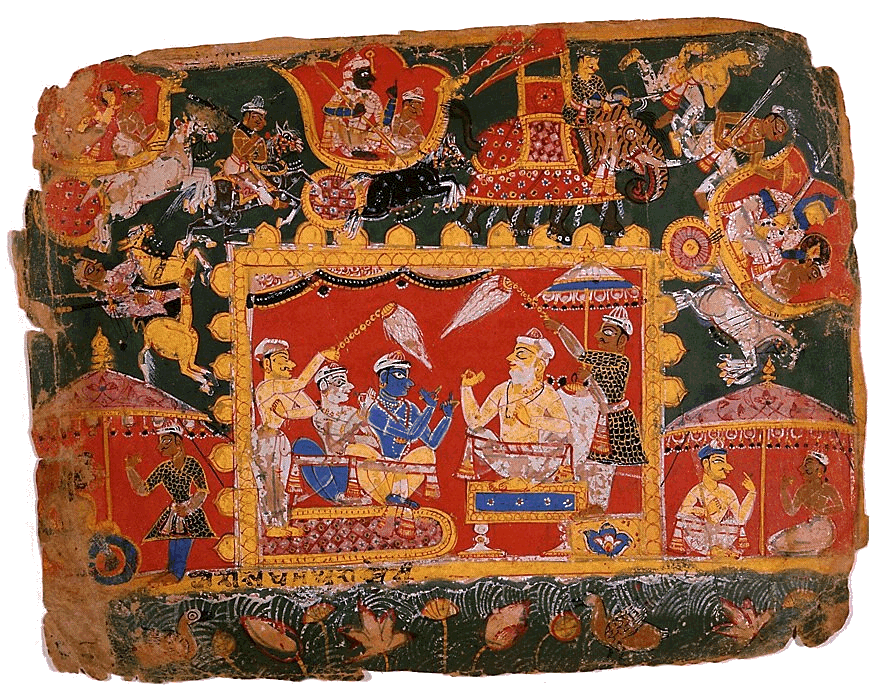
The image is
titled: 'Jarasandha, the King of Magadha, Besieges Mathura for
the First Time',
Leaf from a Series Illustrating the 10th Book of the Bhagavata
Purana,
Source: Ackland
Museum
of Art.
Production: Filognostic
Association of The Order of Time.

Feed-back | Links | Downloads | Music | Pictures | What's New | Search | Donations



 Text 1