

Canto
10

Canto
10
Chapter 12: The Killing of the Demon Aghâsura
(1) S'rî S'uka said: 'One day the Lord decided to have a picnic in the forest. Rising early He blew His horn nicely to wake up His comrades and the calves. Then they departed from Vraja driving their groups of calves in front of them. (2) It offered a most attractive sight to see them all happy and beautifully together as they walked away in His company, with their prods, horns, flutes and the many calves each of them had. All together they numbered over a thousand. (3) With Krishna's personal calves added to them they could not be counted anymore. Immersed in their children's games, the boys had a good time at different places [in the forest].
(4) Even though they were already adorned with gems, shells, gold and pearls, they also used fruits, green leaves, bunches of beautiful flowers, peacock feathers and colored minerals to decorate themselves. (5) They snatched away each other's belongings and threw them at a distance when it was discovered. Others threw them further away, but then again they were returned with a laugh. (6) When Krishna walked away to admire the beauty of the forest, they enjoyed it to say 'me first, me first' while they touched Him. (7-11) Some blew their flutes, some vibrated their horns, some hummed along with the bumblebees and others imitated the cuckoos. Some ran after the shadows of the birds, some walked elegantly with the swans or sat with the ducks just as silent or danced with the peacocks. They searched for young monkeys and hopped along with them between the trees as they were skipping from tree to tree. They jumped together with the frogs, getting wet in the water, they laughed at their shadows and mocked their own echoes. This way they enjoyed the merit of their previous lives in friendship with Him who is the Supreme Divinity for those who are entangled in mâyâ, He who is the spiritual happiness for those transcendentalists who accept it to be of service [as a consequence thereof. See * and 1.1: 2, 1.7: 6 and 2.1: 6]. (12) Yogis skilled in self-control do not even after many lives of doing penance achieve the dust of His lotus feet. How fortunate then are the inhabitants of Vraja by whom He personally being present could be observed directly?
(13) And then the one named Agha ['the evil one'] appeared on the scene, a great demon who could not tolerate the sight of their happy pastimes. His life's end was awaited by all the immortal souls, in spite of the nectar they drank. (14) When Aghâsura, who was sent by Kamsa and who was the younger brother of Bakî [Pûtanâ] and Bakâsura, saw the boys who were led by Krishna, he thought: 'This must be the killer of the two who together with me took birth from the same mother. Let me therefore now for their sake kill Him and His boys! (15) When these boys have become the sesame and water for the funeral rites of my brother and sister, when the strength of the life of the inhabitants of Vraja [their children] has disappeared, when these living beings whom they consider the very embodiment of their love and breath have left them, they all will be as good as dead.' (16) Thus having decided he assumed the wondrous form of a very, very large python that extended for miles. Therewith he occupied, as high as a mountain and with a mouth spread wide open like a mountain cave, that moment most wickedly the road in order to swallow the picnickers. (17) Keeping his mouth wide open, his lower lip rested on the earth and his upper lip touched the sky. His teeth were like mountain peaks, the inside was pitch dark, his tongue resembled a broad road, his breath was like a warm wind and his fiery look was like a fire. (18) Seeing him in that position they all considered it Vrindâvana at its best. It was for them a known game [to act] as if they were looking at the form of a python's mouth: (19) 'Look dear friends! A dead python there before us, ready to swallow us all with its snake mouth spread open, is it not? (20) It is obvious, really, that cloud up there is the upper lip and below, that big sand bank with that reddish glow, is his lower lip... (21) On the left and right, those caves, look just like the corners of the mouth and those peaks there, are exactly like the animal's teeth. (22) The length and breadth of the broad path, is like the tongue and the darkness, in between the mountains, looks like the inside of its mouth. (23) Just notice how that hot wind blowing from a forest fire is like its breath, and the bad smell of the flesh of the burned corpses, stinks like the flesh within its belly. (24) Would this animal be here to devour all who dare to enter? With that being so, he will, just like the heron, be immediately vanquished by Krishna!' so they said, looking at the gleaming face of Him, Baka's enemy, while they loudly laughing and clapping their hands entered its mouth.
(25) Krishna heard them talking this and that way besides the truth. They did not realize what they were dealing with. He knew that the Rakshasa was very real and was deceiving them, and so He arrived at the conclusion that He, the Supreme Lord, the Complete Whole of All Living Beings who is situated in the heart, should stop His comrades. (26) Meanwhile, all the boys and their calves had entered the belly of the demon, but they were not devoured. The Rakshasa, who was thinking of his dead relatives, waited for Baka's enemy to enter. (27) Krishna, who for each and everyone is the source of fearlessness, was amazed to witness that and compassionately felt sorry about this twist of fate. They who had no one but Him now helplessly had moved away from His control to burn as straws in the fire of the belly of Aghâsura, death personified. (28) What to do now? This rogue should not exist, nor should the innocent and faithful souls find their end. How could He achieve both ends at the same time? Gathering His thoughts the Lord, the Unlimited Seer, knew what to do and entered the mouth. (29) That very moment all the gods exclaimed from behind the clouds in fear: 'Alas, alas!', and Kamsa and the other bloodthirsty friends of Aghâsura rejoiced. (30) When He heard that, Krishna, the Supreme Lord who is never vanquished, immediately expanded Himself [see siddhi] within the throat of the demon who tried to crush the boys and the calves in his belly. (31) With that action the airways were blocked and the eyes of the squirming and wrestling giant popped out. The life air was arrested within the internally completely obstructed body and then broke out through the top of the skull. (32) After all life air had left the body and Krishna saw that the boys and calves lay dead, He, Mukunda, the Supreme Lord, brought them back to life, whereupon He reappeared from the mouth in their company. (33) From the body a most wonderful bright light issued that all by itself illumined the ten directions. It remained in the sky waiting until the Supreme Personality appeared and then, before the eyes of the demigods, it entered His body [sâyujya-mukti]. (34) Everyone most pleased thereupon performed his specific service of worship [see also 1.2: 13]: flowers were showered, the singers of heaven sang, the heavenly girls danced, the demigods played their specific instruments and the brahmins offered prayers. (35) The Unborn One [Lord Brahmâ], who nearby in his abode heard the wondrous sounds of those for everyone so very auspicious prayers, sweet sounds, songs and different celebrations, came immediately and stood amazed to see the glory of the Supreme Master.
(36) Oh King, after the skin of the python had dried, it became a place of interest for the inhabitants of Vrindâvana that for a long, long time afterwards was used as a cave. (37) This incident - of the snake's death and deliverance and the liberation of Him and His associates - that took place when the Lord was five years old [kaumâra], was by the boys in Vraja disclosed one year later [pauganda] as if it had happened that very day. (38) However unthinkable it might be for an impure soul, it is not that astonishing that even Aghâsura was liberated from all contamination and [with the light of his soul] could merge with the Supersoul. All he had to do was to associate but for a moment with the Supreme Creator of a higher and lower existence, when He assumed the form of a human child. (39) This destination He even grants those who [like Aghâsura] but once got innerly connected to His form because of a certain state of mind in relation to His divinity [thus even being connected in hatred]. What then would that mean for those in whom He is ever present as the remover of illusion, as the One who always grants each and every soul the realization of transcendental happiness?' "
(40) S'rî Sûta [see 1: 12-15] said: "He [Parîkchit] who was protected by the God of the Yadus [Yâdavadeva or Krishna] and who this way, oh twice-born one, heard about the so very wonderful activities of his savior [see 1.8], thus being fixed in his consciousness asked the son of Vyâsa for more about these meritorious deeds. (41) The honorable king said: 'Oh brahmin how could what happened in the past, be described as having happened in the present? How can that be possible? How could what the Lord did at the age of five years, by the boys be described as having occurred at His sixth? (42) Oh great yogi, I am burning with curiosity. Please, explain this incident to me, oh guru, I am certain that it was caused by nothing but the deluding potency of the Lord [yoga-mâyâ]. (43) In this world, oh teacher, we as a mundane ruler are most blessed with the opportunity to always drink from the nectar of your sacred talks about Krishna.' "(44) S'rî Sûta said: "When the man of penance this way was questioned by him, he had completely lost contact with his senses the very moment he was reminded of the Infinite One. After with difficulty slowly having regained his external vision, he answered the Lord's most outstanding, finest adherent."

Third revised edition, loaded June 24, 2020.
Previous Aadhar edition and Vedabase links:
S'rî S'uka said: 'One day the Lord decided to have a picnic in the forest. Rising early He blew His horn nicely to wake up His comrades and the calves. Then they departed from Vraja driving their groups of calves in front of them.S'rî S'uka said: 'One day planned the Lord to have a picnic in the forest. Rising early He woke His comrades and the calves, blowing His horn nicely to make them rise. Next they departed from Vraja driving their groups of calves in front of them. (Vedabase)
It offered a most attractive sight to see them all happy and beautifully together as they walked away in His company, with their prods, horns, flutes and the many calves each of them had. All together they numbered over a thousand.
They all happy, beautifully shining in His company walking out with their prods, horns, flutes and the many of each his calves, who together numbered over a thousand, offered a most attractive sight. (Vedabase)
With Krishna's personal calves added to them they could not be counted anymore. Immersed in their children's games, the boys had a good time at different places [in the forest].
With Krishna His own calves thereto had a countless number of them assembled and together with them had He then, immersed in their boyish games, a good time in various places [in the forest]. (Vedabase)
Even though they were already adorned with gems, shells, gold and pearls, they also used fruits, green leaves, bunches of beautiful flowers, peacock feathers and colored minerals to decorate themselves.
Even though they with gems, shells, gold and pearls already were adorned, used they also fruits, green leaves, bunches of beautiful flowers, peacock feathers and colored minerals to decorate themselves. (Vedabase)
They snatched away each other's belongings and threw them at a distance when it was discovered. Others threw them further away, but then again they were returned with a laugh.
Snatching away one another's belongings threw them at a distance from the one concerned and were they by those seeing him coming tossed further, but then again with a laugh returned. (Vedabase)
When Krishna walked away to admire the beauty of the forest, they enjoyed it to say 'me first, me first' while they touched Him.
If Krishna walked away with eyes for the beauty of the forest had they fun trying 'me first, me first' to touch Him. (Vedabase)
Some blew their flutes, some vibrated their horns, some hummed along with the bumblebees and others imitated the cuckoos. Some ran after the shadows of the birds, some walked elegantly with the swans or sat with the ducks just as silent or danced with the peacocks. They searched for young monkeys and hopped along with them between the trees as they were skipping from tree to tree. They jumped together with the frogs, getting wet in the water, they laughed at their shadows and mocked their own echoes. This way they enjoyed the merit of their previous lives in friendship with Him who is the Supreme Divinity for those who are entangled in mâyâ, He who is the spiritual happiness for those transcendentalists who accept it to be of service [as a consequence thereof. See * and 1.1: 2, 1.7: 6 and 2.1: 6].
Some blew their flutes, some vibrated their horns, some hummed along with the bumblebees and others imitated the cuckoos. Some ran after the shadows of the birds, some walked elegant with the swans or sat with the ducks as silent or danced with the peacocks. They searched for young monkeys and hopped with them between the trees the way they were skipping from tree to tree. They jumped along with the frogs getting wet in the water, laughed at their shadows and mocked their own echoes. This way enjoyed they the merit of their previous lives in friendship with Him who for those entangled in mâyâ is the Supreme Divinity, who for the transcendentalists who accepted it to be of service, as a consequence is the spiritual happiness [see * and 1.1: 2, 1.7: 6 and 2.1: 6]. (Vedabase)
Yogis skilled in self-control do not even after many lives of doing penance achieve the dust of His lotus feet. How fortunate then are the inhabitants of Vraja by whom He personally being present could be observed directly?
Not even for many lives being of penance do yogis apt in self-control achieve the dust of His lotus feet; how fortunate then are the inhabitants of Vraja to whom He indeed personally being present became the object of their personal witnessing? (Vedabase)
And then the one named Agha ['the evil one'] appeared on the scene, a great demon who could not tolerate the sight of their happy pastimes. His life's end was awaited by all the immortal souls, in spite of the nectar they drank.
And then appeared he, named Agha ['the bad one'] on the scene, a great demon unable to bear the sight of their happy pastimes whose life's end was awaited by practically all the immortals despite of their drinking the nectar. (Vedabase)
When Aghâsura, who was sent by Kamsa and who was the younger brother of Bakî [Pûtanâ] and Bakâsura, saw the boys who were led by Krishna, he thought: 'This must be the killer of the two who together with me took birth from the same mother. Let me therefore now for their sake kill Him and His boys!
Seeing the boys headed by Krishna thought Aghâsura, who was sent by Kamsa and was the younger brother of Bakî [Pûtanâ] and Bakâsura: 'This indeed is the killer of the two born along with me; so for their sake, let me now kill Him and His boys! (Vedabase)
When these boys have become the sesame and water for the funeral rites of my brother and sister, when the strength of the life of the inhabitants of Vraja [their children] has disappeared, when these living beings whom they consider the very embodiment of their love and breath have left them, they all will be as good as dead.'
When these boys for my brother and sister have become the sesame and water to their death rites, will all the inhabitants of Vraja be as good as dead when the strength of their life has left them, when these living beings whom they consider the very embodiment of their love and breath are gone.' (Vedabase)
Thus having decided he assumed the wondrous form of a very, very large python that extended for miles. Therewith he occupied, as high as a mountain and with a mouth spread wide open like a mountain cave, that moment most wickedly the road in order to swallow the picnickers.
Thus decided assumed he the wondrous body of a very, very large python extending for miles and occupied he, mountain high and with a mouth spread open like a mountain cave, at that time most crooked the road to swallow the picnickers. (Vedabase)
Keeping his mouth wide open, his lower lip rested on the earth and his upper lip touched the sky. His teeth were like mountain peaks, the inside was pitch dark, his tongue resembled a broad road, his breath was like a warm wind and his fiery look was like a fire.
With the inside of his mouth gaping, rested his lower lip on the earth and touched his upper lip the sky; his teeth were like mountain peaks and within was it pitch dark, his tongue resembled a broad road, his breath was like a warm wind and his fiery look was like a fire. (Vedabase)
Seeing him in that position they all considered it Vrindâvana at its best. It was for them a known game [to act] as if they were looking at the form of a python's mouth:
Seeing him in that position they all thought it to be Vrindâvana at its best; it was in the line of their games indeed [to act] as if they were looking at the form of a python's mouth: (Vedabase)
'Look dear friends! A dead python there before us, ready to swallow us all with its snake mouth spread open, is it not?
'Look o friends, a dead python laying before us to swallow us all with its snake mouth spread open, don't you think? (Vedabase)
It is obvious, really, that cloud up there is the upper lip and below, that big sand bank with that reddish glow, is his lower lip...
Really, it's as clear as the sun, there is the upper lip and below, that big bank is his lower lip with that reddish glow... (Vedabase)
On the left and right, those caves, look just like the corners of the mouth and those peaks there, are exactly like the animal's teeth.
On the left and right, those caves, they just resemble the corners of the mouth, and those peaks there, they look exactly like the animal's teeth. (Vedabase)
The length and breadth of the broad path, is like the tongue and the darkness, in between the mountains, looks like the inside of its mouth.
The broad path, long and wide, is like the tongue and the darkness in between the mountains, that's indeed the inside of his mouth. (Vedabase)
Just notice how that hot wind blowing from a forest fire is like its breath, and the bad smell of the flesh of the burned corpses, stinks like the flesh within its belly.
Just notice how the hot wind blowing from it like fire indeed is like his breath, smelling as bad as burning flesh with the corpses inside of him. (Vedabase)
Would this animal be here to devour all who dare to enter? With that being so, he will, just like the heron, be immediately vanquished by Krishna!' so they said, looking at the gleaming face of Him, Baka's enemy, while they loudly laughing and clapping their hands entered its mouth.
Would this animal be here to devour all who dare to enter? If so, then will he just like Bakâsura by Him immediately be vanquished!' they said looking at the gleaming face of Krishna, Baka's enemy, while they loudly laughing, clapping their hands entered the mouth. (Vedabase)
Krishna heard them talking this and that way besides the truth. They did not realize what they were dealing with. He knew that the Rakshasa was very real and was deceiving them, and so He arrived at the conclusion that He, the Supreme Lord, the Complete Whole of All Living Beings who is situated in the heart, should stop His comrades.
Hearing them this and that way besides the truth talking without realizing what they were dealing with, came Krishna, who knew that the Rakshasa was very real and deceiving them, to the conclusion that He, the Supreme Lord, the Complete of all living beings situated in the heart, should stop His comrades. (Vedabase)
Meanwhile, all the boys and their calves had entered the belly of the demon, but they were not devoured. The Rakshasa, who was thinking of his dead relatives, waited for Baka's enemy to enter.
Meanwhile had all the boys and their calves entered the belly of the demon, but they were not devoured; the Rakshasa, thinking of his dead relatives, was waiting for Baka's enemy to enter. (Vedabase)
Krishna, who for each and everyone is the source of fearlessness, was amazed to witness that and compassionately felt sorry about this twist of fate. They who had no one but Him now helplessly had moved away from His control to burn as straws in the fire of the belly of Aghâsura, death personified.
Krishna, who for each and everyone is the source of fearlessness, was amazed to witness that and compassionately felt sorry about the way things were turning out to be with His friends, who had no one but Him and now helplessly had ran out of His control to be as straws to the fire of the belly of Aghâsura, of death personified. (Vedabase)
What to do now? This rogue should not exist, nor should the innocent and faithful souls find their end. How could He achieve both ends at the same time? Gathering His thoughts the Lord, the Unlimited Seer, knew what to do and entered the mouth.
What to do now; this rogue shouldn't exist, nor should the innocent faithful ones find their end; how could He have both at the same time? Gathering His thoughts knew the Lord, the Seer of the Unlimited, what to do and entered He Himself the mouth. (Vedabase)
That very moment all the gods exclaimed from behind the clouds in fear: 'Alas, alas!', and Kamsa and the other bloodthirsty friends of Aghâsura rejoiced.
At that moment exclaimed all the gods from behind the clouds in fear 'Alas, alas!' and rejoiced Kamsa and the other blood thirsty friends of Aghâsura. (Vedabase)
When He heard that, Krishna, the Supreme Lord who is never vanquished, immediately expanded Himself [see siddhi] within the throat of the demon who tried to crush the boys and the calves in his belly.
When He heard that expanded Krishna, the Supreme Lord who indeed never is vanquished, immediately Himself [see siddhi] from within the throat of the demon who tried to crush the boys and the calves in his belly. (Vedabase)
With that action the airways were blocked and the eyes of the squirming and wrestling giant popped out. The life air was arrested within the internally completely obstructed body and then broke out through the top of the skull.
With that action were all openings blocked and popped out the eyes of the giant squirming and wrestling; the life air arrested within the completely stuffed body then broke out and left through the top of the skull. (Vedabase)
After all life air had left the body and Krishna saw that the boys and calves lay dead, He, Mukunda, the Supreme Lord, brought them back to life, whereupon He reappeared from the mouth in their company.
When all life-air had left the body and Krishna saw that all the boys and calves were laying dead, brought He, Mukunda, the Supreme Lord, them back to life and reappeared He, accompanied by them, from the mouth. (Vedabase)
From the body a most wonderful bright light issued that all by itself illumined the ten directions. It remained in the sky waiting until the Supreme Personality appeared and then, before the eyes of the demigods, it entered His body [sâyujya-mukti].
Issuing from the lusty body there was a most wonderful light which all by itself illumined the ten directions; it waited remaining in the sky until the Supreme Personality came out and then entered, for all the gods to see, His body [sâyujya-mukti]. (Vedabase)
Everyone most pleased thereupon performed his specific service of worship [see also 1.2: 13]: flowers were showered, the singers of heaven sang, the heavenly girls danced, the demigods played their specific instruments and the brahmins offered prayers.
Next did everyone most pleased his own thing, in worship celebrating His glory [see also 1.2: 13]: flowers were showered, the singers of heaven sang, the heavenly girls danced, all the demigods played their specific instruments and the brahmins offered prayers. (Vedabase)
The Unborn One [Lord Brahmâ], who nearby in his abode heard the wondrous sounds of those for everyone so very auspicious prayers, sweet sounds, songs and different celebrations, came immediately and stood amazed to see the glory of the Supreme Master.
The Unborn One [Brahmâ] nearby in his abode hearing the wondrous sounds of those for everyone so very auspicious prayers, sweet sounds, songs and cheers for the One Supreme Lord, very quickly went over there to witness the glorification of God that amazed him. (Vedabase)
Oh King, after the skin of the python had dried, it became a place of interest for the inhabitants of Vrindâvana that for a long, long time afterwards was used as a cave.
O King, the dried python skin was a marvel of Vrindâvana that became a cave frequented for a long, long time afterwards.(Vedabase)
This incident - of the snake's death and deliverance and the liberation of Him and His associates - that took place when the Lord was five years old [kaumâra], was by the boys in Vraja disclosed one year later [pauganda] as if it had happened that very day.
This incident of the python its death and liberation and the deliverance of His associates, that took place when the Lord was five years old [kaumâra], was only one year later [pauganda] by the boys in Vraja disclosed as if it had happened that very day. (Vedabase)
However unthinkable it might be for an impure soul, it is not that astonishing that even Aghâsura was liberated from all contamination and [with the light of his soul] could merge with the Supersoul. All he had to do was to associate but for a moment with the Supreme Creator of a higher and lower existence, when He assumed the form of a human child.
The fact that by the little association with the Supreme Personality of the Brahman, of the apparent and nonapparent, who for the people was of mercy as a child, also Agha was freed from all material contamination and was elevated to merge with the Supersoul, was not so astonishing at all, however difficult it is for those far removed from the truth to attain. (Vedabase)
This destination He even grants those who [like Aghâsura] but once got innerly connected to His form because of a certain state of mind in relation to His divinity [thus even being connected in hatred]. What then would that mean for those in whom He is ever present as the remover of illusion, as the One who always grants each and every soul the realization of transcendental happiness?' "
If they, who [like Aghâsura] somehow by chance or even by force got His image installed in their hearts, by Him are granted the destination, what then indeed would that mean for those in whom He is ever present as the remover of the illusion, always granting each and every soul the unfailing resultant pleasure?' " (Vedabase)
S'rî Sûta [see 1: 12-15] said: "He [Parîkchit] who was protected by the God of the Yadus [Yâdavadeva or Krishna] and who this way, oh twice-born one, heard about the so very wonderful activities of his savior [see 1.8], thus being fixed in his consciousness asked the son of Vyâsa for more about these meritorious deeds.
S'rî Sûta [see 1: 12-15] said: "He [Parîkchit] who was protected by the God of the Yadus [Yâdavadeva or Krishna] this way, o twice-born, hearing about the all-wonderful activities of his savior [see 1.8], inquired thus fixed in his consciousness with the son of Vyâsa even more after those so meritorious deeds. (Vedabase)
The honorable king said: 'Oh brahmin how could what happened in the past, be described as having happened in the present? How cand that be possible? How could what the Lord did at the age of five years, by the boys be described as having occurred at His sixth?
The honorable king said: 'O brahmin what happened in another time, was described as if it had happened right then, how could that be; how could what the Lord did at five years of age by all the boys be described at His sixth? (Vedabase)
Oh great yogi, I am burning with curiosity. Please, explain this incident to me, oh guru, I am certain that it was caused by nothing but the deluding potency of the Lord [yoga-mâyâ].
I'm burning with curiosity, o great yogi, to hear from you about it, o guru, I am certain that it was caused by nothing else but the deluding capacity of the Lord [yoga-mâyâ]. (Vedabase)
In this world, oh teacher, we as a mundane ruler are most blessed with the opportunity to always drink from the nectar of your sacred talks about Krishna.' "
Being but a mundane ruler are we most blessed in this world, o teacher, with the opportunity to always drink from the nectar of your sacred talks about Krishna'." (Vedabase)
S'rî Sûta said: "When the man of penance this way was questioned by him, he had completely lost contact with his senses the very moment he was reminded of the Infinite One. After with difficulty slowly having regained his external vision, he answered the Lord's most outstanding, finest adherent."
S'rî Sûta said: "When he, the man of penance, this way indeed was questioned by him had he, the moment he was reminded of the Infinite One, completely lost contact with his senses; with difficulty slowly regaining his external vision he then replied the Lord His most outstanding, very best adherent." (Vedabase)
*: S'rîla Prabhupâda comments: 'The secret of success is unknown to people in general, and therefore S'rîla Vyâsadeva, being compassionate toward the poor souls in this material world, especially in this age of Kali, has given us the S'rîmad Bhâgavatam. S'rîmad Bhâgavatam purânam amalam yad vaishnavânâm priyam (S.B. 12.13: 18). For Vaishnavas who are somewhat advanced, or who are fully aware of the glories and potencies of the Lord, S'rîmad Bhâgavatam is a beloved Vedic literature. After all, we have to change this body (tathâ dehântara-prâptih). If we do not care about Bhagavad Gîtâ and S'rîmad Bhâgavatam, we do not know what the next body will be. But if one adheres to these two books - Bhagavad Gîtâ and S'rîmad Bhâgavatam - one is sure to obtain the association of Krishna in the next life (tyaktvâ deham punar janma naiti mâm eti so 'rjuna [B.G. 4: 9]). Therefore, distribution of S'rîmad Bhâgavatam all over the world is a great welfare activity for theologians, philosophers, transcendentalists and yogis (yoginâm api sarveshâm [B.G. 6: 47]), as well as for people in general'.


The
text and audio are offered under the conditions of the
Creative Commons
Attribution-Noncommercial-Share Alike 3.0 Unported License.
The first
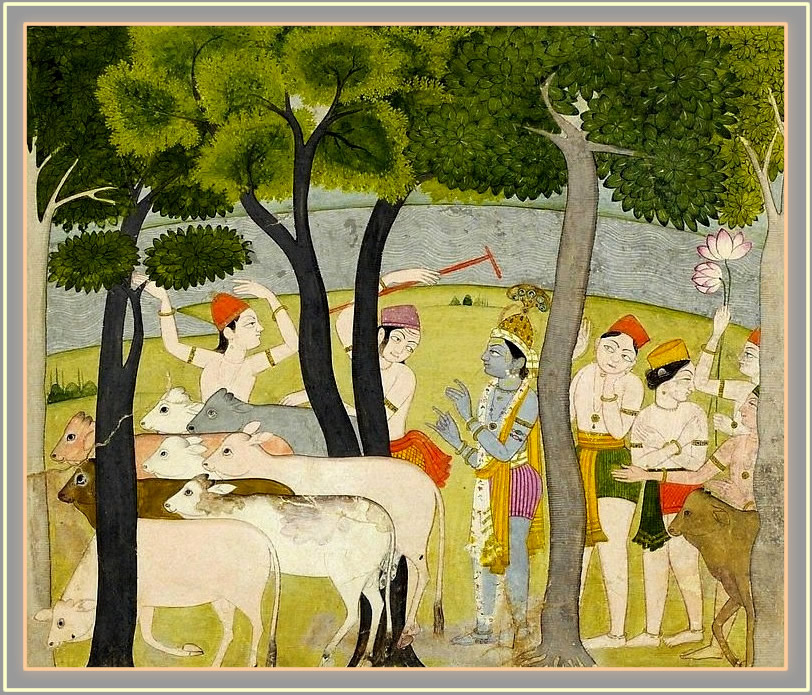
painting on this page is titled 'Krishna and the cowherds under trees'
c. 1800 Kulu, India,
©
Victoria and Albert Museum.
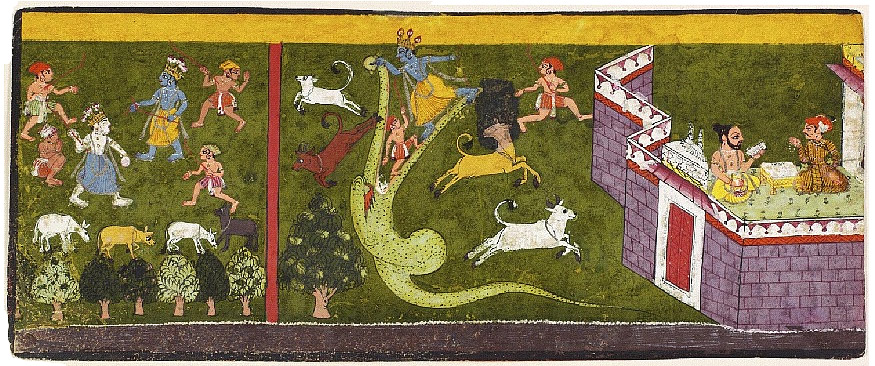
The second painting is titled: 'Krishna Destroys the Demon Agha'.
Page from a dispersed series of the Bhagavata Purana.
Kota, Rajasthan, India c. 1740-50. Source: Philadelphia
Museum
of
Art.
Production: Filognostic Association of The Order of Time.

Feed-back | Links | Downloads | Music | Pictures | What's New | Search | Donations



 Text
1
Text
1