
Canto 10
Canto 10
Chapter 56: How the Syamantaka jewel Brought Krishna Jâmbavatî and Satyabhâmâ
(1) S'rî S'uka said: 'Satrâjit ['always victorious', see 9.24: 13], who had offended Lord Krishna, did his best for Him and gave Him his daughter and the jewel Syamantaka.'
(2) The honorable king said: 'What offense committed Satrâjit against Krishna, oh brahmin? Where did the Syamantaka come from and why gave he his daughter to the Lord?'
(3) S'rî S'uka said: 'Satrâjit was a devotee of the sun god. The godhead was very satisfied with him and gave him, his best friend, out of affection the jewel called Syamantaka. (4) He, who wore the jewel that shone as brilliant as the sun around his neck, was upon his arrival in Dvârakâ, because of its effulgence not recognized, oh King. (5) The people blinded by the glare thought, when they saw him from a distance, that he was Sûrya, and reported that to the Supreme Lord who was engaged in a game of dice. (6) 'Oh Nârâyana, our obeisances unto You, oh Holder of the Conch, Disc and Club, oh Dâmodara, oh Lotus-eyed One, oh Govinda, oh son of the Yadus! (7) Savitâ ['the radiant one'], he who with the intense radiation of his glowing disc robs the people of their vision, has arrived to see You, oh Lord of the Universe. (8) Knowing that You at the moment are hiding among the Yadus, the leaders of the demigods in the three worlds are eagerly looking for You. And now the one unborn [Sûrya], has come to see You, oh Master!'
(9) S'rî S'uka said: 'When He with the lotus eyes heard these innocent words, He said with a smile: 'This person is not Ravideva, it is Satrâjit who glows because of his jewel.'
(10) Arriving at his opulent home Satrâjit festively executed auspicious rituals in the temple room, where he, with the help of scholars, installed the jewel. (11) Day after day that brought him eight bhâras [of about 9.7 kg] of gold, oh prabhu, and nothing inauspicious, like food scarcity, a premature death, catastrophes, snakebites, mental and physical disorders and cheaters, occurred there in the presence of the correctly worshiped gem. (12) Once S'auri [Krishna] on behalf of the king of the Yadus [Ugrasena] asked for the gem, but Satrâjit, greedy for the wealth, considered it no offense not to hand it over.
(13) Prasena [Satrâjit's brother] one day hung the intensely radiating jewel around his neck, mounted a horse and went hunting in the forest. (14) A lion killed Prasena and his horse and took the jewel into a cave, where he in his turn was killed by Jâmbavân ['he from the Jambu trees', the king of the bears] who wanted the jewel. (15) In the cave he gave the jewel to his offspring as a toy to play with. Satrâjit meanwhile not seeing his brother, got deeply troubled. (16) He said: 'My brother, who disappeared in the forest wearing the jewel around his neck, is probably killed by Krishna.' The people, hearing this, whispered it in each other's ears. (17) When the Supreme Lord heard about this He, in order to exonerate Himself from the imputation, together with some citizens followed the path Prasena had taken. (18) In the forest they discovered that he and his horse were killed by a lion and that, further on a hillside, the lion in its turn had been killed by Riksha [Jâmbavân]. (19) The Supreme Lord positioned His men outside the terrifying cave of the king of the rikshas [the bears], and then entered the pitch-dark place alone. (20) When He saw that that most precious of all jewels was used as a child's toy, He decided to take it away and approached the child. (21) Seeing the stranger the nurse cried in fear so that Jâmbavân, that strongest of the strong hearing it, infuriated came running. (22) Unaware whom he dealt with, he took Him for a worldly person and angrily fought against Him, the Supreme Lord, his own Master [compare 5.6: 10-11 and B.G. 16: 18]. (23) A most furious fight ensued between the two, who each tried to win with the help of stones, trees, their arms and with weapons, as if they were two hawks fighting over some meat. (24) For twenty-eight days they continued fighting day and night without interruption, with fist against fist dealing blows as hard as lightening. (25) Jâmbavân with the muscles of his huge body pummeled by the blows of Krishna's fists, perspired all over and exhausted addressed Him in great amazement: (26) 'I know You, You are the life air, the physical and mental strength of all living beings, Lord Vishnu, the Primeval Personality, the All-powerful Supreme Controller. (27) You are the Eternal Creator of All Creators and Created Beings of the Universe, the Subduer of the subduers, the Lord, the Supreme Soul of all Souls [compare 3.25: 41-42]. (28) You are the One because of whose commanding glances, manifesting a slight anger, the crocodiles and whale-eaters [timingilas] became agitated and the ocean was directed to give way. You are the One to the glory of whom a bridge was built and by whose arrows the heads of the Râkshasa [Râvana] were severed and fell to the ground [see 9: 10].'
(29-30) Oh King, Acyuta, the lotus-eyed Supreme Lord, the son of Devakî, then, from His great compassion for His devotees, addressed the king of the bears who had understood the truth. He touched him with the hand that bestows all blessings and said with a voice as deep as the [rumbling] clouds: (31) 'Oh lord of the bears, We came here to this cave because of the jewel. I want to disprove the false accusation held against Me in association with this jewel.' (32) Thus being addressed he [Jâmbavân] happily presented to Krishna his maiden daughter Jâmbavatî together with the jewel, as a respectful offering.
(33) His people, not seeing S'auri coming out who had entered the cave, after waiting for twelve days, most unhappily returned to their city. (34) Devakî, Rukminî devî, Vasudeva and all His friends and relatives, lamented after hearing that Krishna had not reappeared from the cave. (35) The residents of Dvârakâ full of sorrow cursed Satrâjit and then worshiped Candrabhâgâ [the 'fortune of the moon'], Durgâ, in order to retrieve Krishna. (36) After having worshiped the goddess she thereupon granted them the benediction. To their great jubilation the Lord, who had achieved His purpose, then directly appeared together with His [new] wife. (37) Greatly aroused on finding out that Hrishîkes'a had arrived with both a wife and with the jewel around His neck, they all rejoiced as if someone had risen from death. (38) Satrâjit, by the Supreme Lord summoned to the royal assembly, was in the presence of the king informed that the jewel had been recovered, which then was presented to him. (39) Most ashamed he, hanging his head, accepted the gem and went home, leaving full of remorse about his sinful behavior. (40-42) Pondering over his offense [of having kept it for himself and having accused Krishna] he, apprehensive about a conflict with those in power, thought: 'How will I cleanse myself of the contamination and how can I satisfy Acyuta? What good should I do, so that the people will not curse me for being narrow-minded, petty, befooled and avaricious after the wealth? I will give Krishna the [Syamantaka] jewel and also my daughter, that jewel among women. That is the way to make it up with Him and nothing else!'
(43) Thus intelligently having taken a decision, Satrâjit set himself to it and presented both his fair daughter and the jewel to Krishna. (44) Satyabhâmâ, who was sought by many men for her qualities, her fine character, her beauty and the magnanimity she was blessed with, married the Lord according to the customs. (45) The Supreme Lord said: 'We do not wish to have the jewel back, oh King. You are devoted to the godhead [Sûrya], let it be yours so that We also may be the enjoyers of its fruits.'


Third revised edition, loaded May 13, 2021.
Previous Aadhar edition and Vedabase links:
S'rî S'uka said: 'Satrâjit ['always victorious', see 9.24: 13], who had offended Lord Krishna, did his best for Him and gave Him his daughter and the jewel Syamantaka.'S'rî S'uka said: 'Satrâjit ['always victorious', see 9.24: 13] having been offensive with Lord Krishna gave Him as atonement his daughter in marriage together with the jewel known as Syamantaka.' (Vedabase)
The honorable king said: 'What offense committed Satrâjit against Krishna, oh brahmin? Where did the Syamantaka come from and why gave he his daughter to the Lord?'
The honorable king said: 'What offense committed Satrâjit against Krishna, o brahmin, from where came Syamantaka and why gave he his daughter to the Lord?' (Vedabase)
S'rî S'uka said: 'Satrâjit was a devotee of the sun god. The godhead was very satisfied with him and gave him, his best friend, out of affection the jewel called Syamantaka.
S'rî S'uka said: 'The sungod who was Satrâjit's best friend gave, satisfied with him as his devotee, full of affection the jewel called Syamantaka. (Vedabase)
He, who wore the jewel that shone as brilliant as the sun around his neck, was upon his arrival in Dvârakâ, because of its effulgence not recognized, oh King.
He, wearing that jewel shining as brilliant as the sun around his neck was, when he arrived in Dvârakâ o King, because of the effulgence not recognized. (Vedabase)
The people blinded by the glare thought, when they saw him from a distance, that he was Sûrya, and reported that to the Supreme Lord who was engaged in a game of dice.
The people, by the glare robbed of their vision when they saw him from a distance, presumed that Sûrya had arrived and reported that to the Supreme Lord who was engaged in a game of dice: (Vedabase)
'Oh Nârâyana, our obeisances unto You, oh Holder of the Conch, Disc and Club, oh Dâmodara, oh Lotus-eyed One, oh Govinda, oh son of the Yadus!
'O Nârâyana, with obeisances unto You, o Holder of Club, Cakra and Lotus, o Dâmodara, o Lotus-eyed One, o Govinda, o beloved of the Yadus! (Vedabase)
Savitâ ['the radiant one'], he who with the intense radiation of his glowing disc robs the people of their vision, has arrived to see You, oh Lord of the Universe.
Savitâ ['the radiant one'], who with the intense radiation of his radiating disc steals the vision of men, has come to see You, o Lord of the Universe. (Vedabase)
Knowing that You at the moment are hiding among the Yadus, the leaders of the demigods in the three worlds are eagerly looking for You. And now the one unborn [Sûrya], has come to see You, oh Master!'
It must be so that of the most exalted of the gods of wisdom seeking out Your path, the one not born [Sûrya], knowing that You now hide among the Yadus, has come to see You.' (Vedabase)
S'rî S'uka said: 'When He with the lotus eyes heard these innocent words, He said with a smile: 'This person is not Ravideva, it is Satrâjit who glows because of his jewel.'
S'rî S'uka said: 'Hearing these innocent words said He with the Lotuslike Eyes smiling: 'That's not Ravideva, it's Satrâjit glowing because of his jewel.' (Vedabase)
Arriving at his opulent home Satrâjit festively executed auspicious rituals in the temple room, where he, with the help of scholars, installed the jewel.
He [Satrâjit] arriving at his opulent home executed with festivity auspicious rituals in the temple room where he with the help of the learned installed the jewel. (Vedabase)
Day after day that brought him eight bhâras [of about 9.7 kg] of gold oh prabhu, and nothing inauspicious, like food scarcity, a premature death, catastrophes, snakebites, mental and physical disorders and cheaters, occurred there in the presence of the correctly worshiped gem.
Day after day would it bring him eight bhâras [of about 9.7 kg] of gold, o prabhu, and none of the inauspicious of famines, premature deaths, catastrophes, snakebites, mental and physical disorders and cheaters would there in the presence of the gem properly being worshiped take place. (Vedabase)
Once S'auri [Krishna] on behalf of the king of the Yadus [Ugrasena] asked for the gem, but Satrâjit, greedy for the wealth, considered it no offense not to hand it over.
Some day asked S'auri [Krishna] on behalf of the king of the Yadus [Ugrasena] for the gem, but, he, greedy for the wealth, saw no offense in it not to hand it over. (Vedabase)
Prasena [Satrâjit's brother] one day hung the intensely radiating jewel around his neck, mounted a horse and went hunting in the forest.
One day, hanging the intensely radiating jewel around his neck, mounted Prasena [Satrâjit's brother] a horse and went he hunting in the forest. (Vedabase)
A lion killed Prasena and his horse and took the jewel into a cave, where he in his turn was killed by Jâmbavân ['he from the Jambu trees', the king of the bears] who wanted the jewel.
Prasena along with his horse were killed and dragged away by a lion who on his turn entering a cave was killed by Jâmbavân ['he from the Jambu-trees'] who wanted the jewel. (Vedabase)
In the cave he gave the jewel to his offspring as a toy to play with. Satrâjit meanwhile not seeing his brother, got deeply troubled.
He then in the cave handed the jewel over to his kid as a toy to play with. Meanwhile not seeing his brother, got Satrâjit deeply troubled: (Vedabase)
He said: 'My brother, who disappeared in the forest wearing the jewel around his neck, is probably killed by Krishna.' The people hearing this whispered it in each other's ears.
'My brother gone to the forest wearing the jewel around his neck is probably killed by Krishna', and what he thus said was what the people heard whispering in one another's ears. (Vedabase)
When the Supreme Lord heard about this He, in order to exonerate Himself from the imputation, together with some citizens followed the path Prasena had taken.
When the Supreme Lord came to hear of it followed He, in order to clear Himself of the gossip of His infamy, together with the citizens the path taken by Prasena. (Vedabase)
In the forest they discovered that he and his horse were killed by a lion and that, further on a hillside, the lion in its turn had been killed by Riksha [Jâmbavân].
Seeing that he and his horse were killed by a lion in that forest, discovered they that the lion had been killed too on a mountain slope by Riksha [Jâmbhavân]. (Vedabase)
The Supreme Lord positioned His men outside the terrifying cave of the king of the rikshas [the bears], and then entered the pitch-dark place alone.
Stationing the people outside of the terrifying cave of the king of the rikshas [the bears] entered the Supreme Lord alone the pitch-dark place. (Vedabase)
When He saw that that most precious of all jewels was used as a child's toy, He decided to take it away and approached the child.
When He saw that that most precious of jewels was used as a child's plaything, decided He to take it away and approached He the child. (Vedabase)
Seeing the stranger the nurse cried in fear so that Jâmbavân, that strongest of the strong hearing it, infuriated came running.
Seeing the stranger cried the nurse in fear so that Jâmbavân, that best one of the strong, when he heard that in anger ran forward. (Vedabase)
Unaware whom he dealt with, he took Him for a worldly person and angrily fought against Him, the Supreme Lord, his own Master [compare 5.6: 10-11 and B.G. 16: 18].
He keeping Him for a worldly person, fought then, unaware of who he dealt with, against Him, the Supreme Lord, his own Master [compare 5.6: 10-11 and B.G. 16: 18]. (Vedabase)
A most furious fight ensued between the two, who each tried to win with the help of stones, trees, their arms and with weapons, as if they were two hawks fighting over some meat.
A very furious fight ensued between the two who each tried to win with the help of stones, trees, their arms and with weapons as if they were two hawks fighting over some meat. (Vedabase)
For twenty-eight days they continued fighting day and night without interruption, with fist against fist dealing blows as hard as lightening.
Day and night continued without interruption for twenty-eight days the fight of fists against fists with blows hard as lightening. (Vedabase)
Jâmbavân with the muscles of his huge body pummeled by the blows of Krishna's fists, perspired all over and exhausted addressed Him in great amazement:
With the muscles of his huge body pummeled by the blows of Krishna's fists, perspired he, diminished in strength, all over and addressed he Him in great amazement: (Vedabase)
'I know You, You are the life air, the physical and mental strength of all living beings, Lord Vishnu, the Primeval Personality, the All-powerful Supreme Controller.
'I know You, You are the life air, the physical and mental strength of all living beings, Lord Vishnu, the Primeval Personality, the All-powerful Supreme Controller. (Vedabase)
You are the Eternal Creator of All Creators and Created Beings of the Universe, the Subduer of the subduers, the Lord, the Supreme Soul of all Souls [compare 3.25: 41-42].
You indeed are the Creator who of All Creators and the Created of the Universe art the Essence, who of the subduers art the Subduer, the Lord, the Soul Supreme to all the Souls [compare 3.25: 41-42]. (Vedabase)
You are the One because of whose commanding glances, manifesting a slight anger, the crocodiles and whale-eaters [timingilas] became agitated and the ocean was directed to give way. You are the One to the glory of whom a bridge was built and by whose arrows the heads of the Râkshasa [Râvana] were severed and fell to the ground [see 9: 10].'
You are the One of whose little evidence of anger with Your glances the ocean and the crocodiles and whale-eating whales [timingilas] agitated gave way for building a bridge; You are the one famous for setting Lankâ afire; by Your hand fell the heads of the Râkshasa to the ground that You cut off with Your arrows [see 9: 10].' (Vedabase)
Oh King, Acyuta, the lotus-eyed Supreme Lord, the son of Devakî, then, from His great compassion for His devotees, addressed the king of the bears who had understood the truth. He touched him with the hand that bestows all blessings and said with a voice as deep as the [rumbling] clouds:
O King, Acyuta, the lotus-eyed Supreme Lord, the son of Devakî, then from His great compassion for His devotees addressed the king of the bears who had understood the truth. Touching him with the hand that bestows all blessings said He with with a voice as deep as the [rumbling] clouds: (Vedabase)
'Oh lord of the bears, We came here to this cave because of the jewel. I want to disprove the false accusation held against Me in association with this jewel.'
'O lord of the bears, We came here to the cave because of the jewel, in order to dispel the false accusation that with this jewel was held against Me.' (Vedabase)
Thus being addressed he [Jâmbavân] happily presented to Krishna his maiden daughter Jâmbavatî together with the jewel, as a respectful offering.
Thus addressed presented he along with the jewel happily as a respectful offering his maiden daughter named Jâmbavatî to Krishna. (Vedabase)
His people, not seeing S'auri coming out who had entered the cave, after waiting for twelve days, most unhappily returned to their city.
Not seeing S'auri who had entered the cave coming out, went the people after waiting for twelve days unhappy back to their city. (Vedabase)
Devakî, Rukminî devî, Vasudeva and all His friends and relatives, lamented after hearing that Krishna had not reappeared from the cave.
Devakî, Rukminî devî, Vasudeva and all His friends and relatives lamented over Krishna not coming out of the cave. (Vedabase)
The residents of Dvârakâ full of sorrow cursed Satrâjit and then worshiped Candrabhâgâ [the 'fortune of the moon'], Durgâ, in order to retrieve Krishna.
They, the residents of Dvârakâ sorrowfully cursed Satrâjit and then worshiped Durgâ, the fortune of the moon [the deity called Candrabhâgâ] in order to retrieve Krishna. (Vedabase)
After having worshiped the goddess she thereupon granted them the benediction. To their great jubilation the Lord, who had achieved His purpose, then directly appeared together with His [new] wife.
After the worship of the goddess granted she responding to them the benediction. Directy thereafter appeared to their great jubilation the Lord who had achieved His purpose on the scene together with His [new] wife. (Vedabase)
Greatly aroused on finding out that Hrishîkes'a had arrived with both a wife and with the jewel around His neck, they all rejoiced as if someone had risen from death.
Greatly aroused on finding out that Hrishîkes'a had come with a wife and the jewel around His neck, they all rejoiced as if someone had risen from death. (Vedabase)
Satrâjit, by the Supreme Lord summoned to the royal assembly, was in the presence of the king informed that the jewel had been recovered, which then was presented to him.
Satrâjit, summoned by the Supreme Lord to the royal assembly, was in the presence of the king informed of the recovery of the jewel which then was presented to him. (Vedabase)
Most ashamed he, hanging his head, accepted the gem and went home, leaving full of remorse about his sinful behavior.
And he took extremely ashamed, head down, the gem and went home leaving full of remorse about his sinful behavior. (Vedabase)
Pondering over his offense [of having kept it for himself and having accused Krishna] he, apprehensive about a conflict with those in power, thought: 'How will I cleanse myself of the contamination and how can I satisfy Acyuta? What good should I do, so that the people will not curse me for being narrow-minded, petty, befooled and avaricious after the wealth? I will give Krishna the [Syamantaka] jewel and also my daughter, that jewel among women. That is the way to make it up with Him and nothing else!'
Pondering over that evident offense thought he, apprehensive about a conflict with the ones in power: 'How will I cleanse myself of the contamination and how can I satisfy Acyuta? What good should I do so that the people won't curse me for being narrow-minded, petty, befooled and avaricious after the wealth? I'll give the [Syamantaka-]jewel to Him as well as my daughter, that jewel among women; that's the way to make it up with Him and nothing else!' (Vedabase)
Thus intelligently having taken a decision, Satrâjit set himself to it and presented both his fair daughter and the jewel to Krishna.
Thus intelligently deciding set Satrâjit himself to it and presented he his fair daughter and the jewel to Krishna. (Vedabase)
Satyabhâmâ, who was sought by many men for her qualities, her fine character, her beauty and the magnanimity she was blessed with, married the Lord according to the customs.
She, Satyabhâmâ, sought by many men for being endowed with the qualities of a fine character, beauty and magnanimity, married the Lord according the customs. (Vedabase)
The Supreme Lord said: 'We do not wish to have the jewel back, oh King. You are devoted to the godhead [Sûrya], let it be yours so that We also may be the enjoyers of its fruits.'
The Supreme Lord said: 'We do not desire back the jewel o King, let it remain with you being of devotion with the godhead [Sûrya] so that We may also be the enjoyers of its fruits.' (Vedabase)

The text and audio are offered under the
conditions of the
Creative
Commons Attribution-Noncommercial-Share Alike 3.0 Unported
License.
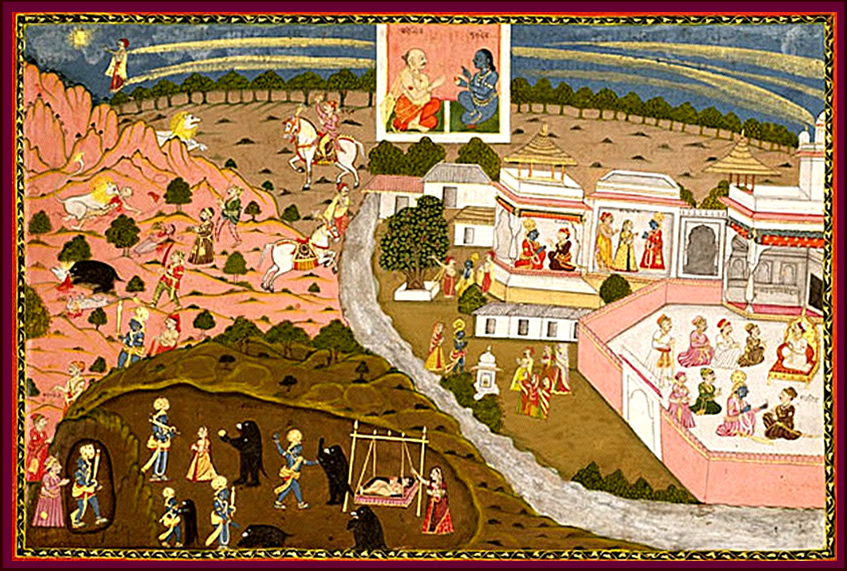
The picture
is titled: 'Story of the Syamantaka gem'. Unknown.
India 1780 - 1800, courtesy of Berkeley
Art Museum/Pacific Film Archive.
Production: Filognostic
Association of The Order of Time.

Feed-back | Links | Downloads | Music | Pictures | What's New | Search | Donations



 Text 1