
Canto 10
Canto 10
Chapter 57: Satrâjit Murdered, the Jewel Stolen and Returned Again
(1) The son of Vyâsa said: 'When Krishna heard [the rumor] that the sons of Pându and queen Kuntî had burned to death [in the house of lac], He, who exactly knew what had transpired, together with Balarâma went to the Kuru kingdom for His family obligations. (2) Meeting Bhîshma, Kripa, Vidura, Gândhârî and Drona They equally sorrowful said: 'Ah how painful this is!'
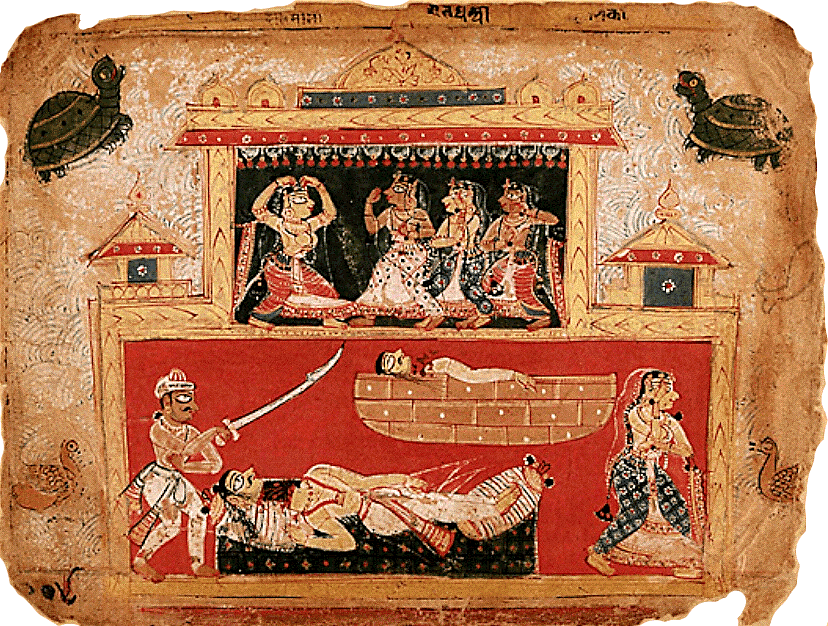
(3) [Meanwhile in Krishna's absence in Dvârakâ] Akrûra and [the Bhoja] Kritavarmâ saw an opportunity and said to S'atadhanvâ ['hundredbow', a bad character]: 'Why not take the jewel? (4) He [Satrâjit] promised us his gem of a daughter, but he ignored us and gave her to Krishna. Why then should Satrâjit not follow his brother [in death, see 10.56: 13 and *]?' (5) Thus influenced by the two that most wicked man, in his sinfulness shortening his lifespan, killed out of greed Satrâjit while he was sleeping [compare 1.17: 39]. (6) As the women [in Satrâjit's residence] helplessly cried, calling for help after he had killed him like a butcher kills animals, he took the jewel and disappeared.
(7) When Satyabhâmâ saw that her father had been killed, she thrown in grief lamented: 'Oh father, alas, oh father, with you being killed I am killed!' and then she fainted. (8) Putting the corpse in a large vessel of oil she went to Hastinâpura to Krishna, who [already] knew of the situation, and related sorrowfully the murder of her father. (9) The Lords hearing that, oh King, imitating the human ways both lamented with eyes full of tears: 'Oh what a tragedy fell upon us!'
(10) The Supreme Lord thereupon returned to His capital together with His wife and elder brother, prepared to kill S'atadhanvâ and take the jewel from him. (11) When he heard about it, he in fear took action to save his life and asked Kritavarmâ for assistance. But he told him: (12-13) 'I cannot commit such an offense against the Lords Râma and Krishna. How can anyone who causes Them trouble find happiness? Kamsa and his followers lost their wealth and lives because they hated Them, and Jarâsandha lost after seventeen battles [even] his chariot!'
(14) Turned down by him, he next begged Akrûra for help. But he said likewise: 'Who, knowing the strength of the Lordships, can oppose Them? (15-17) He who maintains, creates and destroys this universe as a pastime, He whose purpose is not even known to the secondary creators [headed by Brahmâ] who are bewildered by His invincible [mâyâ] potency, He who playing as a child of seven years old uprooted a mountain which He held up with a single hand like a boy holds a mushroom [see 10.25], Him, Krishna the Supreme Lord to whose wondrous acts there is no end, I worship. I offer my obeisances to Him who, as the source of all existence, is the Supreme Soul, the immovable center.'
(18) S'atadhanvâ, also being rejected by him, left the precious jewel with him, mounted a horse that could cover a hundred yojanas and took off. (19) Krishna and Râma mounted the chariot with the emblem of Garuda and pursued the murderer of Their respected senior with the fastest horses, oh King. (20) In a park in a suburb of Mithilâ S'atadhanvâ's horse collapsed. He abandoned it and continued on foot in terror, with a furious Krishna after him who also ran. (21) With him on the run the Lord, on foot, severed with His sharp-edged disc, his head from his body and then searched his upper and lower garments for the gem. (22) Not finding the stone, Krishna approached His elder brother and said: 'S'atadhanvâ was killed in vain, he did not carry the jewel.'
(23) Balarâma then said: 'S'atadhanvâ must have left the rock with some person, therefore go [back] to the city [of Dvârakâ] and search for him. (24) l myself wish to pay a visit to the king of Videha [the later Janaka, see 9.10: 11] who is most dear to Me.' Having said this, the descendant of Yadu, oh King, entered Mithilâ [the capital of Videha]. (25) Seeing Him, the king of Mithilâ immediately, with a mind full of love, rose to his feet and honored Him who was so worshipable with all available means, as was prescribed. (26) He, the Mighty One, honored by the affectionate great soul Janaka, lived there in Mithilâ for several years. During that time He taught Dhritarâshtra’s son Duryodhana to wield the club.
(27) When Kes'ava, the Almighty Lord, arrived in Dvârakâ, He, to comfort His beloved [the grieving Satyabhâmâ], told her about the demise of S'atadhanvâ and the failure to get hold of the jewel. (28) He, the Supreme Lord, together with all His friends then saw to it that the necessary ritual duties for the funeral of the deceased relative [Satrâjit] were performed. (29) As soon as the ones responsible, Akrûra and Kritavarmâ, heard that S'atadhanvâ had been killed, they out of fear went into exile, somewhere outside of Dvârakâ. (30) With Akrûra in exile ill omens arose for the residents of Dvârakâ. They continually experienced physical and mental troubles, and had problems with other living beings and the higher powers [natural disasters included, compare 1.14; 1.17: 19 **]. (31) Some citizens, my dear, were thus lost in guesses, forgetting completely what formerly was said about Him, the refuge of the sages. How can with Him being present any calamity arise? (32) [They said:] 'When Indra withheld the rains, the king of Benares [Kâs'î, see also 9.17: 4] gave his daughter Gândinî to S'vaphalka [Akrûra's father, 9.24: 15], who visited him. Thereupon it rained in Kâs'î. (33) Wherever his son Akrûra stays, who has his [father's] prowess, lord Indra will shower rains and no painful disturbances or untimely deaths will be seen.'
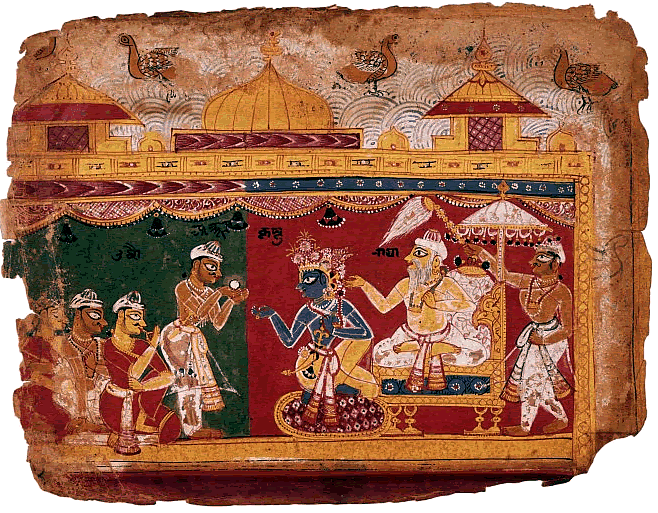
(34) Hearing these words of the elders, Janârdana, convinced that this [absence of Akrûra] was not the only explanation for the omens happening [***], ordered that Akrûra should be brought back. (35-36) Greeting him with respect and honor, and pleasantly discussing topics, He, fully aware of everything that went on in his heart, smiled and said: 'We of course, oh master of charity, are already familiar with the fact that you at present possess the opulent Syamantaka jewel entrusted to you by S'atadhanvâ. (37) Since Satrâjit had no sons it are his daughter's sons [she ànd her sons] who should receive his inheritance, after having presented water, offerings and having cleared his remaining debts. (38-39) Nevertheless, the jewel should stay with you, for it is for others impossible to manage, oh trustworthy keeper of the vows. My brother however, does not fully believe Me concerning the gem. To bring peace to My relatives, please show it now to Us, oh most fortunate soul who with your altars of gold uninterrupted continue with your sacrifices.' (40) Thus won over by the conciliatory words, the son of S'vaphalka took the gem hidden in his garment and handed over the jewel that shone as brilliant as the sun. (41) After showing the Syamantaka jewel to His relatives, [and thus] doing away with the emotions [of the accusations] against Him, the Lord returned it to him. (42) Whoever recites, hears or remembers this narration full of the prowess of the Supreme Controller Vishnu that most auspiciously removes all distress, will attain peace and drive away his sins and bad reputation.'


Third revised edition, loaded May 20, 2021.
Previous Aadhar edition and Vedabase links:
The son of Vyâsa said: 'When Krishna heard [the rumor] that the sons of Pându and queen Kuntî had burned to death [in the house of lac], He, who exactly knew what had transpired, together with Balarâma went to the Kuru kingdom for His family obligations.The son of Vyâsa said: 'Even though He was aware of what factually had transpired went Krishna, hearing [of the rumor] that the sons of Pându and queen Kuntî had burned to death [in the house of lac], in order to answer to His family obligations together with Balarâma to the Kuru kingdom. (Vedabase)
Meeting Bhîshma, Kripa, Vidura, Gândhârî and Drona They equally sorrowful said: 'Ah how painful this is!'
Meeting with Bhîshma, Kripa, Vidura, Gândhârî and Drona They equally sorrowful said: 'Ah how painful this is!' (Vedabase)
[Meanwhile in Krishna's absence in Dvârakâ] Akrûra and [the Bhoja] Kritavarmâ saw an opportunity and said to S'atadhanvâ ['hundredbow', a bad character]: 'Why not take the jewel?
Getting the chance, o King, said Akrûra and [the Bhoja] Kritavarmâ [meanwhile in Krishna's absence in Dvârakâ] to S'atadhanvâ ['hundredbow', a bad character]: 'Why not take the jewel? (Vedabase)
He [Satrâjit] promised us his gem of a daughter, but he ignored us and gave her to Krishna. Why then should Satrâjit not follow his brother [in death, see 10.56: 13 and *]?'
He who promised each of us his gem of a daughter, gave her, ignoring us, to Krishna; why then should Satrâjit not follow his brother [in death, see 10.56: 13 and footnote*]? (Vedabase)
Thus influenced by the two that most wicked man, in his sinfulness shortening his lifespan, killed out of greed Satrâjit while he was sleeping [compare 1.17: 39].
Thus influenced by the two killed that most wicked man, in his sinfulness shortening his lifespan, out of greed Satrâjit while he was sleeping [compare 1.17: 39]. (Vedabase)
As the women [in Satrâjit's residence] helplessly cried, calling for help after he had killed him like a butcher kills animals, he took the jewel and disappeared.
As the women helplessly cried calling for help took he, after having killed like a butcher does animals, the jewel and took he off. (Vedabase)
When Satyabhâmâ saw that her father had been killed, she thrown in grief lamented: 'Oh father, alas, oh father, with you being killed I am killed!' and then she fainted.
When Satyabhâmâ saw that her father had been killed, lamented she thrown in grief: 'O father, alas o father, with you being killed I am killed!' and then she fainted. (Vedabase)
Putting the corpse in a large vessel of oil she went to Hastinâpura to Krishna, who [already] knew of the situation, and related sorrowfully the murder of her father.
Putting the corpse in a large vessel of oil she went to Hastinâpura to Krishna who [already] knew of the situation, and related sorrowfully the murder of her father. (Vedabase)
The Lords hearing that o King, imitating the human ways both lamented with eyes full of tears: 'Oh what a tragedy fell upon us!'
The Lords hearing that o King, imitating the human ways both lamented with eyes full of tears: 'Oh what a tragedy fell upon us!' (Vedabase)
The Supreme Lord thereupon returned to His capital together with His wife and elder brother, prepared to kill S'atadhanvâ and take the jewel from him.
The Supreme Lord then went back to His capital with His wife and elder brother, prepared to kill S'atadhanvâ and take the jewel from him. (Vedabase)
When he heard about it, he in fear took action to save his life and asked Kritavarmâ for assistance. But he told him:
He, learning that, in fear took action to save his life and entreated for assistance Kritavarmâ who told him: (Vedabase)
'I cannot commit such an offense against the Lords Râma and Krishna. How can anyone who causes Them trouble find happiness? Kamsa and his followers lost their wealth and lives because they hated Them, and Jarâsandha lost after seventeen battles [even] his chariot!'
'I cannot be of any offense with the Lords Râma and Krishna; how can he who causes Them trouble indeed be of good fortune? Kamsa and his followers in their hatred of waging against Them lost their wealth and lives while Jarâsandha in seventeen battles [even] lost his chariot!' (Vedabase)
Turned down by him, he next begged Akrûra for help. But he said likewise: 'Who, knowing the strength of the Lordships, can oppose Them?
He, turned down, next begged Akrûra for help but he also said: 'Who, knowing the strength of the Lordships, can oppose Them? (Vedabase)
He who maintains, creates and destroys this universe as a pastime, He whose purpose is not even known to the secondary creators [headed by Brahmâ] who are bewildered by His invincible [mâyâ] potency, He who playing as a child of seven years old uprooted a mountain which He held up with a single hand like a boy holds a mushroom [see 10.25], Him, Krishna the Supreme Lord to whose wondrous acts there is no end, I worship. I offer my obeisances to Him who, as the source of all existence, is the Supreme Soul, the immovable center.'
He who maintains, creates and destroys this universe as a pastime; He whose purpose is not even known to the secondary creators [headed by Brahmâ] who are bewildered by His invincible potency [of mâyâ]; He who playing as a child of seven years old uprooted a mountain that He held up with a single hand like a boy does a mushroom [see 10.25]; Him, Krishna the Supreme Lord to whose wondrous acts there is no end I do worship; Him who as the source of all existence is the Supreme Soul, the immovable center, I offer my obeisances.' (Vedabase)
S'atadhanvâ, also being rejected by him, left the precious jewel with him, mounted a horse that could cover a hundred yojanas and took off.
He, S'atadhanvâ also by him refused, left the precious jewel with him, mounted a horse that could cover a hundred yojanas and departed. (Vedabase)
Krishna and Râma mounted the chariot with the emblem of Garuda and pursued the murderer of Their respected senior with the fastest horses, oh King.
Krishna and Râma mounting the chariot with the emblem of Garuda followed with the swiftest horses, o King, the murderer of Their guru [Their father-in-law as a teacher]. (Vedabase)
In a park in a suburb of Mithilâ S'atadhanvâ's horse collapsed. He abandoned it and continued on foot in terror, with a furious Krishna after him who also ran.
In a Mithilâ suburban park abandoning his horse that had fallen, ran he on foot terrified with a furious Krishna who likewise speeded after him. (Vedabase)
With him on the run the Lord, on foot, severed with His sharp-edged disc, his head from his body and then searched his upper and lower garments for the gem.
With him on the run severed the Lord on foot with the sharp edged disc his head from his body, and searched He his upper and lower garments for the gem. (Vedabase)
Not finding the stone, Krishna approached His elder brother and said: 'S'atadhanvâ was killed in vain, he did not carry the jewel.'
Not finding the stone said Krishna going to His approaching elder brother: 'S'atadhanvâ was killed in vain, he didn't carry the jewel.' (Vedabase)
Balarâma then said: 'S'atadhanvâ must have left the rock with some person, therefore go [back] to the city [of Dvârakâ] and search for him.
Balarâma then said: 'S'atadhanvâ must have left the rock with some person, so go [back] to the city [of Dvârakâ] and search him out. (Vedabase)
l myself wish to pay a visit to the king of Videha [the later Janaka, see 9.10: 11] who is most dear to Me.' Having said this, the descendant of Yadu, oh King, entered Mithilâ [the capital of Videha].
l wish to see the king of Videha [the later Janaka, see 9.10: 11] most dear to Me', and thus having spoken entered the descendant of Yadu, o King, Mithilâ [the capital of Videha]. (Vedabase)
Seeing Him, the king of Mithilâ immediately, with a mind full of love, rose to his feet and honored Him who was so worshipable with all available means, as was prescribed.
Seeing Him rose the king of Mithilâ immediately with a mind full of love and honored he Him who was so worshipable, as was prescribed with all there was to it. (Vedabase)
He, the Mighty One, honored by the affectionate great soul Janaka, lived there in Mithilâ for several years. During that time He taught Dhritarâshtra’s son Duryodhana to wield the club.
There in Mithilâ did He, the Mighty One, honored by the affectionate Janaka, the great soul, live for several years. During that time taught He Duryodhana to wield the club. (Vedabase)
When Kes'ava, the Almighty Lord, arrived in Dvârakâ, He, to comfort His beloved [the grieving Satyabhâmâ], told her about the demise of S'atadhanvâ and the failure to get hold of the jewel.
Kes'ava the All-powerful One arriving in Dvârakâ, told to the comfort of His beloved [the grieving Satyabhâmâ] of the demise of S'atadhanvâ and the failure to get hold of the jewel. (Vedabase)
He, the Supreme Lord, together with all His friends then saw to it that the necessary ritual duties for the funeral of the deceased relative [Satrâjit] were performed.
He, the Supreme Lord together with all the well-wishers one may so have at the end of one's life, then saw to it that the obsequies were performed for the deceased relative [Satrâjit]. (Vedabase)
As soon as the ones responsible, Akrûra and Kritavarmâ, heard that S'atadhanvâ had been killed, they out of fear went into exile, somewhere outside of Dvârakâ.
The ones responsible, Akrûra and Kritavarmâ, upon hearing that S'atadhanvâ had been killed, went stricken by fear into exile outside of Dvârakâ. (Vedabase)
With Akrûra in exile ill omens arose for the residents of Dvârakâ. They continually experienced physical and mental troubles, and had problems with other living beings and the higher powers [natural disasters included, compare 1.14; 1.17: 19 **].
With Akrûra in exile ill omens arose indeed for the residents of Dvârakâ that gave them by higher powers [natural disasters included] and other living beings [compare 1.14; 1.17: 19], constantly trouble in body and mind [**]. (Vedabase)
Some citizens, my dear, were thus lost in guesses, forgetting completely what formerly was said about Him, the refuge of the sages. How can with Him being present any calamity arise?
Thus, my dear, were some lost in guesses forgetting what of old had been described by the sages as the consequence of His stay among the human beings; how could with Him present any calamity arise? (Vedabase)
[They said:] 'When Indra withheld the rains, the king of Benares [Kâs'î, see also 9.17: 4] gave his daughter Gândinî to S'vaphalka [Akrûra's father, 9.24: 15], who visited him. Thereupon it rained in Kâs'î.
[They said:] 'When Indra withheld the rains gave the king of Benares [Kâs'î, see also 9.17: 4] his daughter Gândinî to S'vaphalka [Akrûra's father, 9.24: 15] who came to him, after which it then indeed rained in Kâs'î. (Vedabase)
Wherever his son Akrûra stays, who has his [father's] prowess, lord Indra will shower rains and no painful disturbances or untimely deaths will be seen.'
Wherever indeed he, Akrûra, his son, having his [father's] prowess stays, will lord Indra shower rains and will there be no painful disturbances or untimely deaths.' (Vedabase)
Hearing these words of the elders, Janârdana, convinced that this [absence of Akrûra] was not the only explanation for the omens happening [***], ordered that Akrûra should be brought back.
Hearing of the elders these words, ordered Janârdana, with the thought in mind that this was not the only explanation for the omens happening [***], that Akrûra should be brought back. (Vedabase)
Greeting him with respect and honor, and pleasantly discussing topics, He, fully aware of everything that went on in his heart, smiled and said: 'We of course, oh master of charity, are already familiar with the fact that you at present possess the opulent Syamantaka jewel entrusted to you by S'atadhanvâ.
Greeting him with respect and honor and pleasantly discussing topics, smiled He, fully aware of everything that went on in his heart, and said: 'We of course, o master of charity, are already familiar with the fact that you indeed at present hold the opulent Syamantaka jewel that S'atadhanvâ put under your care. (Vedabase)
Since Satrâjit had no sons it are his daughter's sons [she ànd her sons] who should receive his inheritance, after having presented water, offerings and having cleared his remaining debts.
Since Satrâjit had no sons is it his daughter's sons [she and her sons] who after presenting water, offerings and having cleared his remaining debts, should receive his inheritance. (Vedabase)
Nevertheless, the jewel should stay with you, for it is for others impossible to manage, oh trustworthy keeper of the vows. My brother however, does not fully believe Me concerning the gem. To bring peace to My relatives, please show it now to Us, oh most fortunate soul who with your altars of gold uninterrupted continue with your sacrifices.'
Nevertheless should the jewel, because it for others is impossible to manage, remain with you, o trustworthy keeper of the vows. However, My brother does not completely believe Me concerning the gem. Please, to bring peace to My relatives, show it Us now, o most fortunate soul who with your altars of gold without interruption continue with your sacrifices.' (Vedabase)
Thus won over by the conciliatory words, the son of S'vaphalka took the gem hidden in his garment and handed over the jewel that shone as brilliant as the sun.
Thus won over by the conciliant words took the son of S'vaphalka the gem hidden in his garment and gave he the gem that shone as brilliant as the sun. (Vedabase)
After showing the Syamantaka jewel to His relatives, [and thus] doing away with the emotions [of the accusations] against Him, the Lord returned it to him.
After showing Syamantaka to His relatives, [and thus] doing away with the emotions [of the accusations held] with Him, offered the Master it back to him again. (Vedabase)
Whoever recites, hears or remembers this narration full of the prowess of the Supreme Controller Vishnu that most auspiciously removes all distress, will attain peace and drive away his sins and bad reputation.'
Whoever recites, hears or remembers this narration which indeed, rich as it is with the prowess of the Supreme Controller Vishnu, most auspiciously removes the reactions to sin, will attain peace and drive away his badness and bad reputation.' (Vedabase)
*: Being pure devotees they could not actually be unhappy about this match, nor could they become jealous rivals of the Lord. Therefore they had an ulterior motive in behaving like His rivals. So there are speculations in the paramparâ about Akrûra being cursed for his taking Krishna away from Gokula [see 10.39] or about Kritavarmâ being a member of Kamsa's family, or that the two might have been angry with the victim because he spoiled Krishna's good name by slandering that He would have killed his brother.
**: According to S'rîla S'rîdhara Svâmî, reasoning after verse 32 and 35-36, Akrûra took the Syamantaka jewel and went to reside in the city of Benares, where he became known as Dânapati, "the master of charity." There he executed elaborate fire sacrifices on golden altars with assemblies of qualified priests.
***: Also concerning this there are speculations on why there could have been this trouble despite the Lord's gracious presence. Some suggest that Krishna would deliver the bad times because He was compromised by Akrûra who took the jewel elsewhere in rivalry with His rule. At the other hand it is not that unusual that murder in a community, to the rule of God and Krishna, delivers that community a bad time, as one often sees taking place after major wars as pointed out in the Bhâgavatam with its description of the bad times when Krishna after the great Kuru war Himself departed for His heavenly abode [1.14].

The text and audio are offered under the conditions of
the
Creative
Commons Attribution-Noncommercial-Share Alike 3.0 Unported
License.
The first
picture is titled: "Two scenes in a palace surrounded by water"
Delhi-Agra, India , Pre-Mughal period ,ca. 1525-40.
Source: Smithsonian
Sackler Gallery.
The second picture is a gouache titled: 'Akrura presenting the
jewel Shyamantaka to Krishna',
1520-1540 (painted), © Victoria
&
Albert Museum
Production: Filognostic
Association of The Order of Time.

Feed-back | Links | Downloads | Music | Pictures | What's New | Search | Donations



 Text 1