Canto
9
Canto
9
Chapter 24: The Yadu and Vrishni Dynasties, Prithâ and the Glory of Lord Krishna
(1) S'rî S'uka said: 'Vidarbha [the son of the Yadu Jyâmagha] begot in her [the girl brought by his father, see 9.23: 35-38] the two sons Kus'a and Kratha and a third one called Romapâda [also, see 9.23: 7-10] who was the favorite of the Vidarbha dynasty. (2) Romapâda's son was Babhru, he gave life to Kriti who begot Us'ika, who had the son Cedi [see also 9.22: 6], from whom Damaghosha [the father of S'is'upâla] and other protectors of man were born. (3-4) From Kratha there was a son born called Kunti who begot Vrishni, from whom next Nirvriti took his birth. From his loins the one named Das'ârha was born. He fathered a son called Vyoma, who begot Jîmûta. Jîmûta had the son Vikriti, who had a son called Bhîmaratha, and his son Navaratha had the son Das'aratha. (5) [Das'aratha's son] S'akuni fathered Karambhi, who begot a son called Devarâta. His son was Devakshatra, and from him there was Madhu, who had the son Kuruvas'a who gave life to Anu. (6-8) From Puruhotra, the son of Anu, there was Ayu. Ayu fathered the son Sâtvata and he had seven sons called Bhajamâna, Bhaji, Divya, Vrishni, Devâvridha, Andhaka and Mahâbhoja, oh worthy friend. From Bhajamâna there were with one wife the sons Nimloci, Kinkana and Dhrishthi, and with another wife there were also three sons: S'atâjit, Sahasrâjit and Ayutâjit, oh master. (9) From Devâvridha there was the son Babhru and about the two of them two verses are recited by the elder generation. 'We heard from others and also saw with our own eyes the following: (10-11) Babhru was the best among the human beings and Devâvridha equalled the demigods', and: 'Because of Babhru and Devâvridha all the fourteen thousand sixty-five persons [who appeared after them] have achieved immortality.' In the dynasty of Mahâbhoja, who was a most pious soul, there were the rulers called the Bhoja kings.
(12) From Vrishni [the son of Sâtvata] the sons Sumitra and Yudhâjit appeared, oh subduer of the enemies. S'ini and Anamitra then took birth [from Yudhâjit], and from Anamitra the son Nighna appeared. (13) Nighna fathered the sons Satrâjit and Prasena. Anamitra had another son who was also called S'ini, and Satyaka was his son. (14) Yuyudhâna was fathered by Satyaka. His son was Jaya, and from him there was Kuni, whose son was Yugandhara. Another son of Anamitra was Vrishni. (15) S'vaphalka and Citraratha were the sons of Vrishni. Akrûra was by S'vaphalka begotten in Gândinî. He was the eldest of twelve other most celebrated sons: (16-18) Âsanga, Sârameya, Mridura, Mriduvit, Giri, Dharmavriddha, Sukarmâ, Kshetropeksha, Arimardana; S'atrughna, Gandhamâda and Pratibâhu. Next to these twelve sons there was also a daughter called Sucârâ. From Akrûra there were two sons named Devavân and Upadeva. Citraratha had many sons, beginning with Prithu and Vidûratha, who are known as the sons of Vrishni.
(19) Kukura, Bhajamâna, S'uci and Kambalabarhisha [were the sons of Andhaka, see 6-8]. Kukura had a son called Vahni from whom Vilomâ was born. (20) His son Kapotaromâ had the son Anu, who had a friend called Tumburu [a famous Gandharva, a musician]. From Andhaka [Anu's son] there was Dundubhi, who gave life to Avidyota, who fathered a son called Punarvasu. (21-23) From him there were Âhuka and Âhukî, a son and a daughter. From Âhuka there were the sons Devaka and Ugrasena. Devaka had four sons: Devavân, Upadeva, Sudeva and Devavardhana. There were also seven daughters, o protector of man: S'ântidevâ, Upadevâ, S'rîdevâ, Devarakshitâ, Sahadevâ, Devakî and Dhritadevâ, who was the eldest. Vasudeva [Kṛṣṇa's father] married them. (24) Kamsa, Sunâmâ, Nyagrodha, Kanka, S'anku, Suhû, Râshthrapâla, Dhrishthi and Tushthimân were the sons of Ugrasena. (25) Ugrasena's daughters Kamsâ, Kamsavatî, Kankâ, S'ûrabhû and Râshthrapâlikâ, became the wives of the younger brothers of Vasudeva.
(26) Vidûratha [the son of Citraratha] begot S'ûra, who had a son called Bhajamâna from whose loins S'ini was born. S'ini fathered the son called Bhoja, and his son is known as Hridika. (27) His sons were called Devamîdha, S'atadhanu and Kritavarmâ. From Devamîdha there was [another son called] S'ûra, who had a wife named Mârishâ. (28-31) With her he begot ten perfect sons: Vasudeva, Devabhâga, Devas'ravâ, Ânaka, Sriñjaya, S'yâmaka, Kanka, S'amîka, Vatsaka and Vrika. When Vasudeva took his birth, he was welcomed by the godly souls with the sounds of kettledrums. He is also called Ânakadundubhi ['kettle drum beaten'] because he provided the Lord's [Lord Krishna, Vâsudeva] place of birth. S'ûra's daughters, Prithâ [the mother of Arjuna who was Krishna's nephew and friend] S'rutadevâ, S'rutakîrti, S'rutas'ravâ and Râjâdhidevî, were Vasudeva's five sisters. Father S'ûra gave Prithâ to a childless friend called Kunti [therefore she is also known as Kuntî].
(32) She received from Durvâsâ, whom she had pleased, the knowledge to call for any demigod. Just to examine that potency she, that pious soul, summoned the sun god. (33) When she saw the godhead appearing before her, she was very surprised and said: 'Forgive me, oh godhead, please return, I only engaged this way to check out what it would do!'
(34) [The sun god answered:] 'In order not to be fruitless in your encounter with a godhead, I shall give you a son in your womb and arrange it so, oh my beauty, that you will not be defiled.'
(35) With this promise the sun god made her pregnant and returned to his heavenly abode. Directly thereafter a child was born that looked like a second sun god. (36) Afraid of what the people might think she greatly sorry gave up that child [named Karna: 'the ear'] by letting it go in the water of the river [in a basket, see also 9.23: 13]. Pându, your pious and chivalrous great-grandfather, was the one who [later on] married her.
(37) From the marriage of S'rutadevâ [Kuntî's sister] with Vriddhas'armâ, the king of Karûsha, the son Dantavakra was born. Dantavakra was the [incarnation of the] one who became a son of Diti [called Hiranyâksha], after having been cursed by the sages [by the Kumâras, see Jaya and Vijaya]. (38) Dhrishthaketu, the king of Kekaya, married [Kuntî's sister] S'rutakîrti with whom he had five sons of whom Santardana was the eldest. (39) Râjâdhidevî [another sister of Kuntî] married Jayasena and gave birth to two sons [named Vinda and Anuvinda]. S'rutas'ravâ married Damaghosha, the king of Cedi. (40) S'is'upâla was her son. His birth I already described to you [7.1: 46; 7.10: 38]. Devabhâga [one of Vasudeva's brothers] had [the sons] Citraketu and Brihadbala with the wife Kamsâ. (41) Devas'ravâ fathered with Kamsavatî the sons Suvîra and Ishumân. Kanka together with his wife Kankâ gave life to the sons Baka, Satyajit and Purujit. (42) Sriñjaya had together with Râshthrapâlikâ sons of whom Vrisha and Durmarshana were the eldest. S'yâmaka gave together with S'ûrabhûmi life to the sons Harikes'a and Hiranyâksha. (43) Vatsaka fathered Vrika and other sons together with his wife Mis'rakes'î, a girl of heaven. Vrika with his wife Durvâkshî had sons that were headed by Taksha, Pushkara and S'âla. (44) S'amîka together with Sudâmanî gave life to sons who were headed by Sumitra and Arjunapâla. Ânaka together with his wife Karnikâ brought two sons into the world who were called Ritadhâmâ and Jaya.
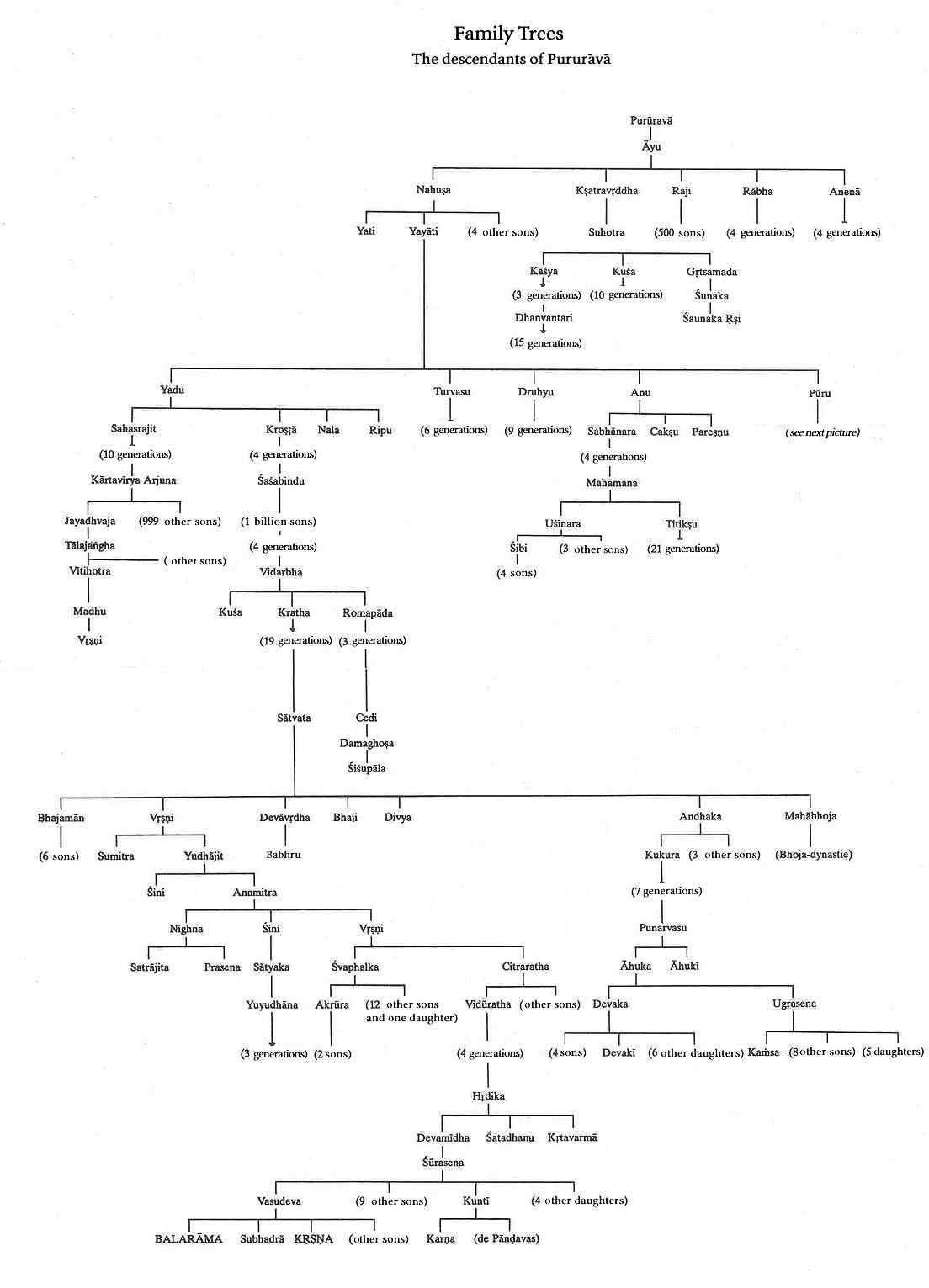
(45) The wives of Ânakadundubhi [Vasudeva, see also 21-23] were first of all Devakî and then Pauravî, Rohinî, Bhadrâ, Madirâ, Rocanâ and Ilâ. (46) The sons who were begotten by Vasudeva in Rohinî were Krita, the eldest son, and Bala, Gada, Sârana, Durmada, Vipula, Dhruva and others. (47-48) Bhûta, the eldest son, Subhadra, Bhadrabâhu, Durmada and Bhadra belonged to the twelve sons Pauravî gave birth to. Nanda, Upananda, Kritaka, S'ûra and others were the sons of Madirâ, while Kaus'alyâ [Bhadrâ] gave birth to only one son named Kes'î. (49) Vasudeva begot in Rocanâ the sons Hasta, Hemângada and others. In Ilâ he begot the sons, with Uruvalka as the eldest one, who were the leading personalities of the Yadu dynasty. (50) Ânakadundubhi begot in Dhritadevâ one son: Viprishthha, while Pras'ama, Prasita and others were the sons he had with S'ântidevâ, oh King. (51) With Upadevâ there were ten sons headed by Râjanya, Kalpa and Varsha. Vasu, Hamsa and Suvams'a and others were the six sons [Vasudeva had] with S'rîdevâ. (52) With his wife Devarakshitâ he also gave life to nine sons of whom Gadâ was the first one. With Sahadevâ Vasudeva fathered eight sons. (53-55) These sons, headed by S'ruta and Pravara [or Pauvara], were of the same dharma as the Vasus [they were their incarnations]. Vasudeva begot in Devakî eight highly qualified sons: Kîrtimân, Sushena, Bhadrasena, Riju, Sammardana, Bhadra and [Bhagavân] Sankarshana, the serpent controller [the ruler of the ego, see 3.26: 25]. The eighth one to appear from them was [svayam] the Lord in person [Lord Krishna]. Subhadrâ [His sister], as you know, is your so greatly fortunate grandmother, oh King.(Picture: family tree from Purûravâ up to Krishna)
Thus the ninth Canto of the S'rîmad Bhâgavatam ends named: Liberation.
Third revised edition, loaded March 26, 2020.
Previous Aadhar edition and Vedabase links:
S'rî S'uka said: 'Vidarbha [the son of the Yadu Jyâmagha] begot in her [the girl brought by his father, see 9.23: 35-38] the two sons Kus'a and Kratha and a third one called Romapâda [also, see 9.23: 7-10] who was the favorite of the Vidarbha dynasty.S'rî S'uka said: 'In her [see 9.23: 35-38] begot Vidarbha [the son of the Yadu Jyâmagha] the two sons Kus'a and Kratha and a third one called Romapâda [also, see 9.23: 7-10] who was the favorite of the Vidarbha dynasty. (Vedabase)
Romapâda's son was Babhru, he gave life to Kriti who begot Us'ika, who had the son Cedi [see also 9.22: 6], from whom Damaghosha [the father of S'is'upâla] and other protectors of man were born.
Romapâda's son was Babhru, from Babhru was Kriti born and from his son Us'ika there was Cedi [see also 9.22: 6] from whom Caidya [Damaghosha, 7.1: 18] and other protectors of man were born. (Vedabase)
From Kratha there was a son born called Kunti who begot Vrishni, from whom next Nirvriti took his birth. From his loins the one named Das'ârha was born. He fathered a son called Vyoma, who begot Jîmûta. Jîmûta had the son Vikriti, who had a son called Bhîmaratha, and his son Navaratha had the son Das'aratha.
Of Kratha there was a son called Kunti, of whom Vrishni was born, from whom then Nirvriti took birth of whom the one named Das'ârha was born. From him there was a son Vyoma who begot Jîmûta who had Vikriti for his son of whom Bhîmaratha was born whose son Navaratha had Das'aratha. (Vedabase)
[Das'aratha's son] S'akuni fathered Karambhi, who begot a son called Devarâta. His son was Devakshatra, and from him there was Madhu, who had the son Kuruvas'a who gave life to Anu.
Karambhi of S'akuni [Das'aratha's son] got a son Devarâta, his son was Devakshatra and after him there was Madhu who got Kuruvas'a who begot Anu. (Vedabase)
From Puruhotra, the son of Anu, there was Ayu. Ayu fathered the son Sâtvata and he had seven sons called Bhajamâna, Bhaji, Divya, Vrishni, Devâvridha, Andhaka and Mahâbhoja, oh worthy friend. From Bhajamâna there were with one wife the sons Nimloci, Kinkana and Dhrishthi, and with another wife there were also three sons: S'atâjit, Sahasrâjit and Ayutâjit, oh master.
From Puruhotra, known as the son of Anu, there was Ayu who had Sâtvata for his son and Bhajamâna, Bhaji, Divya, Vrishni, Devâvridha, Andhaka and Mahâbhoja were the seven sons of Sâtvata, o worthy friend. From Bhajamâna there were with one wife the sons Nimloci, Kinkana and Dhrishthi, and with another one alike were there also the three sons of S'atâjit, Sahasrâjit and Ayutâjit, o master. (Vedabase)
From Devâvridha there was the son Babhru and about the two of them two verses are recited by the elder generation. 'We heard from others and also saw with our own eyes the following:
Of Devâvridha and his son Babhru there are, as we have heard from others and is still the same seen at present, two verses recited by the old generation: (Vedabase)
Babhru was the best among the human beings and Devâvridha equalled the demigods', and: 'Because of Babhru and Devâvridha all the fourteen thousand sixty-five persons [who appeared after them] have achieved immortality.' In the dynasty of Mahâbhoja, who was a most pious soul, there were the rulers called the Bhoja kings.
'Babhru, the best of all the humans and Devâvridha, the best among the godly - of the accord of these two have all the fourteen thousand sixty-five persons [who followed after them] achieved the eternal abode.' and: 'In the dynasty of Mahâbhoja was there from the association of the Bhoja kings of Babhru and Devâvridha only the more and more complete of the dharma'. (Vedabase)
From Vrishni [the son of Sâtvata] the sons Sumitra and Yudhâjit appeared, oh subduer of the enemies. S'ini and Anamitra then took birth [from Yudhâjit], and from Anamitra the son Nighna appeared.
Of Vrishni [born from Sâtvata] appeared the sons Sumitra and Yudhâjit, o subduer of the enemies. S'ini and Anamitra took birth from him [Yudhâjit] and from Anamitra appeared Nighna. (Vedabase)
Nighna fathered the sons Satrâjit and Prasena. Anamitra had another son who was also called S'ini, and Satyaka was his son.
From Nighna came into existence the sons Satrâjita and Prasena. Another son of him was also called S'ini and his son was Satyaka. (Vedabase)
Yuyudhâna was fathered by Satyaka. His son was Jaya, and from him there was Kuni, whose son was Yugandhara. Another son of Anamitra was Vrishni.
Yuyudhâna there of Satyaka had Jaya and from him there was Kuni whose son was Yugandhara. Another son of Anamitra was Vrishni. (Vedabase)
S'vaphalka and Citraratha were the sons of Vrishni. Akrûra was by S'vaphalka begotten in Gândinî. He was the eldest of twelve other most celebrated sons:
S'vaphalka and Citraratha were his sons. Begotten in Gândinî by S'vaphalka there was Akrûra, the eldest of twelve other most celebrated sons: (Vedabase)
Âsanga, Sârameya, Mridura, Mriduvit, Giri, Dharmavriddha, Sukarmâ, Kshetropeksha, Arimardana; S'atrughna, Gandhamâda and Pratibâhu. Next to these twelve sons there was also a daughter called Sucârâ. From Akrûra there were two sons named Devavân and Upadeva. Citraratha had many sons, beginning with Prithu and Vidûratha, who are known as the sons of Vrishni.
Âsanga, Sârameya and Mridura; Mriduvit, Giri, Dharmavriddha, Sukarmâ, Kshetropeksha and Arimardana; S'atrughna, Gandhamâda and Pratibâhu. To the twelve of them there was a sister named Sucârâ. Of Akrûra there are two sons named Devavân and Upadeva. Citraratha had, beginning with Prithu and Vidûratha, many sons known as the sons of Vrishni. (Vedabase)
Kukura, Bhajamâna, S'uci and Kambalabarhisha [were the sons of Andhaka, see 6-8]. Kukura had a son called Vahni from whom Vilomâ was born.
Among Kukura, Bhajamâna, S'uci and Kambalabarhisha [sons of Andhaka see 6-8] had Kukura a son called Vahni from whom was born Vilomâ. (Vedabase)
His son Kapotaromâ had the son Anu, who had a friend called Tumburu [a famous Gandharva, a musician]. From Andhaka [Anu's son] there was Dundubhi, who gave life to Avidyota, who fathered a son called Punarvasu.
His son Kapotaromâ had Anu and his friend was Tumburu. Of Andhaka [Anu's son] there was Dundubhi from whom there was Avidyota who had a son named Punarvasu. (Vedabase)
From him there were Âhuka and Âhukî, a son and a daughter. From Âhuka there were the sons Devaka and Ugrasena. Devaka had four sons: Devavân, Upadeva, Sudeva and Devavardhana. There were also seven daughters, o protector of man: S'ântidevâ, Upadevâ, S'rîdevâ, Devarakshitâ, Sahadevâ, Devakî and Dhritadevâ, who was the eldest. Vasudeva [Krishna's father] married them.
From him there were Âhuka and Âhukî, a son and a daughter, and of Âhuka there were the sons Devaka and Ugrasena. Devaka had four sons: Devavân, Upadeva, Sudeva and Devavardhana. There existed also seven daughters, o protector of man: S'ântidevâ, Upadevâ, S'rîdevâ, Devarakshitâ, Sahadevâ, Devakî and Dhritadevâ who was the eldest. Vasudeva [Krishna's father] married with them. (Vedabase)
Kamsa, Sunâmâ, Nyagrodha, Kanka, S'anku, Suhû, Râshthrapâla, Dhrishthi and Tushthimân were the sons of Ugrasena.
Kamsa, Sunâmâ, Nyagrodha, Kanka, S'anku, Suhû as also Râshthrapâla and next Dhrishthi and Tushthimân were Ugrasena's sons. (Vedabase)
Ugrasena's daughters Kamsâ, Kamsavatî, Kankâ, S'ûrabhû and Râshthrapâlikâ, became the wives of the younger brothers of Vasudeva.
Ugrasena's daughters Kamsâ, Kamsavatî, Kankâ, S'ûrabhû and Râshthrapâlikâ became the wives of the younger brothers of Vasudeva. (Vedabase)
Vidûratha [the son of Citraratha] begot S'ûra, who had a son called Bhajamâna from whose loins S'ini was born. S'ini fathered the son called Bhoja, and his son is known as Hridika.
From S'ûra who was born to Vidûratha [the son of Citraratha of Vrishni] took a son called Bhajamâna his birth and from him there was S'ini who fathered the famous king Bhoja whose son is the celebrated Hridika. (Vedabase)
His sons were called Devamîdha, S'atadhanu and Kritavarmâ. From Devamîdha there was [another son called] S'ûra who had a wife named Mârishâ.
Devamîdha, S'atadhanu and Kritavarmâ then were his sons. Of Devamîdha there was [another] S'ûra who had a wife named Mârishâ. (Vedabase)
With her he begot ten perfect sons: Vasudeva, Devabhâga, Devas'ravâ, Ânaka, Sriñjaya, S'yâmaka, Kanka, S'amîka, Vatsaka and Vrika. When Vasudeva took his birth he was welcomed by the godly souls with the sounds of kettledrums. He is also called Ânakadundubhi ['kettle drum beaten'] because he provided the Lord's [Lord Krishna, Vâsudeva] place of birth. S'ûra's daughters, Prithâ [the mother of Arjuna who was Krishna's nephew and friend] S'rutadevâ, S'rutakîrti, S'rutas'ravâ and Râjâdhidevî, were Vasudeva's five sisters. Father S'ûra gave Prithâ to a childless friend called Kunti [therefore she is also known as Kuntî].
In her he begot ten sons: Vasudeva, Devabhâga, Devas'ravâ, Ânaka, Sriñjaya, S'yâmaka, Kanka, S'amîka, Vatsaka and Vrika. When Vasudeva took his birth was he by the godly welcomed with the sounds of kettledrums beaten. He is also called Ânakadundubhi for giving the Lord His place of birth. S'ûra's daughters Prithâ [the mother of Arjuna, Krishna's nephew and friend] and S'rutadevâ as also S'rutakîrti, S'rutas'ravâ and Râjâdhidevî were his five sisters. Father S'ûra delivered to a childless friend called Kunti, Prithâ who thus is also known as Kuntî. (Vedabase)
She received from Durvâsâ, whom she had pleased, the knowledge to call for any demigod. Just to examine that potency she, that pious soul, summoned the sun god.
She received from Durvâsâ, whom she had pleased, the knowledge to call for any demigod. Just to examine that potency called she, the pious one, for the sungod. (Vedabase)
When she saw the godhead appearing before her, she was very surprised and said: 'Forgive me, oh godhead, please return, I only engaged this way to check out what it would do!'
When she saw that very instant the godhead appearing before her, was she very surprised and said she: 'Please forgive me o godhead, please return, I only engaged to check out what it would do!' (Vedabase)
[The sun god answered:] 'In order not to be fruitless in your encounter with a godhead, I shall give you a son in your womb and arrange it so, oh my beauty, that you will not be defiled.'[The sungod answered:] 'Not to be fruitless in your meeting with a godhead shall I give you to that a son in your womb and I'll arrange it so for you, o my beauty, that you will not be defiled.' (Vedabase)
With this promise the sun god made her pregnant and returned to his heavenly abode. Directly thereafter a child was born that looked like a second sun god.
Promising her this made the sun-god her pregnant and returned He to His heavenly abode.' Directly thereafter was a child born that was like a second sungod. (Vedabase)
Afraid of what the people might think she greatly sorry gave up that child [named Karna: 'the ear'] by letting it go in the water of the river [in a basket, see also 9.23: 13]. Pându, your pious and chivalrous great-grandfather, was the one who [later on] married her.
Afraid of what the people might think did she greatly sorry forsake that child [Karna: 'into the ear'] letting it go in the water of the river [in a basket, see also 9.23: 13]; it was indeed your pious and chivalrous great-grandfather Pându who married her. (Vedabase)
From the marriage of S'rutadevâ [Kuntî's sister] with Vriddhas'armâ, the king of Karûsha, the son Dantavakra was born. Dantavakra was the [incarnation of the] one who became a son of Diti [called Hiranyâksha], after having been cursed by the sages [by the Kumâras, see Jaya and Vijaya].
From the marriage of S'rutadevâ [Kuntî's sister] with Vriddhas'armâ, the king of Karûsha, was then Dantavakra born. Dantavakra was the one who, cursed by the seven sages [originally by the Kumâras, see Jaya and Vijaya], became a son of Diti. (Vedabase)
Dhrishthaketu, the king of Kekaya, married [Kuntî's sister] S'rutakîrti with whom he had five sons of whom Santardana was the eldest.
Dhrishthaketu, the king of Kekaya, married S'rutakîrti with whom he had five sons headed by Santardana. (Vedabase)
Râjâdhidevî [another sister of Kuntî] married Jayasena and gave birth to two sons [named Vinda and Anuvinda]. S'rutas'ravâ married Damaghosha, the king of Cedi.
Râjâdhidevî gave with Jayasena birth to sons [named Vinda and Anuvinda]. Damaghosha, the king of Cedi, then married S'rutas'ravâ. (Vedabase)
S'is'upâla was her son. His birth I already described to you [7.1: 46; 7.10: 38]. Devabhâga [one of Vasudeva's brothers] had [the sons] Citraketu and Brihadbala with the wife Kamsâ.
S'is'upâla, whose birth I already described [7.1: 46; 7.10: 38], was her son. From Devabhâga [one of Vasudeva's brothers] were there with the wife Kamsâ, [the sons] Citraketu and Brihadbala. (Vedabase)
Devas'ravâ fathered with Kamsavatî the sons Suvîra and Ishumân. Kanka together with his wife Kankâ gave life to the sons Baka, Satyajit and Purujit.
From Devas'ravâ gave Kamsavatî birth to Suvîra and Ishumân; and by Kanka were Baka, Satyajit and Purujit begotten in Kankâ. (Vedabase)
Sriñjaya had together with Râshthrapâlikâ sons of whom Vrisha and Durmarshana were the eldest. S'yâmaka gave together with S'ûrabhûmi life to the sons Harikes'a and Hiranyâksha.
Sriñjaya with Râshthrapâlikâ begot sons headed by Vrisha and Durmarshana. S'yâmaka in S'ûrabhûmi begot Harikes'a and Hiranyâksha. (Vedabase)
Vatsaka fathered Vrika and other sons together with his wife Mis'rakes'î, a girl of heaven. Vrika with his wife Durvâkshî had sons that were headed by Taksha, Pushkara and S'âla.
In Mis'rakes'î, a girl of heaven, were by Vatsaka begotten Vrika and other sons. Vrika gave his wife Durvâkshî sons with Taksha, Pushkara and S'âla as the first among them. (Vedabase)
S'amîka together with Sudâmanî gave life to sons who were headed by Sumitra and Arjunapâla. Ânaka together with his wife Karnikâ brought two sons into the world who were called Ritadhâmâ and Jaya.
Sumitra and Arjunapâla as the eldest were then by S'amîka begotten in Sudâmanî. Ânaka with Karnikâ gave birth to Ritadhâmâ and Jaya as well. (Vedabase)
The wives of Ânakadundubhi [Vasudeva, see also 21-23] were first of all Devakî and then Pauravî, Rohinî, Bhadrâ, Madirâ, Rocanâ and Ilâ.
Pauravî, Rohinî, Bhadrâ, Madirâ, Rocanâ and Ilâ headed by Devakî were the wives [see also 21-23] there for Ânakadundubhi [Vasudeva]. (Vedabase)
The sons who were begotten by Vasudeva in Rohinî were Krita, the eldest son, and Bala, Gada, Sârana, Durmada, Vipula, Dhruva and others.
With Krita first were Bala, Gada, Sârana and Durmada, Vipula and Dhruva the sons that Vasudeva then begot in Rohinî. (Vedabase)
Bhûta, the eldest son, Subhadra, Bhadrabâhu, Durmada and Bhadra belonged to the twelve sons Pauravî gave birth to. Nanda, Upananda, Kritaka, S'ûra and others were the sons of Madirâ, while Kaus'alyâ [Bhadrâ] gave birth to only one son named Kes'î.
Subhadra, Bhadrabâhu, Durmada and Bhadra were among the twelve sons headed by Bhûta who took birth from Pauravî. Nanda, Upananda, Kritaka, S'ûra and others were the sons of Madirâ, while Kaus'alyâ [Bhadrâ] gave birth to only one son named Kes'î. (Vedabase)
Vasudeva begot in Rocanâ the sons Hasta, Hemângada and others. In Ilâ he begot the sons, with Uruvalka as the eldest one, who were the leading personalities of the Yadu dynasty.
From the one named Rocanâ were thereafter Hasta, Hemângada and others born. In Ilâ he begot the sons headed by Uruvalka who were the leading personalities of the Yadu dynasty. (Vedabase)
Ânakadundubhi begot in Dhritadevâ one son: Viprishthha, while Pras'ama, Prasita and others were the sons he had with S'ântidevâ, oh King.
Ânakadundubhi begot in Dhritadevâ one son: Viprishthha, while Pras'ama, Prasita and others were the sons of S'ântidevâ, o King. (Vedabase)
With Upadevâ there were ten sons headed by Râjanya, Kalpa and Varsha. Vasu, Hamsa and Suvams'a and others were the six sons [Vasudeva had] with S'rîdevâ.
Râjanya, Kalpa and Varsha and others were the first of the ten sons with Upadevâ and Vasu, Hamsa and Suvams'a and others were the six sons [Vasudeva had] with S'rîdevâ. (Vedabase)
With his wife Devarakshitâ he also gave life to nine sons of whom Gadâ was the first one. With Sahadevâ Vasudeva fathered eight sons.
In Devarakshitâ he also achieved nine of them to be there with Gadâ as the first. In Sahadevâ begot Vasudeva eight sons. (Vedabase)
These sons, headed by S'ruta and Pravara [or Pauvara], were of the same dharma as the Vasus [they were their incarnations]. Vasudeva begot in Devakî eight highly qualified sons: Kîrtimân, Sushena, Bhadrasena, Riju, Sammardana, Bhadra and [Bhagavân] Sankarshana, the serpent controller [the ruler of the ego, see 3.26: 25]. The eighth one to appear from them was [svayam] the Lord in person [Lord Krishna]. Subhadrâ [His sister], as you know, is your so greatly fortunate grandmother, oh King.
They, with S'ruta and Pravara [or Pauvara] leading, were directly the dharma personified of the Vasus. Vasudeva begot in Devakî then eight highly qualified sons: Kîrtimân, Sushena, Bhadrasena, Riju, Sammardana, Bhadra and Sankarshana, the serpent controller. The eighth one that appeared from the two of them was the Lord in person [Krishna]; and what of [His sister] Subhadrâ, your so greatly fortunate grandmother, o King? (Vedabase)
Whenever and wherever there is a decline in dharma and an increase of sinful activities, then, at that time, the Supreme Lord, the Supreme Master Hari, will manifest Himself [see B.G. 4: 7].
Whenever and wherever there is a decline in the dharma and an increase of sinful activities, then, at that time, descends the Supreme Lord, the Controller Hari personally [see B.G. 4: 7]. (Vedabase)
The Lord's compassion with the fallen souls is the only reason for Him to take birth and engage in action, oh great leader. He is the Original Master in the Beyond, the Witness who is the Supreme Self [see also B.G. 8: 4].
Apart from the Controller His compassion with the fallen souls is there no reason at all for His taking birth or acting either, o great leader; He's the One in the Beyond, the Witness who is the Supreme Self [see also B.G. 8: 4]. (Vedabase)
He mercifully endeavors to put an end to the deluding influence of material existence, to the mâyâ of the [repeated] birth, maintenance and death of the living entities, so that they can attain their true self [so that they can return home, back to Godhead, see B.G. 15: 7 and 13: 20-24].
Whatever He enacts through the material energy He does out of compassion in order to stop the [materialistic] reality of the birth, the duration and annihilation of the living entities and lead them back home, back to Godhead ['to meet with the true self', see B.G. 15: 7 and 13: 20-24]. (Vedabase)
He strives to remove all the great military forces from this world by making the demoniac rulers, who call themselves kings, march against each other [see also 1.11: 35, 3.3 and 7.9: 43].
By the military power which at great expense by the, actually for leadership unfit, unenlightened rulers is set up in order to attack one another, He paves the way for diminishing their numbers [see also 1.11: 35, 3.3 and 7.9: 43]. (Vedabase)
The activities that the Supreme Lord, the killer of Madhu, performed together with Sankarshana [Balarâma], are beyond the comprehension of even the minds of the greatest controllers of enlightenment [Brahmâ and S'iva].
Even to the minds of the controllers of enlightenment [Brahmâ and S'iva] are the activities that by the Supreme Lord, the killer of Madhu, were performed with Sankarshana [Balarâma], beyond measure. (Vedabase)
He displayed His pious activities just to show the devotees His mercy and dispel the darkness of the misery and lamentation of those who are born in this age of Kali.
To dispell the darkness of the misery and lamentation of the ones to be born in this age of Kali, just to show the devotees His mercy, displayed He His pious activities. (Vedabase)
He whose ears are only once gladdened by the truth of hearing with folded hands about His glories - that thus makes those ears the best of all the holy places -, is liberated from his strong desire for karmic activities.
In respect of this pleasing [the soul] with keeping one's ears to the truth and keeping oneself to the holy places is, with one's being in touch in hearing about the transcendental, the strong desire for fruitive activities destroyed forever. (Vedabase)
He who always endeavored with the assistance of the praiseworthy Kurus, Sriñjayas, Pândavas, Bhojas, Vrishnis, Andhakas, Madhus, S'ûrasenas and Das'ârhas, pleased human society with His affectionate smiles, His instructions, His magnanimous, heroic pastimes and His personal form that is so attractive in every respect.
He always endeavoring assisted by the praiseworthy Kurus, Sriñjayas and Pândavas, He together with the ones of Bhoja, Vrishni, Andhaka, Madhu, S'ûrasena and Das'ârha, He with His affectionate smiles, His instructions and His as magnanimous to consider heroic pastimes, pleased the human society with His personal form which is so attractive in every respect. (Vedabase)
All men and women [of Vrindâvana] who could never get enough of the sight of His face and forehead, which are so brilliantly decorated with the shark-shaped earrings in His beautiful ears, they who imbibed His smiles of enjoyment that are a never ending festival to the eye, all got angry with their own eyes when they but blinked [see also B.G. 7: 3]!
All men and women [of Vrindâvana] who to their satisfaction imbibed the sight of His face and forehead, so brilliantly decorated with the shark-shaped earrings in His beautiful ears; all who imbibe His smiles of enjoyment that to the eye are a never ending festival, are all angry with their own eyes for their blinking! [see also B.G. 7: 3] (Vedabase)
After taking birth He left His father's house and brought prosperity to Vraja [and Vrindâvana]. He killed many demons there, He accepted thousands of fine women as His wives and fathered hundreds of sons. He, the Supreme Personality, was of worship with many sacrificial ceremonies and expanded, with that respect for the Vedic rituals, His glory among the people [the householders, see also B.G. 4: 8].
After taking His birth left He His father's house to improve the position of Vraja [and Vrindâvana] by killing there many demons; He begot hundreds of sons accepting thousands of fine women for His wives and as the Supreme Person worshiped by many sacrifices expanded He Himself with the [householder] people with respect for the vedic rituals [see also B.G. 4: 8]. (Vedabase)
On the battlefield [of Kurukshetra] He put an end to the great burden of Kuru personalities on this earth, by arranging a quarrel among them. Under His supervision all the profit-minded rulers were destroyed, to the occasion of which He declared [to Arjuna] what in life would be the victory of conquering [of being devoted, see Gîtâ]. Finally, after giving transcendental instructions to Uddhava [see 3.2, 3.4: 29, eleventh canto], He returned to His heavenly abode.'
He in the battle [of Kurukshetra] put an end to the great burden on this earth of Kuru personalities by arranging a quarrel among them; under His supervision were all the profit-minded rulers vanquished to the occasion of which He [to Arjuna] declared what in life would be the victory [see Gîtâ] and finally, after giving transcendental instructions unto Uddhava [see 3.2, 3.4: 29, eleventh canto], returned He to His heavenly abode.' (Vedabase)

The
text and audio are offered under the conditions of the
Creative
Commons Attribution-Noncommercial-Share Alike
3.0
Unported License.
The first
image
is a collage of Anand Aadhar of an idol of
Sûrya, Bangladesh, West Bengal, India, ca 1075.
Courtesy: LACMA.
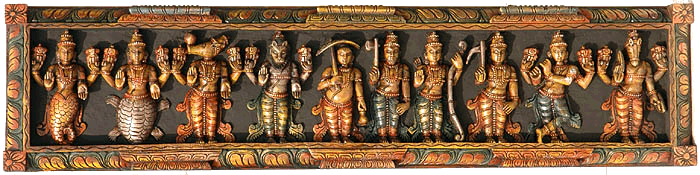
The second image is a South Indian temple wood carving depicting
the
ten incarnations of Lord Vishnu
(From the left - Mâtsya, Kurma, Varâha, Narasimha,
Vâmana, Paras'urâma, Râma, Balarâma,
Krishna
and Kalki).
Source: Exoticindiaart.com,
used with permission.
Production: Filognostic
Association
of The
Order of Time

Feed-back | Links | Downloads | Music | Pictures | What's New | Search | Donations





 Text
1
Text
1