
Canto 10
Canto 10
Chapter 72: Jarâsandha Killed by Bhîma and the Kings Freed
(1-2) S'rî S'uka said: 'Yudhishthhira one day sat in his court surrounded by the sages, the nobles, the popular personalities, the business men and his brothers. With all the âcâryas, the elders of the family, his blood relatives, in-laws and friends listening, he addressed Krishna saying the following. (3) S'rî Yudhishthhira said: 'Oh Govinda, I wish to honor Your different heroic deeds with the purifying sacrifice that is the king of all fire sacrifices named Râjasûya. Please allow us to perform that sacrifice, oh Master. (4) They who constantly, in full service meditate on and glorify Your slippers, which cause the destruction of all inauspicious things, find purification. They and not other persons, oh You whose navel is like a lotus, manage by their prayers to put an end to their material existence, or else, as far as they desire something, get the things done they want. (5) Therefore, oh God of Gods, let the people see the power of serving Your lotus feet in this world. Please, oh All-powerful One, show them both the status of the Kurus and the Sriñjayas who are of worship, and the status of those who are not of worship. (6) In Your mind of Absolute Truth there can be no difference between 'mine and thine', for You are the Soul of All Beings who, equal in Your vision, experience the happiness within Yourself. Those who properly serve You, You, just like the desire tree, grant the desired results according to the service rendered. There is no contradiction in this [catering to desires].'
(7) The Supreme Lord said: 'There is nothing wrong with your plan, oh King, following it all the world will witness your auspicious fame, oh tormentor of the enemies! (8) For the sages, the forefathers, the gods and the friends, oh master of Us, as also for all living beings, [the performance of] this king of sacrifices [the literal meaning of Râjasûja] is desirable. (9) Bring the earth under control by conquering all the kings, collect all the necessities [for the ceremony], and [next] perform the great sacrifice. (10) These brothers of yours, oh King, were born as partial aspects of the demigods who rule the worlds [see family-tree], and I, who am unconquerable for those not in control with themselves, am conquered by you who are of self-control. (11) No person, not even a demigod - not to mention an earthly ruler -, can by his strength, beauty, fame or riches in this world subdue someone who is devoted to Me.'
(12) S'rî S'uka said: 'The king, with a face blossoming like a lotus, was pleased to hear the song [the Gîtâ] of the Supreme Lord. Energized by the potency of Vishnu, he engaged his brothers in the conquest of all the directions. (13) He sent Sahadeva with the Sriñjayas to the south, Nakula with the Matsyas in the western direction, Arjuna with the Kekayas to the north and Bhîma with the Madrakas to the east. (14) The heroes, by their personal strength subduing many kings, brought him from everywhere an abundance of riches, because for him, intent upon performing the sacrifice, the enemy still had to be born, oh King. (15) The king heard that Jarâsandha was not defeated and thought about it. The Original Person, the Lord, then enlightened him on the means Uddhava had mentioned [in 10.71: 2-10]. (16) And so Bhîmasena, Arjuna and Krishna, disguised as brahmins, together went to Girivraja, my dear, where the son of Brihadratha [Jarâsandha] resided. (17) Going to his residence at the hour appointed for receiving [uninvited] guests, the nobles, appearing as brahmins, begged with the religious householder of respect for the brahminical culture: (18) 'Oh King, know us as guests in need who have arrived from afar. We wish you all the best. Please grant us everything we desire. (19) What would for a patient person be intolerable, what would for an impious person be impossible, what would by a generous person not be donated, and who would exclude someone who has an equal vision towards all? (20) He is reprehensible and pitiable who, while being very well capable, fails to acquire with the temporary body the lasting fame glorified by the saints. (21) Many souls like Haris'candra, Rantideva, Uñchavritti Mudgala, S'ibi, Bali, and the legendary pigeon with its hunter [see*], attained the eternal [Soul] by [forsaking] the impermanent.'
(22) S'rî S'uka said: 'However, from their voices, their physical stature and even the bowstring marks on their arms, he [Jarâsandha] recognized them as nobles, as members of the family he had seen before. (23) [He thought:] 'These relatives of the royal class wearing the insignia of brahmins, I should give whatever they demand, even something as difficult to forsake as my own body. (24-25) Was Bali not known as someone whose spotless glory spread wide in all directions, even though he was brought down by Lord Vishnu [Vâmana] who, appearing in the form of a twice-born soul, of a brahmin, wanted to take away from him Indra's opulence? Despite the advise against it [from his guru, see 8.19], the Daitya king [Bali] knowingly gave away the entire earth. (26) Of what use is it for someone from a kshatriya background, to be alive but, with his perishable body, not to endeavor in favor of the greater glory of the brahmins?' (27) With that mentality the generous soul said to Krishna, Arjuna and Vrikodara ['wolf-belly' or Bhîma]: 'Oh men of learning, I will give you whatever you want, even if you ask for my own head!'
(28) The Supreme Lord said: 'Please, oh high and mighty King, accept the challenge to give us battle in a one-to-one fight, if you deem that fit. We, members of the royalty, have come here with the wish to fight and do not want anything else. (29) That is Bhîma the son of Prithâ, the other one is his brother Arjuna, and know Me to be Krishna, their maternal cousin, your enemy [see 10.50].'
(30) Thus being invited, the king of Magadha laughed loudly and said contemptuously: 'In that case, I will give you battle, you fools! (31) But I will not fight with You. Cowardly You, lacking in strength in the battle, abandoned Your city Mathurâ and left for a safe place in the ocean. (32) As for this one, Arjuna, he is not old enough nor very strong, he is no match for me and should not be my opponent. Bhîma is the one equal in strength to me.'
(33) Thus having spoken he gave Bhîma a large club and went outside the city, himself taking up another one. (34) Then opposing on the battle ground, the two heroes stroke each other with their lightning-bolt like clubs. The fight drove them to mad fury. (35) Skillfully circling each other to the left and the right, the fight appeared as beautiful as of a couple of actors on a stage. (36) The clash of their clubs swung against each other, oh King, resembled a crash of lightning or the clattering of elephant tusks. (37) Infuriated vigorously fighting like a couple of elephants, their clubs, which with the rapid force of their arms were powerfully swung against each other's shoulders, hips, feet, hands, thighs and collarbones, were in the contact smashed to pieces like they were some arka branches. (38) With their clubs thus being ruined, the two great heroes among men angrily pummeled each other with their iron-like fists. [And also] the slapping of their hands sounded like elephants crashing into each other or as harsh claps of thunder. (39) The fight of the two men striking each other who were equally trained, just as strong and of the same endurance, thus remained undecided and continued unabated, oh King [**]. (40) Krishna who had knowledge about the birth and death of the enemy and how he by Jarâ was brought to life [see 9.22: 8 and ***], then shared the power of His thought with [Bhîma,] the son of Prithâ. (41) He whose Vision is Infallible had determined the means to kill their enemy, and demonstrated it to Bhîma by tearing apart a twig for a sign. (42) Understanding the sign, the immensely strong Bhîma, the best of all fighters, seized his enemy by the feet and threw him to the ground. (43) Standing with his foot on top of one leg, he with both hands took hold of the other one and, just like a great elephant with a tree branch, tore him apart from the anus upward. (44) His subjects then saw him separated in two pieces, with each one leg, one thigh, one testicle, one hip, one backside, one shoulder, one arm, one eye, one eyebrow and one ear. (45) After the lord of Magadha had been killed, a great cry of lamentation rose, while Arjuna and Acyuta both congratulated Bhîma and embraced him. (46) The Unfathomable One Supreme Lord and Sustainer of All Living Beings then freed the kings who were imprisoned by the king of Magadha and crowned his son Sahadeva as the lord and master of the Magadhas.'


Third revised edition, loaded September 9, 2021.
Previous Aadhar edition and Vedabase links:
S'rî S'uka said: 'Yudhishthhira one day sat in his court surrounded by the sages, the nobles, the popular personalities, the business men and his brothers. With all the âcâryas, he elders of the family, his blood relatives, in-laws and friends listening, he addressed Krishna saying the following.S'rî S'uka said: 'Once seated in his court surrounded by the sages, the nobles, the popular personalities, the business men and his brothers, addressed Yudhishthhira Krishna in the midst of all the âcâryas, the family, the elders, his blood relatives, in-laws and friends listening, and said he the following. (Vedabase)
S'rî Yudhishthhira said: 'Oh Govinda, I wish to honor Your different heroic deeds with the purifying sacrifice that is the king of all fire sacrifices named Râjasûya. Please allow us to perform that sacrifice, oh Master.
S'rî Yudhishthhira said: 'O Govinda, I wish to honor the manifold glory of You with the purifying king of all fire sacrifices named Râjasûya; please allow us that to perform o Master. (Vedabase)
They who constantly, in full service meditate on and glorify Your slippers, which cause the destruction of all inauspicious things, find purification. They and not other persons, oh You whose navel is like a lotus, manage by their prayers to put an end to their material existence, or else, as far as they desire something, get the things done they want.
They who constantly in full service meditate upon and glorify Your slippers, which cause the destruction of all things inauspicious, are purified; they, and not other persons, o You whose Navel is like a Lotus, manage to put an end to a material existence or obtain, if they desire something, that what they long for. (Vedabase)
Therefore, oh God of Gods, let the people see the power of serving Your lotus feet in this world. Please, oh All-powerful One, show them both the status of the Kurus and the Sriñjayas who are of worship, and the status of those who are not of worship.
Therefore o God of Gods, let the populace see the power in this world of serving the lotus feet; please show, o All-powerful one, the status of those Kurus and Sriñjayas who worship You like this, relative to the status of those who do not worship. (Vedabase)
In Your mind of Absolute Truth there can be no difference between 'mine and thine', for You are the Soul of All Beings who, equal in Your vision, experience the happiness within Yourself. Those who properly serve You, You, just like the desire tree, grant the desired results according to the service rendered. There is no contradiction in this [catering to desires].'
In Your mind of Absolute Truth can there be no difference between what is Your own and what is of others, for You are the Soul of All Beings who equal in Your vision experience within Yourself the happiness. To those who properly serve You are You like the desire tree granting the desired results in accordance with the service delivered - in this [catering to desires of You] there is no contradiction.' (Vedabase)
The Supreme Lord said: 'There is nothing wrong with your plan, oh King, following it all the world will witness your auspicious fame, oh tormentor of the enemies!
The Supreme Lord said: 'There is nothing wrong with your plan o King, following it will all the world witness your auspicious fame, o tormentor of the enemies! (Vedabase)
For the sages, the forefathers, the gods and the friends, oh master of Us, as also for all living beings, [the performance of] this king of sacrifices [the literal meaning of Râjasûja] is desirable.
For the sages, the forefathers, the gods and the friends also, o master of Us, as well as for all living beings is this king of sacrifices [the literal meaning of Râjasûja] desirable. (Vedabase)
Bring the earth under control by conquering all the kings, collect all the necessities [for the ceremony], and [next] perform the great sacrifice.
Bringing the earth under control, conquering all the kings and collecting all the necessities, [you must next] perform the great sacrifice. (Vedabase)
These brothers of yours oh King, were born as partial aspects of the demigods who rule the worlds [see family-tree], and I, who am unconquerable for those not in control with themselves, am conquered by you who are of self-control.
These brothers of yours o King, were born as individual parts of the demigods who rule the worlds [see family-tree], and I, unconquerable for those who are not in control of themselves, am won by you who are self-controlled. (Vedabase)
No person, not even a demigod - not to mention an earthly ruler -, can by his strength, beauty, fame or riches in this world subdue someone who is devoted to Me.'
No person, not even a demigod - not mentioning an earthly ruler -, can by his strength, beauty, fame or might subdue in this world someone who is dedicated to Me.' (Vedabase)
S'rî S'uka said: 'The king, with a face blossoming like a lotus, was pleased to hear the song [the Gîtâ] of the Supreme Lord. Energized by the potency of Vishnu, he engaged his brothers in the conquest of all the directions.
S'rî S'uka said: 'With a face blossoming like a lotus, pleased to hear the song [the Gîtâ] of the Supreme Lord, engaged he, invigorated by the potency of Vishnu, his brothers in the conquest of all the directions. (Vedabase)
He sent Sahadeva with the Sriñjayas to the south, Nakula with the Matsyas in the western direction, Arjuna with the Kekayas to the north and Bhîma with the Madrakas to the east.
Sahadeva with the Sriñjayas he sent to the south, Nakula with the Matsyas in the western direction, Arjuna with the Kekayas to the north and Bhîma with the Madrakas to the east. (Vedabase)
The heroes, by their personal strength subduing many kings, brought him from everywhere an abundance of riches, because for him, intent upon performing the sacrifice, the enemy still had to be born, oh King.
They, the heroes, with their personal strength subduing many kings brought from everywhere an abundance of riches to him of whom, intent upon performing the sacrifice, the enemy wasn't born, o King. (Vedabase)
The king heard that Jarâsandha was not defeated and thought about it. The Original Person, the Lord, then enlightened him on the means Uddhava had mentioned [in 10.71: 2-10].
The king pondering over the news that Jarâsandha was not defeated, was by the Original Person of the Lord enlightened on the means which thereto had been mentioned by Uddhava [in 10.71: 2-10]. (Vedabase)
And so Bhîmasena, Arjuna and Krishna, disguised as brahmins, together went to Girivraja, my dear, where the son of Brihadratha [Jarâsandha] resided.
And so went Bhîmasena, Arjuna and Krishna disguised as brahmins together to Girivraja, my dear, where the son of Brihadratha [Jarâsandha] resided. (Vedabase)
Going to his residence at the hour appointed for receiving [uninvited] guests, the nobles, appearing as brahmins, begged with the religious householder of respect for the brahminical culture:
Going to his residence at the hour appointed for receiving uninvited guests begged the nobles, appearing as brahmins, with the religious householder who was of respect for brahmins: (Vedabase)
'Oh King, know us as guests in need who have arrived from afar. We wish you all the best. Please grant us everything we desire.
'O King, know us to be guests who in their need have arrived from afar; wishing you all the best, please grant us all that we desire. (Vedabase)
What would for a patient person be intolerable, what would for an impious person be impossible, what would by a generous person not be donated, and who would exclude someone who has an equal vision towards all?
What would for a person of patience be intolerable, what would for the impious all be impossible, what wouldn't be donated by the generous, and who would exclude those who are equal in their vision? (Vedabase)
He is reprehensible and pitiable who, while being very well capable, fails to acquire with the temporary body the lasting fame glorified by the saints.
He indeed is contemptible and pitiable who, very well being able, with the temporary existence of his body fails to acquire the lasting fame as sung by the saintly. (Vedabase)
Many souls like Haris'candra, Rantideva, Uñchavritti Mudgala, S'ibi, Bali, and the legendary pigeon with its hunter [see*], attained the eternal [Soul] by [forsaking] the impermanent.'
Many like Haris'candra, Rantideva, Uñchavritti Mudgala, S'ibi, Bali, and the legendary hunter and pigeon [see*], attained the permanent by departing from the impermanent.' (Vedabase)
S'rî S'uka said: 'However, from their voices, their physical stature and even the bowstring marks on their arms, he [Jarâsandha] recognized them as nobles, as members of the family he had seen before.
S'rî S'uka said: 'However, from their voices, their physical stature and the marks of bowstrings on their arms even, recognized he [Jarâsandha] them as nobles, as members of the family he had seen before. (Vedabase)
[He thought:] 'These relatives of the royal class wearing the insignia of brahmins, I should give whatever they demand, even something as difficult to forsake as my own body.
[he thought:] 'These relatives of the royal class wearing the insignia of brahmins I should give whatever they ask for, even something as difficult to forsake as my own body. (Vedabase)
Was Bali not known as someone whose spotless glory spread wide in all directions, even though he was brought down by Lord Vishnu [Vâmana] who, appearing in the form of a twice-born soul, of a brahmin, wanted to take away from him Indra's opulence? Despite the advise against it [from his guru, see 8.19], the Daitya king [Bali] knowingly gave away the entire earth.
Isn't it known of Bali that his glories spread wide in all directions because of his spotless rule of state, even though he was brought down by Lord Vishnu [Vâmana] who, in the guise of a brahmin appearing as a twiceborn one of Vishnu, wanted to take away Indra's opulence? Knowingly gave he away the entire earth, despite the advise against the daitya king [Bali] received [from his guru, see 8.19]. (Vedabase)
Of what use is it for someone from a kshatriya background, to be alive but, with his perishable body, not to endeavor in favor of the greater glory of the brahmins?'
What use at all is it for a fallen kshatriya to be alive but with his perishable body not to endeavor for the benefit, the greater glory, of the brahmins?' (Vedabase)
With that mentality the generous soul said to Krishna, Arjuna and Vrikodara ['wolf-belly' or Bhîma]: 'Oh men of learning, I will give you whatever you want, even if you ask for my own head!'
Thus being a broad-minded person said he to Krishna, Arjuna and Vrikodara ['wolf-belly' or Bhîma]: 'O men of learning, ask me whatever you want, I'll even give my own head to you!' (Vedabase)
The Supreme Lord said: 'Please, oh high and mighty King, accept the challenge to give us battle in a one-to-one fight, if you deem that fit. We, members of the royalty, have come here with the wish to fight and do not want anything else.
The Supreme Lord said: 'Please o high and mighty King, accept the challenge to give us battle in a one-to-one fight; we, members of the royalty, came here wishing a fight and don't want anything else. (Vedabase)
That is Bhîma the son of Prithâ, the other one is his brother Arjuna, and know Me to be Krishna, their maternal cousin, your enemy [see 10.50].'
That one is Bhîma the son of Prithâ and this other one is Arjuna in person and I, I am Krishna their maternal cousin, your enemy as you know [see 10.50].' (Vedabase)
Thus being invited, the king of Magadha laughed loudly and said contemptuously: 'In that case, I will give you battle, you fools!
Thus being invited had the king of Magadha to laugh out loud and said he contemptuously: 'In that case, I'll give you battle, you fools! (Vedabase)
But I will not fight with You. Cowardly You, lacking in strength in the battle, abandoned Your city Mathurâ and left for a safe place in the ocean.
But I won't fight with You. Cowardly, You lacked in strength in battle when You abandoned Your own city Mathurâ to leave for a safe place in the ocean. (Vedabase)
As for this one, Arjuna, he is not old enough nor very strong, he is no match for me and should not be my opponent. Bhîma is the one equal in strength to me.'
As for this one, Arjuna, he, not old enough nor very strong, is no match for me and shouldn't be the contender; Bhîma is the one equal in strength to me.' (Vedabase)
Thus having spoken he gave Bhîma a large club and went outside the city, himself taking up another one.
Thus having spoken gave he Bhîma a large club and went he outside the city, himself taking another one. (Vedabase)
Then opposing on the battle ground, the two heroes stroke each other with their lightning-bolt like clubs. The fight drove them to mad fury.
Then, engaged in the fighting area, stroke the two heroes each other with their lightning-bolt like clubs. The fight drove them to mad fury. (Vedabase)
Skillfully circling each other to the left and the right, the fight appeared as beautiful as of a couple of actors on a stage.
Skillfully circling left and right appeared the two thus moving around in the fight, as splendidly as a couple of actors on a stage. (Vedabase)
The clash of their clubs swung against each other, oh King, resembled a crash of lightning or the clattering of elephant tusks.
When they swung their clubs against each other gave that a sound resembling a crash of lightning, o King, or the clattering of the tusks of elephants. (Vedabase)
Infuriated vigorously fighting like a couple of elephants, their clubs, which with the rapid force of their arms were powerfully swung against each other's shoulders, hips, feet, hands, thighs and collarbones, were in the contact smashed to pieces like they were some arka branches.
Infuriated vigorously fighting like a couple of elephants were the clubs that with the rapid force of their arms powerfully were swung against each other's shoulders, hips, feet, hands, thighs and collarbones, in the contact smashed to pieces like some arka branches. (Vedabase)
With their clubs thus being ruined, the two great heroes among men angrily pummeled each other with their iron-like fists. [And also] the slapping of their hands sounded like elephants crashing into each other or as harsh claps of thunder.
With their clubs thus ruined pummeled the two great heroes among men angrily each other with their fists iron to the touch. The slapping of their hands sounded like elephants crashing into each other or as harsh claps of thunder. (Vedabase)
The fight of the two men striking each other who were equally trained, just as strong and of the same endurance, thus remained undecided and continued unabated, oh King [**].
With the two thus striking, equally trained, strong and of endurance as they were, remained the fight undecided and continued it unabated, o King. [**] (Vedabase)
Krishna who had knowledge about the birth and death of the enemy and how he by Jarâ was brought to life [see 9.22: 8 and ***], then shared the power of His thought with [Bhîma,] the son of Prithâ.
Knowing of the birth and death of the enemy and how he was brought to life by Jarâ [see 9.22: 8 and ***], empowered Krishna the son of Prithâ with His own power of thought. (Vedabase)
He whose Vision is Infallible had determined the means to kill their enemy, and demonstrated it to Bhîma by tearing apart a twig for a sign.
Having determined the means to kill their enemy showed He whose Vision is Infallible it to Bhîma by tearing apart a twig as a sign. (Vedabase)
Understanding the sign, the immensely strong Bhîma, the best of all fighters, seized his enemy by the feet and threw him to the ground.
Understanding that seized the immensely strong Bhîma, the best of fighters, his enemy by the feet and threw he him to the ground. (Vedabase)
Standing with his foot on top of one leg, he with both hands took hold of the other one and, just like a great elephant with a tree branch, tore him apart from the anus upward.
Standing with his foot on top of one leg took he with both hands hold of the other one and tore he, like a great elephant with the branch of a tree, him apart from the anus upward. (Vedabase)
His subjects then saw him separated in two pieces, with each one leg, one thigh, one testicle, one hip, one backside, one shoulder, one arm, one eye, one eyebrow and one ear.
The king's subjects then saw him separated in two pieces with each one leg, thigh, testicle, hip, backside, shoulder, arm, eye, eyebrow and ear. (Vedabase)
After the lord of Magadha had been killed, a great cry of lamentation rose, while Arjuna and Acyuta both congratulated Bhîma and embraced him.
With the lord of Magadha being killed arose a great cry of lamentation, while Arjuna and Acyuta both congratulated Bhîma as they embraced him. (Vedabase)
The Unfathomable One Supreme Lord and Sustainer of All Living Beings then freed the kings who were imprisoned by the king of Magadha and crowned his son Sahadeva as the lord and master of the Magadhas.'
The Unfathomable One Supreme Lord and Sustainer of All Living Beings crowned his son Sahadeva to be the lord and master of the Magadhas and next freed the kings who were imprisoned by the king of Magadha.' (Vedabase)
*: The story goes that the pigeon and his mate gave their own flesh to a hunter to prove their hospitality, and thus they were taken to heaven in a celestial airplane. When the hunter understood their situation in the mode of goodness, he also became renounced, gave up hunting and went off to perform severe austerities. Because he was freed of all sins, was he, after his body burned to death in a forest fire, elevated to heaven.
**: Some âcâryas include the following two verses in the text of this chapter, and S'rîla Prabhupâda has also translated them in 'Krishna':
evam tayor mahâ-râja
yudhyatoh sapta-vims'atih
dinâni niragams tatra
suhrid-van nis'i tishthhatohekadâ mâtuleyam vai
prâha râjan vrikodarah
na s'akto 'ham jarâsandham
nirjetum yudhi mâdhava"Thus, oh King, they continued to fight for twenty-seven days. At the end of each day's fighting, both lived at night as friends in Jarâsandha's palace. Then on the twenty-eighth day, oh King, Vrikodara [Bhîma] told his maternal cousin, 'Mâdhava, I cannot defeat Jarâsandha in battle.' "
***: S'rîla Prabhupâda writes "Jarâsandha was born in two different parts from two different mothers. When his father saw that the baby was useless, he threw the two parts in the forest, where they were later found by a black-hearted witch named Jarâ. She managed to join the two parts of the baby from top to bottom. Knowing this, Lord Krishna therefore also knew how to kill him."

The text and
audio are offered under the conditions of the
Creative
Commons Attribution-Noncommercial-Share Alike 3.0 Unported
License.
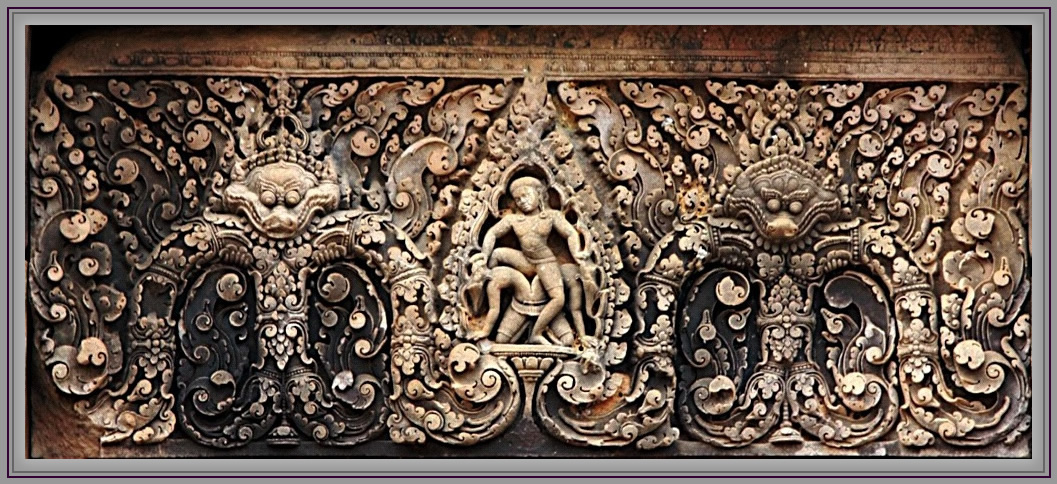
Tne picture of the relief shows Bhîma tearing Jarâsandha in two.
Production: Filognostic
Association of The Order of Time.

Feed-back | Links | Downloads | Music | Pictures | What's New | Search | Donations



 Text 1-2