
Canto
11

Canto
11
Chapter 23: Forbearance: the Song of the Avantî Brâhmana
(1) The son of Vyâsa said: 'After Uddhava, the greatest of the devotees, had said this to Him, the chief of the Dâs'ârhas whose heroism is so worth mentioning, He praised His servant for his words and replied. (2) The Supreme Lord said: 'Oh disciple of Brihaspati, in this world there is virtually no pious soul capable of keeping his mind in check after being disturbed by the insulting words of an uncivilized person. (3) A person is not as much hurt when pierced by arrows through a sensitive part of his body, as by the painful arrows of the harsh words of uncivilized people getting lodged in his heart. (4) In this regard, Uddhava, a most pious story is told. Please listen carefully, I shall describe it to you. (5) It was related by a mendicant who, upon being insulted by bad people, kept his composure reminding himself that it happened as a consequence of his past deeds. (6) In Avantî [in the district of Malwa] there once lived a certain brahmin, very rich with many opulences, who earned his livelihood doing business; but he was a miserly person, full of lust, greed and very prone to anger [see also B.G. 2: 49]. (7) He had no respect for his relatives and guests, not even in words, nor catered he, devoid of religiosity, timely to his own needs. (8) His sons, in-laws, his wife, daughters and servants turned against the miser with his bad character and in disgust withheld their affection. (9) Thus lacking in dharma as also in pleasure, the five claimants of sacrifice [the deities, see pañca-bhâga] became angry with that obsessive treasurer who failed for both the worlds [this and the next]. (10) By his neglect of them he lost all his credit oh magnanimous one, and all the wealth he so painstakingly had troubled himself for was lost. (11) Oh Uddhava, a part of the wealth of this so-called brahmin was seized by his relatives, some by thieves, some by providence, some by time, some by common people and some by higher authorities [see also 10.49: 22]. (12) When he had lost his property a hard to endure anxiety arose in him who, devoid of religiosity and pleasure, was neglected by his kin. (13) Thus ruminating he, choked with tears, for a long time lamented in pain over his lost riches, whereupon a great feeling of disgust for worldly affairs came over him.
(14) He then said to himself: 'Alas, how painful to trouble myself that much with all this toiling for money that brought me neither pleasure, nor served the dharmic purpose. (15) In general the wealth of misers never ever results in any happiness: in this life it leads to self-torment and when they die they end up in hell with it. (16) However pure the reputation of the famous may be or however praiseworthy the qualities of the virtuous are, it is all destroyed with a little greed, just like what white leprosy [vitiligo] does with an enchanting, physical beauty. (17) In the building up, realizing, increasing, protecting, spending, losing of and rejoicing with capital, man must toil, fear, worry and live with uncertainty. (18-19) Theft, violence, lies, duplicity, lust, anger, perplexity, pride, discord, enmity, lack of faith, competition and [the three] dangers [of intoxication, promiscuity and gambling, see also 1.17: 24], are the fifteen unwanted things known by man as the consequence of fostering riches. He who desires the ultimate benefit in life should therefore keep the undesirable, which poses as wealth, at a great distance. (20) One's brothers, wife, parents and friends who are unified in love, all, from one moment to the next, turn into enemies over a single penny. (21) For the smallest amount of money they agitated give in to anger, and very quickly, as an adversary out for destruction, forget their goodwill and turn you down in the wink of an eye. (22) They who do not appreciate it as a human being to have achieved a birth the immortals pray for, with next to that [having the option of even] a superior second birth, destroy their self-interest and head for an unfavorable destination [see also B.G. 16: 19-20]. (23) What person who achieved this human life, this gateway to heaven and liberation, would attach to property, a realm of meaninglessness where one is subject to death? (24) When one does not share with those who deserve a share - the greater family of the gods, the seers, the forefathers, one's relatives, the living entities and oneself - one falls down like a money minded Yaksha. (25) What can one do as an old man when one, maddened by one's youth, strength and wealth - the means by which a smart man settles for his perfection - has wasted one's life endeavoring for money [and status etc., see B.G. 3: 35]? (26) How does [even] a man of intelligence fall victim to a never ending, vain pursuit of wealth? All the world is most bewildered enchanted by some kind of inescapable illusory power! (27) What is the use of the goods or those who provide them, or what would be the use of the objects of desire or the people who try to satisfy you? Or, differently stated, of what use is it for someone in the grip of death to be engaged in fruitful activities that only lead to yet another birth? (28) The Supreme Lord, the Supreme Personality who comprises all the gods and who, satisfied with me, led me to this condition of detachment, constitutes the boat for the soul [to cross the material ocean. See also 11.17: 44]. (29) With the time remaining [in my life] I will, free from confusion about my true self-interest, restrict my body to the minimum and find peace within my self [see also 2.2: 3, 7.12: 6]. (30) May the gods, the controllers of the three worlds, with this be pleased with me. Was it not Khathvânga [see 9.9: 41-47] who achieved the spiritual abode in a single moment?'
(31) The Supreme Lord said: 'Thus making up his mind, the most pious brahmin from Avantî untied the knots [of desire] in his heart and became a peaceful, silent mendicant. (32) He wandered this world alone and inconspicuous, and entered, with his self, senses and vital air under control [see tridanda], its cities and villages to subsist on charity. (33) Seeing him as an old, dirty beggar, low-class people dishonored him with many an insult, oh blessed soul. (34) Some stole away his triple staff, his begging bowl, his water pot and his seat, while others took his prayer beads and his torn rags. Showing them to him they offered them back and then took them again away from the sage. (35) When he at the river shore wanted to enjoy his share of the food he had acquired by begging, the grave sinners urinated upon it and spat on his head. (36) He who after his vow of silence did not speak, they would challenge to speak, beating him when he kept silent. Some shouted: 'This one is a thief' while others said: 'Tie him up, bind him!' and bound him in ropes. (37) Some taunted him with disrespect like: 'This one is a religious hypocrite, a cheater who lost his wealth, was thrown out by his family and has now taken to this profession.' (38-39) 'See how this person, who in his silence pursues his goal as powerful and steadfast as the king of the mountains, is as firmly determined as a [deceptive] heron.' Some ridiculed him speaking thus, while others passed foul air and, binding him in chains, kept the brahmin captive like a pet animal. (40) Thus subjected to [the three types of] impositions, as caused by other living beings, by higher powers and by his own nature [see kles'a], he understood that whatever came his way, befell him because of fate. (41) Being insulted by lowly people trying to get the better of him he, fixed in goodness keeping firm to his duty, sang the following song [see also B.G. 18: 33].
(42) The brahmin said: 'These people are not the cause of my happiness or distress, nor can I blame the demigods, my body, the planets, my karma or the time. It is, according to the standard authorities [the s'ruti], nothing but the mind that causes someone to rotate in the cycle of material life. (43) The mind acquiring the qualities of the modes, becomes very strong because of them and thus gives rise to the different sorts of white [good], red [passionate] and black [ignorant] activities, that lead to the conditions [the societal classes] corresponding to those colors. (44) The uninvolved Supersoul of transcendental enlightenment as a friend exists along with - and perceives - the struggling mind, that, with the image of the world it carries, embraces the objects of desire. It is in the engagement with the modes of nature that the individual soul [bewildered by that mind] gets entangled in attachment [see also B.G. 3.42-43]. (45) Charity, one's prescribed duty, niyama, yama, and listening [to the scripture], pious works and the purification by vows, all entail the subduing of the mind and have as their aim the absorption of the mind [samâdhi] that constitutes the supreme [self-realization] of yoga. (46) What would be the use of charitative rituals and such for someone whose mind has been pacified by perfectly being absorbed [in Him]? Or, why would one in addition, occupy oneself with these processes of distribution and such when one has lost one's way with a mind not under control? (47) Other gods [and the senses they represent] have always fallen under the control of the mind that itself never allows the control of anything [or anyone] else. It constitutes a fearsome god stronger than the strongest and the One who [in the form of His mantras] can bring it under control, is therefore the God of gods [see also B.G. 6: 35-36, *]. (48) When one [being worldly engaged] fails to subdue that difficult to conquer enemy [see B.G. 6: 6] tormenting and attacking because of its unmanageable urges, some therefore being utterly bewildered create useless quarrels and are thus, with the mortals in this world, friends, neuters and rivals. (49) People whose entire mind is seized by their body, think in terms of 'I' and 'mine' and are thus blinded in their intelligence. Because of this difficult to defeat illusion of 'this I am' and 'that is someone else', they wander around in darkness. (50) When you say that [adhibhautika] another human being is the cause of your happiness or distress, you may wonder what this means for the soul; happiness and distress [thus seen] belong to the earth [and not to the soul who finds happiness by self-realization]. With whom can you be angry about the pain when your tongue happens to be bitten by your own teeth? (51) When you [adhidaivika] say that the gods are responsible for your suffering, then how would that relate to your soul? That sufferig pertains to the changeable nature [of the senses and their rulers, the soul stands apart from]. With whom should you be angry when one limb of your body hurts another limb? (52) When you say that the soul itself [adhyâtmika] would be the cause of your happiness and distress, such a difference would be part of your own nature. But how can one blame anyone when there is only the soul and nothing outside - neither happiness nor distress? That difference after all would be unreal then [see B.G. 2: 14]. (53) If the planets would be the cause of one's happiness and distress, how would that relate to the soul who is unborn? The heavenly bodies relate to that what is born. A planet is only troubled by other planets, so they [the astrologers] say, so with whom should the living being distinguished from his body [and his planetary positions] be angry then? (54) If you assume karma to be the cause of your happiness and distress, what does that karma then mean to your soul? Certain is that with the animating person on the one hand and this animated body on the other hand endowed with consciousness [that on itself is] not alive, neither of both constitute the root cause of your karma. What is there left to be upset about then? (55) And if we say that time would be the cause of our happiness and distress, where do we find the soul in that notion? The soul is not equal to the time [phenomena], the way fire is not equal to its heat and snow is not equal to [cold]. With whom must one be angry when there is no duality in the transcendental position [see also B.G. 18: 16 and time quotes]? (56) For him, [the spiritual soul] superior in transcendence, there is not from anyone, from whatever side or in any way the influence of the duality [of happiness and distress], the influence of the world of opposites, as can be seen with the arising false ego [of the mind being seized] that shapes one's material existence. He who awakens to this intelligence has nothing to fear from the material creation [with all her living beings]. (57) By the worship of Mukunda's feet I will cross over the difficult to defeat ocean of material nescience. I am certain of this because of the foregoing great seers [or âcâryas] who were firmly fixed in the worship of the Supreme Soul [see also B.G. 6: 1-2].'
(58) The Supreme Lord said: 'While he had lost his wealth and gotten detached, while he had left his home and free from moroseness traveled the earth, the sage, despite being insulted by rascals, did not forsake his duties and spoke this song. (59) There is no other cause of happiness and grief than the bewilderment of someone's mind that in material life out of ignorance created its friends, neuters and enemies [see also 10.32: 17-22, B.G. 9: 29]. (60) Therefore, My best, bring in every respect with an intelligence absorbed in Me, the mind under control and [attain] thus being connected the essence of the science of yoga [see also S'rî S'rî S'ikshâshthaka verse 1]. (61) Whoever with full attention meditates on, makes others listen or listens himself to this [song] based upon the knowledge of the Absolute as sung by the mendicant, will for certain never [again] be overwhelmed by the dualities [of happiness and grief].'


Third revised edition, loaded July 10 2022.
Previous Aadhar edition and Vedabase links:
The son of Vyâsa said: 'After Uddhava, the greatest of the devotees, had said this to Him, the chief of the Dâs'ârhas whose heroism is so worth mentioning, He praised His servant for his words and replied.The son of Vyâsa said: 'Thus respectfully being requested by Uddhava, the greatest of the devotees, began the chief of the Dâs'ârhas whose heroism is so worthy to be discussed, to speak, praising the words of His servant. (Vedabase)
The Supreme Lord said: 'Oh disciple of Brihaspati, in this world there is virtually no pious soul capable of keeping his mind in check after being disturbed by the insulting words of an uncivilized person.
The Supreme Lord said: 'O disciple of Brihaspati, there is virtually no pious soul in this world capable of keeping his mind in check when it is disturbed by the insulting words of a bad person. (Vedabase)
A person is not as much hurt when pierced by arrows through a sensitive part of his body, as by the painful arrows of the harsh words of uncivilized people getting lodged in his heart.
A person is not as much pained when pierced by arrows that go through the heart as he is hurt by a load of arrows in the form of the harsh words of untruthful people. (Vedabase)
In this regard, Uddhava, a most pious story is told. Please listen carefully, I shall describe it to you.
In this regard Uddhava, is a most pious story told. Please listen carefuly, I shall now describe it to you. (Vedabase)
It was related by a mendicant who, upon being insulted by bad people, kept his composure reminding himself that it happened as a consequence of his past deeds.
It was related by a mendicant who, upon being insulted by bad people, kept his composure reminding himself that it happened as a consequence of his past deeds. (Vedabase)
In Avantî [in the district of Malwa] there once lived a certain brahmin, very rich with many opulences, who earned his livelihood doing business; but he was a miserly person, full of lust, greed and very prone to anger [see also B.G. 2: 49].
In Avantî [in the district of Malwa] there once lived a certain brahmin very rich with opulences who earned his livelihood doing business; but he was a miser, full of lust, greed and prone to anger [see also B.G. 2: 49]. (Vedabase)
He had no respect for his relatives and guests, not even in words, nor catered he, devoid of religiosity, timely to his own needs.
He had no respect for his relatives and guests, not even in words. Nor catered he, devoid of religiosity, at the right time to his own needs. (Vedabase)
His sons, in-laws, his wife, daughters and servants turned against the miser with his bad character and in disgust withheld their affection.
With him so ill-behaved his sons, in-laws, his wife, daughters and servants turned against the miser. Full of enmity they withheld their affection. (Vedabase)
Thus lacking in dharma as also in pleasure, the five claimants of sacrifice [the deities, see pañca-bhâga] became angry with that obsessive treasurer who failed for both the worlds [this and the next].
This way lacking in dharma as well as in pleasure, the five claimants of sacrifice [the deities, see pañca-bhâga] became angry with that obsessive treasurer who failed for both the worlds [this and the next]. (Vedabase)
By his neglect of them he lost all his credit, oh magnanimous one, and all the wealth he so painstakingly had troubled himself for was lost.
With his neglecting them depleted his stock of piety, o magnanimous one, and thus he lost all the wealth he so painstakingly had troubled himself for. (Vedabase)
Oh Uddhava, a part of the wealth of this so-called brahmin was seized by his relatives, some by thieves, some by providence, some by time, some by common people and some by higher authorities [see also 10.49: 22].
Because he was only in name a brahmin Uddhava, some of his wealth was seized by his relatives, some by thieves, some by providence, some by time, some by common people and some by higher authorities [see also 10.49: 22]. (Vedabase)
When he had lost his property a hard to endure anxiety arose in him who, devoid of religiosity and pleasure, was neglected by his kin.
When he thus bereft of religiosity and love had lost his wealth, arose in him being neglected by his family members, a hard to endure anxiety. (Vedabase)
Thus ruminating he, choked with tears, for a long time lamented in pain over his lost riches, whereupon a great feeling of disgust for worldly affairs came over him.
For a long time he, choked with tears, lamented in pain over his lost riches, whereupon a great feeling of disgust for worldly affairs came over him. (Vedabase)
He then said to himself: 'Alas, how painful to trouble myself that much with all this toiling for money that brought me neither pleasure, nor served the dharmic purpose.
He then said to himself: 'Alas, how painful to trouble myself that much with all this toiling that brings me no pleasure, nor the love of God. (Vedabase)
In general the wealth of misers never ever results in any happiness: in this life it leads to self-torment and when they die they end up in hell with it.
Generally the wealth of misers never ever results in any happiness: in this life it becomes a torment and when one dies one ends up in hell with it. (Vedabase)
However pure the reputation of the famous may be or however praiseworthy the qualities of the virtuous are, it is all destroyed with a little greed, just like what white leprosy [vitiligo] does with an enchanting, physical beauty.
Whatever the good call of the famous might be or however praiseworthy the qualities of the virtuous are, a little bit of greed is enough to see it all destroyed, the same as what white leprosy does with an enchanting physical beauty. (Vedabase)
In the building up, realizing, increasing, protecting, spending, losing of and rejoicing with capital, man must toil, fear, worry and live with uncertainty.
In the building, protecting, spending, losing and rejoicing about capital, man must toil, fear, worry and live with uncertainty. (Vedabase)
Theft, violence, lies, duplicity, lust, anger, perplexity, pride, discord, enmity, lack of faith, competition and [the three] dangers [of intoxication, promiscuity and gambling, see also 1.17: 24], are the fifteen unwanted things known by man as the consequence of fostering riches. He who desires the ultimate benefit in life should therefore keep the undesirable, which poses as wealth, at a great distance.
Theft, violence, lies, duplicity, lust, anger, perplexity, pride, discord, enmity, lack of faith, competition and [the three] dangers [of intoxication, promiscuity and gambling, see also 1.17: 24] are the fifteen unwanted things man knows as the consequence of fostering riches. For that reason he who wishes the ultimate benefit in life should keep at a great distance the undesirable which poses itself as wealth. (Vedabase)
One's brothers, wife, parents and friends who are unified in love, all, from one moment to the next, turn into enemies over a single penny.
The brothers, wife, parents and friends who are unified in love, all from one moment to the other turn into enemies over a single penny. (Vedabase)
For the smallest amount of money they agitated give in to anger, and very quickly, as an adversary out for destruction, forget their goodwill and turn you down in the wink of an eye.
For the smallest amount of money they give, agitated and inflamed, in to anger and forget as an adversary out for destruction just like that, in the wink of an eye, their goodwill. (Vedabase)
They who do not appreciate it as a human being to have achieved a birth the immortals pray for, with next to that [having the option of even] a superior second birth, destroy their self-interest and head for an unfavorable destination [see also B.G. 16: 19-20].
Having attained the human birth the immortals pray for and in that life having achieved the status of the best of the twice-born, they, destructive to their own best interest, have no appreciation for it. And thus they gradually slide down [see also B.G. 16: 19-20]. (Vedabase)
What person who achieved this human life, this gateway to heaven and liberation, would attach to property, a realm of meaninglessness where one is subject to death?
What person achieving this human life, which is the gateway to heaven and liberation, would become attached to property and would choose to remain in the realm of meaninglessness where he is subject to death? (Vedabase)
When one does not share with those who deserve a share - the greater family of the gods, the seers, the forefathers, one's relatives, the living entities and oneself - one falls down like a money minded Yaksha.
Like a moneyminded Yaksha not sharing with the shareholders, viz. the greater family of the gods, the seers, the forefathers, one's relatives, the living entities and oneself, one falls down. (Vedabase)
What can one do as an old man when one, maddened by one's youth, strength and wealth - the means by which a smart man settles for his perfection - has wasted one's life endeavoring for money [and status etc., see B.G. 3: 35]?
Maddened by my youth, strength and wealth, the means by which a smart man settles for his perfection, I wasted my life endeavoring for money. What can I, as an old man, achieve that way [see B.G. 3: 35]? (Vedabase)
How does [even] a man of intelligence fall victim to a never ending, vain pursuit of wealth? All the world is most bewildered enchanted by some kind of inescapable illusory power!
Why would a man of intelligence constantly have to suffer in the vain pursuit of wealth? For certain someone in this world gets most bewildered because of her illusory power. (Vedabase)
What is the use of the goods or those who provide them, or what would be the use of the objects of desire or the people who try to satisfy you? Or, differently stated, of what use is it for someone in the grip of death to be engaged in fruitful activities that only lead to yet another birth?
What is the use of the goods or the ones providing them, or what would be the use of the objects of desire or the people who give satisfaction? Or, differently stated, of what use would it be for someone in the grip of death to be of the fruitive action which only leads to yet another birth? (Vedabase)
The Supreme Lord, the Supreme Personality who comprises all the gods and who, satisfied with me, led me to this condition of detachment, constitutes the boat for the soul [to cross the material ocean. See also 11.17: 44].
The Supreme Lord, the Supreme Personality who comprises all the gods and who, satisfied with me, led me to this condition of detachment, constitutes assuredly the boat to carry the soul [see also 11.17: 44]. (Vedabase)
With the time remaining [in my life] I will, free from confusion about my true self-interest, restrict my body to the minimum and find peace within my self [see also 2.2: 3, 7.12: 6].
With the time remaining I will, in order to live in peace with myself, not [longer] being bewildered about my real interest, restrict my body to the minimum. (Vedabase)
May the gods, the controllers of the three worlds, with this be pleased with me. Was it not Khathvânga [see 9.9: 41-47] who achieved the spiritual abode in a single moment?'
May the gods, the controllers of the three worlds be pleased with this. Was it not Khathvânga who achieved the spiritual abode in a single moment?' (Vedabase)
The Supreme Lord said: 'Thus making up his mind, the most pious brahmin from Avantî untied the knots [of desire] in his heart and became a peaceful, silent mendicant.
The Supreme Lord said: 'Thus making up his mind became the most pious brahmin from Avantî, untying the knots in his heart, a peaceful and silent mendicant. (Vedabase)
He wandered this world alone and inconspicuous, and entered, with his self, senses and vital air under control [see tridanda], its cities and villages to subsist on charity.
He wandered the wide world alone and inconspicuous, and entered, with his self, senses and vital air therewith controlled [see tri-danda], its cities and villages to live on charity. (Vedabase)
Seeing him as an old, dirty beggar, low-class people dishonored him with many an insult, oh blessed soul.
Seeing him appearing as an old, dirty beggar, was he by the low-class people dishonored with many an insult, My dear. (Vedabase)
Some stole away his triple staff, his begging bowl, his water pot and his seat, while others took his prayer beads and his torn rags. Showing them to him they offered them back and then took them again away from the sage.
Some of them took his triple staff away, his begging bowl, his waterpot and his seat, and some took his prayer beads and his torn rags. Showing them to him they offered them back, and then again took them away from the sage. (Vedabase)
When he at the river shore wanted to enjoy his share of the food he had acquired by begging, the grave sinners urinated upon it and spat on his head.
And when he at the shore of the river wanted to enjoy his share of the food he had acquired by his begging, urinated the grave sinners upon it and spat they on his head. (Vedabase)
He who after his vow of silence did not speak, they would challenge to speak, beating him when he kept silent. Some shouted: 'This one is a thief' while others said: 'Tie him up, bind him!' and bound him in ropes.
He who in accord with the vow of silence didn't speak, they would beat up and deride with their words saying: 'This one is a thief'; thus speaking they bound him in ropes while some shouted thereto: 'Tie him up, bind him!' (Vedabase)
Some taunted him with disrespect like: 'This one is a religious hypocrite, a cheater who lost his wealth, was thrown out by his family and has now taken to this profession.'
Some criticized him committing insults like: 'This one is a religious hypocrite, a cheater who, having lost his wealth after his family threw him out, now has taken to this profession'. (Vedabase)
'See how this person, who in his silence pursues his goal as powerful and steadfast as the king of the mountains, is as firmly determined as a [deceptive] heron.' Some ridiculed him speaking thus, while others passed foul air and, binding him in chains, kept the brahmin captive like a pet animal.
'See how this person as powerful and steadfast as a solid mountain, in his silence pursuing his goal, is as firmly determined as a duck'. Some ridiculed him speaking thus, while others passed foul air and, binding him in chains, kept the twice-born one captive like a pet animal. (Vedabase)
Thus subjected to [the three types of] impositions, as caused by other living beings, by higher powers and by his own nature [see kles'a], he understood that whatever came his way, befell him because of fate.
Thus subjected to all that was caused by other living beings, by higher powers and by himself [see kles'a], he understood that whatever came his way befell him because it was his destiny. (Vedabase)
Being insulted by lowly people trying to get the better of him he, fixed in goodness keeping firm to his duty, sang the following song [see also B.G. 18: 33].
Being insulted by lowly people who tried to get the better of him, he sang, keeping firm to his duty and fixed in goodness, the following song [see also B.G. 18: 33]. (Vedabase)
The brahmin said: 'These people are not the cause of my happiness or distress, nor can I blame the demigods, my body, the planets, my karma or the time. It is, according to the standard authorities [the s'ruti], nothing but the mind that causes someone to rotate in the cycle of material life.
The brahmin said: 'These people are not the cause of my happiness or distress, nor can I blame the demigods, my body, the planets, my karma or the time. It is, according to the standard authorities [the s'ruti] nothing but the mind that is the cause. The mind causes someone to rotate in the cycle of material life. (Vedabase)
The mind acquiring the qualities of the modes, becomes very strong because of them and thus gives rise to the different sorts of white [good], red [passionate] and black [ignorant] activities, that lead to the conditions [the societal classes] corresponding to those colors.
The mind giving evidence of the activity of the modes is very strong because of them and thus gives rise to the different sorts of white [goodness], red [passion] and black [ignorance] activities that lead to the conditions [the societal classes] that correspond with the same colors. (Vedabase)
The uninvolved Supersoul of transcendental enlightenment as a friend exists along with - and perceives - the struggling mind, that, with the image of the world it carries, embraces the objects of desire. It is in the engagement with the modes of nature that the individual soul [bewildered by that mind] gets entangled in attachment [see also B.G. 3.42-43].
The Supersoul not involved and golden [radiating in its own light] exists along with the struggling mind, My friend, and looks down upon the mind that, with the image of the world it carries, embraces the objects of desire. It is in that engagement with the modes of nature that the spark of God that is the individual soul gets entangled in attachment. (Vedabase)
Charity, one's prescribed duty, niyama, yama, and listening [to the scripture], pious works and the purification by vows, all entail the subduing of the mind and have as their aim the absorption of the mind [samâdhi] that constitutes the supreme [self-realization] of yoga.
Charity, doing one's duty, niyama, yama and listening [to the scripture], pious works and the purification by vows all entail the subduing of the mind. Therewith the supreme of yoga, the absorption of the mind [samâdhi], constitutes the purpose of the activities. (Vedabase)
What would be the use of charitative rituals and such for someone whose mind has been pacified by perfectly being absorbed [in Him]? Or, why would one in addition, occupy oneself with these processes of distribution and such when one has lost one's way with a mind not under control?
Tell me what the use is of rituals and such for someone whose mind has been pacified in the perfectly being fixed in charity and assorted processes? And [inversely] how can one occupy oneself with these processes of charity and such when one has lost one's way with a mind not under control? (Vedabase)
Other gods [and the senses they represent] have always fallen under the control of the mind that itself never allows the control of anything [or anyone] else. It constitutes a fearsome god stronger than the strongest and the One who [in the form of His mantras] can bring it under control, is therefore the God of gods [see also B.G. 6: 35-36, *].
Since time immemorial everything else, the [senses and their] gods for example, has fallen under the control of the mind and the mind has never fallen under the control of any other [one but the Supreme One]. As fearsome as a god [Aniruddha] it is accordingly stronger than the strongest - indeed is He who can bring that mind under control the God of gods [see also B.G. 6: 35-36, *]. (Vedabase)
When one [being worldly engaged] fails to subdue that difficult to conquer enemy [see B.G. 6: 6] tormenting and attacking because of its unmanageable urges, some therefore being utterly bewildered create useless quarrels and are thus, with the mortals in this world, friends, neuters and rivals.
Failing [when one is worldly engaged] to subdue that difficult to conquer enemy [see B.G. 6: 6] who in its urges being so unmanageable is tormenting and striking, do some therefore completely bewildered create useless quarrels and are thus with the mortals in this world friends, neuters and rivals. (Vedabase)
People whose entire mind is seized by their body, think in terms of 'I' and 'mine' and are thus blinded in their intelligence. Because of this difficult to defeat illusion of 'this I am' and 'that is someone else', they wander around in darkness.
Having accepted the material body as a part of their mind, in the sense of 'I' and 'mine', wander human beings blinded in darkness in their intelligence bewildered by this hard to overcome illusion of 'this I am' and 'that is someone else'. (Vedabase)
When you say that [adhibhautika] another human being is the cause of your happiness or distress, you may wonder what this means for the soul; happiness and distress [thus seen] belong to the earth [and not to the soul who finds happiness by self-realization]. With whom can you be angry about the pain when your tongue happens to be bitten by your own teeth?
Asserting that [adhibhautika] these or those people would be the cause of my happiness and distress, one may wonder what room there is for the soul in this conception; happiness and distress belong to the earth [and not to the soul]. With whom is one to be angry when the tongue happens to be bitten by one's own teeth? (Vedabase)
When you [adhidaivika] say that the gods are responsible for your suffering, then how would that relate to your soul? That suffering pertains to the changeable nature [of the senses and their rulers, the soul stands apart from]. With whom should you be angry when one limb of your body hurts another limb?
If one says that [adhidaivika] the gods would be responsible for the suffering, then how would that suffering be related to the soul when that pain is fully subject to change [while the soul is not]. With whom should the living being be angry when a limb of his own body hurts another limb? (Vedabase)
When you say that the soul itself [adhyâtmika] would be the cause of your happiness and distress, such a difference would be part of your own nature. But how can one blame anyone when there is only the soul and nothing outside - neither happiness nor distress? That difference after all would be unreal then [see B.G. 2: 14].
If the soul itself [adhyâtmika] would be the cause of one's happiness and distress, it is not possible that joy and grief would be caused by another nature apart from one's own. For nothing exists separately from the soul. Such a claim would be false. But can one be angry [with oneself or the soul] when there is no happiness or distress [in the witnessing soul, see B.G. 2: 14]? (Vedabase)
If the planets would be the cause of one's happiness and distress, how would that relate to the soul who is unborn? The heavenly bodies relate to that what is born. A planet is only troubled by other planets, so they [the astrologers] say, so with whom should the living being distinguished from his body [and his planetary positions] be angry then?
If the planets would be the cause of happiness and distress, how would that relate to the soul who is unborn? The heavenly bodies relate to that what is born, as they [the astrologers] say. A planet is only troubled by other planets. With whom should the living being, when regarded as distinct from its [heavenly] body, be angry now? (Vedabase)
If you assume karma to be the cause of your happiness and distress, what does that karma then mean to your soul? Certain is that with the animating person on the one hand and this animated body on the other hand endowed with consciousness [that on itself is] not alive, neither of both constitute the root cause of your karma. What is there left to be upset about then?
If we assume karma to be the cause of happiness and distress, what does that karma then mean to the soul? For sure with the animating person on the one hand and this animated body endowed with consciousness [on itself] not alive on the other hand, neither of the two are the root cause of the karma of course. What is left to be upset about then? (Vedabase)
And if we say that time would be the cause of our happiness and distress, where do we find the soul in that notion? The soul is not equal to the time [phenomena], the way fire is not equal to its heat and snow is not equal to [cold]. With whom must one be angry when there is no duality in the transcendental position [see also B.G. 18: 16 and time quotes]?
If we say that time would be the cause of happiness and distress, then what for the soul in that idea; the soul belongs to time, the way fire doesn't burn the flames or the snow is not [harmed by cold] - with whom to become angry when there is no duality with the supreme [see also B.G. 18: 16 and timequotes]? (Vedabase)
For him, [the spiritual soul] superior in transcendence, there is not from anyone, from whatever side or in any way the influence of the duality [of happiness and distress], the influence of the world of opposites, as can be seen with the arising false ego [of the mind being seized] that shapes one's material existence. He who awakens to this intelligence has nothing to fear from the material creation [with all her living beings].
Not by anyone, anywhere or by any means there is for him, [the spiritual soul] superior of transcendence, the influence of the duality to which the false ego arises that shapes one's material existence. He who awakens to this intelligence has nothing to fear from other living beings. (Vedabase)
By the worship of Mukunda's feet I will cross over the difficult to defeat ocean of material nescience. I am certain of this because of the foregoing great seers [or âcâryas] who were firmly fixed in the worship of the Supreme Soul [see also B.G. 6: 1-2].'
By the worship of the feet of Mukunda I will cross over the hard to overcome ocean of material nescience. I am certain of this thanks to the foregoing great seers [or âcâryas] who are anchored in the worship of the Soul Supreme [see also B.G. 6: 1-2].' (Vedabase)
The Supreme Lord said: 'While he had lost his wealth and gotten detached, while he had left his home and free from moroseness traveled the earth, the sage, despite being insulted by rascals, did not forsake his duties and spoke this song.
The Supreme Lord said: 'With his wealth destroyed getting detached, leaving home, free from moroseness traveling the earth and still being insulted by rascals, the sage unswerving in his duties sent this song up. (Vedabase)
There is no other cause of happiness and grief than the bewilderment of someone's mind that in material life out of ignorance created its friends, neuters and enemies [see also 10.32: 17-22, B.G. 9: 29].
As for that what causes happiness or distress to the individual soul there is nothing besides the mind. It is the mind that bewildered out of ignorance created a material life of friends, neuters and enemies [see also 10.32: 17-22, B.G. 9: 29]. (Vedabase)
Therefore, My best, bring in every respect with an intelligence absorbed in Me, the mind under control and [attain] thus being connected the essence of the science of yoga [see also S'rî S'rî S'ikshâshthaka verse 1].
Therefore in all respects, My best, bring with an intelligence absorbed in Me the mind under control and thus connected have the complete [the marriage, the comprehension] of yoga [see also S'rî S'rî S'ikshâshthaka-verse 1]. (Vedabase)
Whoever with full attention meditates on, makes others listen or listens himself to this [song] based upon the knowledge of the Absolute as sung by the mendicant, will for certain never [again] be overwhelmed by the dualities [of happiness and grief].'
Whosoever with full attention meditates on, makes others listen or listens himself to this [song] based upon the knowledge of the Absolute as sung by the mendicant, will for certain never be overwhelmed by the dualities.' (Vedabase)
*: Some think that the essence of yoga is to stop the mind all together, but Krishna stresses in this chapter clearly that it is about the control, not the stopping. That stopping is an impersonalist mâyâvâda buddhist technique to concentrate on one's essence and constitutes a willfully created illusion [see Buddhism]. Saying neti-neti like Prahlâda e.g., the mind will indeed concentrate on the essence which exactly will boost the mind in that direction. So with the stopping of its worldly engagement, the real engagement of the mind in prayers and philosophy begins. Not going for the siddhis, the mystical perfections, the mind must thus be engaged for the Fortunate One, for Krishna, by means of concentration on His names, mantras and stories. By s'ravanam, kîrtanam etc. one has to learn to listen, sing and follow according to the scripture, the guru and the co-believers. The first two yoga sûtras I.1 & 2 atha yogânus'âsamam, yogah citta vritti nirodah, should be translated with 'as the lesson of yoga, now curb the rumination of the mind about worldly things' and not with 'your yoga lesson now is to stop the mind from working'. Of course one has to use one's mind, in obedience to the Holy Spirit, to the voice of God; the mind is after all an aspect of the divine ruled by Aniruddha in the catur vyûha (see also vritti and siddhi).

The
text and audio are offered under the conditions of the
Creative
Commons
Attribution-Noncommercial-Share
Alike 3.0 Unported License.
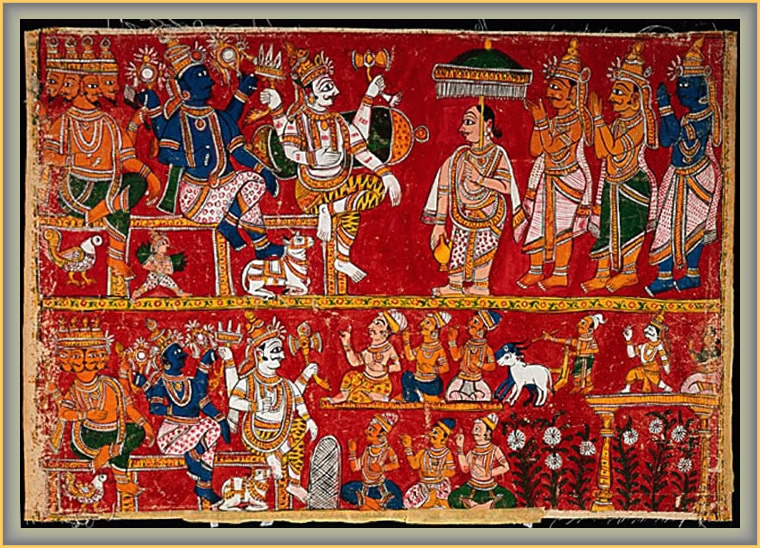
The picture
is titled: "A Brahmin Approaches Shiva, Vishnu, and Brahma".
From the Story of the Sages Markandeya and Bhavana India, Andhra
Pradesh, South Asia, circa 1850-1900.
Courtesy LACMA.
Production: Filognostic Association of The Order of Time

Feed-back | Links | Downloads | Music | Pictures | What's New | Search | Donations


 Text 1