
Canto
11
Canto
11
Chapter 28: Jñâna-Yoga or the Denomination and the Real
(1) The Supreme Lord said: 'When one understands that the world, this combination of matter and person, is based upon one and the same reality, one should refrain from praising and criticizing someone else's nature and activities. (2) He who praises or criticizes someone else's nature and actions quickly will stray from his [real] interest [of self-realization], because he thus adheres to the falsehood [of the world of opposites]. (3) A person aware of the objective diversity is just [as unaware of the one reality] as an embodied soul whose senses, overcome by sleep, experience the illusory reality [of a dream] or the deathlike state of having lost consciousness. (4) What would be good or what would be bad in this unreal, deceptive material duality that, considered by the mind and put into words, results in a false [insufficient] image of reality [*]? (5) Even though shadows, echoes and mirages constitute mere suggestions, they create motives [in people]; the same way the body and what belongs to it gives rise to material conceptions [identifications] that create fear until the day one dies [for they offer no firm hold]. (6-7) The Master, the Lord, the Soul alone, manifests this universe and Himself, protects all that exists and Himself, and withdraws both the creation and Himself. Apart from the Soul, outside of Him, hence no separate living being can be found, just as no other basis can be found for this, within the Self perceived, threefold splendor of the gunas, that you must know as the threefold manifestation generated by the illusory energy of mâyâ [B.G. 14: 19]. (8) Someone who, perfectly conversant and experienced, is well aware of what I have now described, does not blame or praise [in looking for another cause], and wanders the earth as free as the sun. (9) When one by direct perception, logical deduction, scriptural truth and one's self-realization knows that that what is inessential has a beginning and an end, one should move around in this world free from attachment [see also B.G. 2: 16].'
(10) S'rî Uddhava said: 'Material existence is not the experience of the seer who is a soul of self-realization, nor the experience of the spiritless body that constitutes the seen. Whose experience might it be then, oh Lord? (11) The inexhaustible soul, free from the modes, is pure, self-luminous and uncovered just like a fire, while the material body is like firewood that is without understanding. To which of the two belongs the experience of a material life in this world?'
(12) The Supreme Lord said: 'As long as the soul is attracted to the body, the senses and the life force, material existence will continue to flourish, despite being meaningless to the ignorant. (13) Even though not having a purpose of its own, the course of mundane existence [the 'wheel'] does not cease to exist; one keeps, like [being caught] in a dream, contemplating the objects of the senses and the meaninglessness associated with it [compare 3.27: 4, 4.29: 35 & 73, 11.22: 56, B.G. 2: 14]. (14) But that [dreaming], presenting someone not awakened many undesirable experiences in his sleep, will certainly not confound the one who awakened. (15) Lamentation, elation, fear, anger, greed, confusion, hankering and such, one observes with the birth and death of the false ego [ahankâra] and [is] not [seen] with the soul [that does not take birth or die, see 11.22: 12, 11.23: 50-56, 11.25: 30]. (16) The individual soul [of identification] with his attention directed at the body, the senses, the life force and the mind, assumes, depending the gunas and the karma, his form within the [great universal] Self. With the lead [the sûtra] of the complete of nature thus very differently denominated [as a dog, ape or human being], he then, controlled by time, moves around in material existence. (17) A sober sage free from desire moving around in this world will, with the sword of transcendental knowledge sharpened by worship, cut with this, without a firm basis, [in false ego] being represented in the many forms of the mind, the speech, the life force and the bodily functions. (18) Spiritual knowledge [jñâna, entails] the discrimination [of spirit and matter and is nourished by] scripture and penance, personal experience, historical accounts and logical inference. [It is based upon] that what is there in the beginning, what stays the same in between and what remains in the end of this [creation], namely the Time and Ultimate Cause [of brahman, the Absolute Truth, see also B.G. 10: 30 & 33, 11: 32 and kâla]. (19) Just like gold alone being present before it is processed, is present when it is processed and is also present in the final product of the processing, I am present in different disguises of [the with the gunas processing of] this creation [see also guna-avatâras]. (20) My dearest, this spirit of wisdom [this transcendental intelligence] in its three states [of wakefulness, sleep and unconscious sleep], constitutes, with its manifestation in relation to the three natural basic qualities as the causing [of rajas], the caused [of tamas] and the causal agent [of sattva, compare 11.22: 30], the fourth factor [the 'gold' or turîya] that as an independent variable stands for the single [Absolute] Truth of each of them. (21) That what was absent before, is absent afterwards and is not there [independently] in between, is but a designation, a reference. Whatever that was created and is known by something else, is actually only [a reference to] that something else - that is how I see it. (22) Even though this creation, which appears with the transformations of the mode of passion, does not really exist, it thus shines forth as [a reference to] the Absolute Truth standing in its own light, as the Brahman [the impersonal form of God] of the variety of senses, their objects, the self and the transformations [of the five elements, see also siddhânta]. (23) When one by discriminating this way has achieved clarity about the Absolute of the Spiritual Truth, one must wisely speak against the opposite [of falsely identifying oneself], cut with the doubt regarding the Soul, and in the contentment of one's own spiritual happiness desist from all lusty [unregulated] matters [see B.G. 3: 34]. (24) The body made of earth is not the true self, nor are the senses, their gods or the life air, the external air, water, fire or a mind only interested in matter ['food']; nor is the intelligence the true self, or material consciousness, the I that considers itself the doer, the ether, the earth, material things or the restraint [the universal primeval state of equilibrium]. (25) What would the merit be of someone who, by the meditative control of the senses - which are manifestations of the gunas -, properly has distinguished My abode [or personal identity]? Or whom would he blame when the senses are agitated? What difference would it make to the sun whether the clouds gather or disperse? (26) Just as the sky itself is not affected by the coming and going qualities of the atmosphere, fire, water and earth, or by the qualities of the seasons [of heat and cold], also the Imperishable Supreme remains free from the influence of sattva, rajas and tamas, the modes at the foundation of the I-concept of material existence [see also 1.3: 36, 3.27: 1, B.G. 7: 13].(27) One must nevertheless, by firm bhakti-yoga unto Me, ban all the impurity of passion from one's mind, until the contamination by the modes has been eliminated that was produced by the deluding material energy [see B.G. 7: 1 & 14 and **]. (28) The same way a disease that was treated imperfectly time and again returns and gives a man trouble, also a mind not purified of its karmic contamination will torment an inexperienced yogi who is still of all kinds of attachment. (29) Imperfect yogis who are commanded by impediments in the form of the human beings [family members, disciples etc., see e.g. S'rî S'rî S'ikshâshthaka-4] sent to them by the thirty gods [see tridas'a], will, by their perseverance in their previous life, once again [in a new life] engage in the practice of yoga, but never more be entangled in fruitful activities [see also 11.18: 14, B.G. 6: 41-42]. (30) A normal living being affected by the work he performs, his karma, impelled by sometimes this and then again that impulse, remains in that position until the moment he dies. But someone intelligent is, despite being situated in the material position, not that [fickle], because he, with the experience of the happiness he found, gave up his material desire. (31) Someone whose consciousness is fixed in the True Self does not give it a moment's thought whether he is standing, sitting, walking or lying down, urinating, eating food or doing whatever else that manifests from his conditioned nature. (32) When one is intelligent one does not take anything else [but the soul] for essential. Whenever such a one faces the not really [independently] existing matters of the senses, he from his logic denies them their separateness, so that they are like the things of a dream that disappear when one wakes up. (33) The soul is not something one accepts or rejects [that comes and goes], but the ignorance [resulting in a material body] that you in many forms under the influence of karma and guna accepted as an inextricable part of yourself, My best one, [ultimately] dissolves again in simply that [spiritual] vision. (34) Just as the rising sun puts an end to the darkness in the human eye, without creating that what exists, also a clever and thorough search for My pure truth puts an end to the darkness of someone's intelligence. (35) This self-luminous, unborn, immeasurable Greatness of Understanding who is aware of everything, is the One Without a Second in whom words find their closure and, by whom impelled, speech and the life airs are moving. (36) Whatever notion of duality one might have of the [Supreme] Soul is nothing but a figment of the mind; for such an idea there is no other ground than one's own [identified] self [compare 7.13: 7]. (37) The explanations [in terms of good and bad, see also 11.21: 16] offered by the so-called scholars of the meaning of this, in names and forms perceivable, duality that unmistakably consists of the five elements, are [completely] in vain [see also 5.6: 11].
(38) The body of a yogi who with a lack of experience tries to engage in the practice of yoga, may be hindered by rising disturbances. In that case the following rule of conduct is prescribed. (39) Some disturbances may be overcome by postures [âsanas] combined with concentration exercises [dhârana], others can be defeated by penances [tapas, see ***], mantras and medicinal herbs. (40) Certain inauspicious matters one can overcome step by step by constantly thinking of Me [Vishnu-smarana], by [loudly or silently] honoring My names and such [japa, sankîrtana], and by following in the footsteps of the masters of yoga [see also B.G. 6: 25]. (41) Some [yogis] keep their bodies under control and make them fit by focussing on health, employing different methods and exercises for the sake of material perfection [siddhis]. (42) It goes without saying that good health should not be worshiped when such an endeavor is useless [when one is very old e.g.], for in matters of the body one is subject to decay, just like a fruit on a tree [see also 11.15: 33]. (43) Although the material body of someone regularly practicing yoga will attain fitness, being intelligent My devotee does not put faith in such yoga and will [eventually] give it up [*4]. (44) The yogi who, free from desires, takes to My shelter and practices this process of yoga, experiences the inner happiness [of the soul] and accepts no defeat by disturbances.'


Third revised edition, loaded August 15, 2022.
Previous Aadhar edition and Vedabase links:
The Supreme Lord said: 'When one understands that the world, this combination of matter and person, is based upon one and the same reality, one should refrain from praising and criticizing someone else's nature and activities.The Supreme Lord said: 'When one understands that the world, this combination of matter and person, is based upon one and the same reality, one should refrain from praising and criticizing someone else's nature and activities. (Vedabase)
He who praises or criticizes someone else's nature and actions quickly will stray from his [real] interest [of self-realization], because he thus adheres to the falsehood [of the world of opposites].
He who praises or criticizes someone else's nature and actions quickly looses grip on that what is his own interest because he gets entangled in a self-created reality. (Vedabase)
A person aware of the objective diversity is just [as unaware of the one reality] as an embodied soul whose senses, overcome by sleep, experience the illusory reality [of a dream] or the deathlike state of having lost consciousness.
A person aware of the objective diversity is just [as unaware of the one reality] as an embodied soul whose senses overcome by sleep within the physical encasement experience the illusory [of a dream] or the deathlike of having lost consciousness. (Vedabase)
What would be good or what would be bad in this unreal, deceptive material duality that, considered by the mind and put into words, results in a false [insufficient] image of reality [*]?
How can one distinguish between good and bad with this material duality that belongs to the realm of our imagination? Musing over it with our mind and expressing it in words we do not cover the truth [*]. (Vedabase)
Even though shadows, echoes and mirages constitute mere suggestions, they create motives [in people]; the same way the body and what belongs to it gives rise to material conceptions [identifications] that create fear until the day one dies [for they offer no firm hold].
Shadows, echoes and mirages, though mere projections, create motives [in people]; the same way the body and all of its material conceptions create fear until the day one dies. (Vedabase)
The Master, the Lord, the Soul alone, manifests this universe and Himself, protects all that exists and Himself, and withdraws both the creation and Himself. Apart from the Soul, outside of Him, hence no separate living being can be found, just as no other basis can be found for this, within the Self perceived, threefold splendor of the gunas, that you must know as the threefold manifestation generated by the illusory energy of mâyâ [B.G. 14: 19].
The Supreme Soul who alone creates the universe and is created as its Lord, protects and is protected as the Self of all Creation and withdraws and is withdrawn as the Controller. Accordingly no other entity can be ascertained as existing apart from Him, and thus has this threefold appearance established within the Supreme Self and consisting of the modes no [other or independent] basis; know that the threefold [of the seen, the seeing and the seer according to resp. the tamas, the rajas and the sattva quality] is a construct of the illusory energy [under the influence of Him in the form of Time, see also B.G. 14: 19]. (Vedabase)
Someone who, perfectly conversant and experienced, is well aware of what I have now described, does not blame or praise [in looking for another cause], and wanders the earth as free as the sun.
Someone who fixed in the knowledge as laid down and realized by Me knows about this, does not blame or praise [in looking for another cause], he freely wanders the earth just like the sun does [see B.G. 2: 57, 13: 13, 13: 32, 14: 22-25]. (Vedabase)
When one by direct perception, logical deduction, scriptural truth and one's self-realization knows that that what is inessential has a beginning and an end, one should move around in this world free from attachment [see also B.G. 2: 16].'
When one from direct perception, logical deduction, scriptural truth and one's self-realization knows that the inessential has a beginning and an end, one should move around in this world free from attachment [see also B.G. 2: 16].' (Vedabase)
S'rî Uddhava said: 'Material existence is not the experience of the seer who is a soul of self-realization, nor the experience of the spiritless body that constitutes the seen. Whose experience might it be then, oh Lord?
S'rî Uddhava said: 'O my Lord, who is it actually who carries the experience of this [changing] material existence? It is not precisely the [unchanging] soul, the seer who is self-aware, nor does it belong to the body, the seen that [changing itself] has no experiencing self of its own. (Vedabase)
The inexhaustible soul, free from the modes, is pure, self-luminous and uncovered just like a fire, while the material body is like firewood that is without understanding. To which of the two belongs the experience of a material life in this world?'
The inexhaustible soul, free from the modes, is pure, self-luminous and uncovered just like a fire, while the material body is like firewood that is without understanding. To which of the two belongs the experience of a material life in this world?' (Vedabase)
The Supreme Lord said: 'As long as the soul is attracted to the body, the senses and the life force, material existence will continue to flourish, despite being meaningless to the ignorant.
The Supreme Lord said: 'As long as the soul is attracted to the body, the senses and the vital force, his material existence, which carries its fruit in due course, will nevertheless be meaningless because of a lack of discrimination. (Vedabase)
Even though not having a purpose of its own, the course of mundane existence [the 'wheel'] does not cease to exist; one keeps, like [being caught] in a dream, contemplating the objects of the senses and the meaninglessness associated with it [compare 3.27: 4, 4.29: 35 & 73, 11.22: 56, B.G. 2: 14].
Even though material substance has no real existence [because of its impermanence], the material condition [as for its constituent elements] does not cease to be and one has, like in a dream contemplating the objects of the senses, to face the consequent disadvantages [compare 3.27: 4, 4.29: 35 & 73, 11.22: 56, B.G. 2: 14]. (Vedabase)
But that [dreaming], presenting someone not awakened many undesirable experiences in his sleep, will certainly not confound the one who awakened.
That [dream] what brings the one who is not awake in his sleep many undesirable experiences, will certainly not confound the one who awakened though. (Vedabase)
Lamentation, elation, fear, anger, greed, confusion, hankering and such, one observes with the birth and death of the false ego [ahankâra] and [is] not [seen] with the soul [that does not take birth or die, see 11.22: 12, 11.23: 50-56, 11.25: 30].
Lamentation, elation, fear, anger, greed, confusion, hankering and such is seen upon the birth and death of one's identification with the body [ahankâra] and does not depend on the soul [that doesn't take birth or die, see 11.22: 12, 11.23: 50-56, 11.25: 30]. (Vedabase)
The individual soul [of identification] with his attention directed at the body, the senses, the life force and the mind, assumes, depending the gunas and the karma, his form within the [great universal] Self. With the lead [the sûtra] of the complete of nature thus very differently denominated [as a dog, ape or human being], he then, controlled by time, moves around in material existence.
Falsely motivated dwelling within the self of the material body, the senses, life-air and the mind, the living being assumes his form according to the gunas and the karma. He is then, depending the way he relates to the thread constituted by the greater of nature, described with different names when he under the strict control of Time wanders about in the ocean of matter. (Vedabase)
A sober sage free from desire moving around in this world will, with the sword of transcendental knowledge sharpened by worship, cut with this, without a firm basis, [in false ego] being represented in the many forms of the mind, the speech, the life force and the bodily functions.
This without a firm basis being represented in the many forms of the mind, the speech, the life force, the gross body and fruitive actions, will, with the sword of transcendental knowledge that was sharpened in worship, be cut down by a sober sage who walks the earth free from desires. (Vedabase)
Spiritual knowledge [jñâna, entails] the discrimination [of spirit and matter and is nourished by] scripture and penance, personal experience, historical accounts and logical inference. [It is based upon] that what is there in the beginning, what stays the same in between and what remains in the end of this [creation], namely the Time and Ultimate Cause [of brahman, the Absolute Truth, see also B.G. 10: 30 & 33, 11: 32 and kâla].
Spiritual knowledge [entails] the discrimination [of spirit and matter and is nourished by], scripture and penance, personal experience, historical accounts and logical inference. [It is based upon] that which is there equally in the beginning and in the end of this [creation] and which is the same in between, knowing the Time and Ultimate Cause [of brahman, the Absolute Truth, see also B.G. 10: 30, 33, 11: 32 and kâla]. (Vedabase)
Just like gold alone being present before it is processed, is present when it is processed and is also present in the final product of the processing, I am present in different disguises of [the with the gunas processing of] this creation [see also guna-avatâras].
Like gold alone being present before it is processed, when it is processed and in the final product of the processing, I am present in the disguise of the different modes [of processing] of this creation. (Vedabase)
My dearest, this spirit of wisdom [this transcendental intelligence] in its three states [of wakefulness, sleep and unconscious sleep], constitutes, with its manifestation in relation to the three natural basic qualities as the causing [of rajas], the caused [of tamas] and the causal agent [of sattva, compare 11.22: 30], the fourth factor [the 'gold' or turîya] that as an independent variable stands for the single [Absolute] Truth of each of them.
My dearest, this spirit of condensed knowledge in its three conditions [of wakefulness, sleep and unconscious sleep], constitutes, manifesting itself in the form of the modes as the causing [of rajas], the caused [of tamas] and the causer [of sattva, compare 11.22: 30], the fourth factor [the 'gold'] which as an independent variable stands for the single truth of each of them. (Vedabase)
That what was absent before, is absent afterwards and is not there [independently] in between, is but a designation, a reference. Whatever that was created and is known by something else, is actually only [a reference to] that something else - that is how I see it.
That what was absent before, is absent afterwards, and isn't there [independently] in between, is but a designation; whatever that was created and is known by something else, is actually only that something else; that is how I see it. (Vedabase)
Even though this creation, which appears with the transformations of the mode of passion, does not really exist, it thus shines forth as [a reference to] the Absolute Truth standing in its own light, as the Brahman [the impersonal form of God] of the variety of senses, their objects, the self and the transformations [of the five elements, see also siddhânta].
The spiritual reality of God as established in its own light manifests the Absolute Truth as the variety of the senses, their objects, the mind and the transformations. For that reason is this creation, that because of the mode of rajas is subject to modification, self-luminous, even though it is not really there [see also siddhânta]. (Vedabase)
When one by discriminating this way has achieved clarity about the Absolute of the Spiritual Truth, one must wisely speak against the opposite [of falsely identifying oneself], cut with the doubt regarding the Soul, and in the contentment of one's own spiritual happiness desist from all lusty [unregulated] matters [see B.G. 3: 34].
When one this way by discriminating logic has achieved clarity about the Absolute of the Spiritual Truth, one must expertly speak against and cut with the doubt regarding the Self and satisfied in one's own spiritual happiness desist from all lusty [unregulated] matters [see B.G. 3: 34]. (Vedabase)
The body made of earth is not the true self, nor are the senses, their gods or the life air, the external air, water, fire or a mind only interested in matter ['food']; nor is the intelligence the true self, or material consciousness, the I that considers itself the doer, the ether, the earth, material things or the restraint [the universal primeval state of equilibrium].
The body made of earth is not the true self, nor are the senses, their gods or the life air, the external air, water, fire or a mind only interested in food; nor are the intelligence, material consciousness, the I that thinks itself the doer, the ether, the earth, material things or the restraint. (Vedabase)
What would the merit be of someone who, by the meditative control of the senses - which are manifestations of the gunas -, properly has distinguished My abode [or personal identity]? Or whom would he blame when the senses are agitated? What difference would it make to the sun whether the clouds gather or disperse?
What's the merit of him who properly ascertained my identity and in his concentration managed to direct his - by the modes controlled - senses perfectly? And what on the other hand would be the blame for him who is diverted by his senses? Would the sun care about being covered by clouds or a sky clearing up? (Vedabase)
Just as the sky itself is not affected by the coming and going qualities of the atmosphere, fire, water and earth, or by the qualities of the seasons [of heat and cold], also the Imperishable Supreme remains free from the influence of sattva, rajas and tamas, the modes at the foundation of the I-concept of material existence [see also 1.3: 36, 3.27: 1, B.G. 7: 13].
Just as the sky is not affected by the coming and going qualities of the air, fire, water and earth or by the qualities of the seasons [of heat and cold], is likewise the Imperishable Supreme elevated above the influence of the natural modes of sattva, rajas and tamas that are responsible for the fact that he who takes his body for the true self is caught in the material world [see also 1.3: 36, 3.27: 1, B.G. 7: 13]. (Vedabase)
One must nevertheless, by firm bhakti-yoga unto Me, ban all the impurity of passion from one's mind, until the contamination by the modes has been eliminated that was produced by the deluding material energy [see B.G. 7: 1 & 14 and **].
Nevertheless, until by firmly being rooted in My bhakti-yoga one has banned the impurity of the mind of passion, one must eliminate the attachment associated with the qualities that belong to the deluding material energy [see B.G. 7: 1, 14 and **]. (Vedabase)
The same way a disease that was treated imperfectly time and again returns and gives a man trouble, also a mind not purified of its karmic contamination will torment an inexperienced yogi who is still of all kinds of attachment.
The same way as a disease that was imperfectly treated turns back time and again and brings a man trouble, the mind that was not purified of its contamination of karma will torment the inexperienced yogi who still is of all kinds of attachments. (Vedabase)
Imperfect yogis who are commanded by impediments in the form of the human beings [family members, disciples etc., see e.g. S'rî S'rî S'ikshâshthaka-4] sent to them by the thirty gods [see tridas'a], will, by their perseverance in their previous life, once again [in a new life] engage in the practice of yoga, but never more be entangled in fruitfull activities [see also 11.18: 14, B.G. 6: 41-42].
Imperfect yogis who are commanded by impediments in the form of the human beings [family members, disciples etc., see e.g. S'rî S'rî S'ikshâshthaka-4] sent by the thirty gods [see tridas'a] will, on the strength of their perseverance in their previous life once more [in a new life] engage in the practice of yoga, but never again be entangled in fruitive labor [see also 11.18: 14, B.G. 6: 41-42]. (Vedabase)
A normal living being affected by the work he performs, his karma, impelled by sometimes this and then again that impulse, remains in that position until the moment he dies. But someone intelligent is, despite being situated in the material position, not that [fickle], because he, with the experience of the happiness he found, gave up his material desire.
A normal living being who has to experience the consequences of his fruitive labor, remains, impelled by this or that impulse, in that position until the moment he dies. But someone intelligent is, despite being situated in the material position, not that [fickle], because he with the experience of the happiness he found gave up his material desire. (Vedabase)
Someone whose consciousness is fixed in the True Self does not give it a moment's thought whether he is standing, sitting, walking or lying down, urinating, eating food or doing whatever else that manifests from his conditioned nature.
He whose consciousness is fixed in the true self doesn't give it a moment's thought whether he is standing, sitting, walking or lying down, urinating, eating food or doing whatever else that manifests from his conditioned nature. (Vedabase)
When one is intelligent one does not take anything else [but the soul] for essential. Whenever such a one faces the not really [independently] existing matters of the senses, he from his logic denies them their separateness, so that they are like the things of a dream that disappear when one wakes up.
Someone intelligent doesn't take anything else for essential. Whenever he sees the not really [independently] existing things of the senses, he from his logic denies them their separateness, so that they are like the things of a dream that lose their value when one wakes up. (Vedabase)
The soul is not something one accepts or rejects [that comes and goes], but the ignorance [resulting in a material body] that you in many forms under the influence of karma and guna accepted as an inextricable part of yourself, My best one, [ultimately] dissolves again in simply that [spiritual] vision.
Material ignorance which under the influence of the modes of nature assumes many forms is by the conditioned soul taken for an inextricable part of himself, but the ignorance ends by simply developing His vision, My best one. The soul on the other hand is not something one accepts or leaves behind. (Vedabase)
Just as the rising sun puts an end to the darkness in the human eye, without creating that what exists, also a clever and thorough search for My pure truth puts an end to the darkness of someone's intelligence.
When the sun rises is the darkness in the human eye expelled, but that rising is not creating the things that are seen then. Similarly a thorough and adroit search for the true of Me puts an end to the darkness of someone's intelligence [while that search itself is not the reason why his soul exists]. (Vedabase)
This self-luminous, unborn, immeasurable Greatness of Understanding who is aware of everything, is the One Without a Second in whom words find their closure and, by whom impelled, speech and the life airs are moving.
This selfluminous, unborn, immeasurable Greatness of Understanding who is aware of everything is the One Without a Second in whom words find their closure, and by whom impelled the speech and the life airs move. (Vedabase)
Whatever notion of duality one might have of the [Supreme] Soul is nothing but a figment of the mind; for such an idea there is no other ground than one's own [identified] self [compare 7.13: 7].
Whatever the notion of duality the self might have is but a delusion to the unique soul, as it indeed has no basis outside of that very self [compare 7.13: 7]. (Vedabase)
The explanations [in terms of good and bad, see also 11.21: 16] offered by the so-called scholars of the meaning of this, in names and forms perceivable, duality that unmistakably consists of the five elements, are [completely] in vain [see also 5.6: 11].
The dualistic, imaginative interpretation [in terms of good and bad, see also 11.21: 16] by so-called scholars of this in names and forms perceivable duality which unmistakably consists of the five elements, is in vain [see also 5.6: 11]. (Vedabase)
The body of a yogi who with a lack of experience tries to engage in the practice of yoga, may be hindered by rising disturbances. In that case the following rule of conduct is prescribed.
The body of the yogi who with a lack of experience tries to engage in the practice of yoga, may be overcome by rising disturbances. In that case is the following the prescribed rule of conduct: (Vedabase)
Some disturbances may be overcome by postures [âsanas] combined with concentration exercises [dhârana], others can be defeated by penances [tapas, see ***], mantras and medicinal herbs.
Some disturbances may be overcome by postures [âsanas] combined with concentration [dhârana], penance [tapas, see ***], mantras and medicinal herbs. (Vedabase)
Certain inauspicious matters one can overcome step by step by constantly thinking of Me [Vishnu-smarana], by [loudly or silently] honoring My names and such [japa, sankîrtana], and by following in the footsteps of the masters of yoga [see also B.G. 6: 25].
Some of the inauspicious matters can be overcome step by step by constantly thinking of Me [Vishnu-smarana], by the celebration of My names and such [japa, sankîrtana] and by following in the footsteps of the masters of yoga [see also B.G. 6: 25]. (Vedabase)
Some [yogis] keep their bodies under control and make them fit by focussing on health, employing different methods and exercises for the sake of material perfection [siddhis].
Some [yogis] make their self-controlled bodies suitable by fixing themselves on the youthful with the help of various methods and try that way to be perfect in their material control [siddhis]. (Vedabase)
It goes without saying that good health should not be worshiped when such an endeavor is useless [when one is very old e.g.], for in matters of the body one is subject to decay, just like a fruit on a tree [see also 11.15: 33].
By the ones who enjoy a good condition that is not honored though, convinced as they are that such an endeavor is quite useless, because the body, like the fruit of a tree, will perish anyway [see also 11.15: 33]. (Vedabase)
Although the material body of someone regularly practicing yoga will attain fitness, being intelligent My devotee does not put faith in such yoga and will [eventually] give it up [*4].
Someone with a devoted mind does not value it highly to practice yoga regularly with the purpose of realizing a healthy body, he who is devoted to Me gives up on the yoga [for that purpose, *4]. (Vedabase)
The yogi who, free from desires, takes to My shelter and practices this process of yoga, experiences the inner happiness [of the soul] and accepts no defeat by disturbances.'
The yogi following this process of yoga will, freed from desires having taken to the shelter of Me, not be disheartened by obstacles and [thus] experience the happiness of his soul.' (Vedabase)
*: Contrary to popular notions that the medium would be the message, here is stated clearly that the medium is not the message. The words and the ideas, and also the so-called fixed form of things, are all false relative to the original truth, the message, the essence. That what is expressed is the essence, not the expression itself. So the one living being of the person and the living material nature with her Time as the masculine aspect, is the essence and all ideas, fixed things of it and words about it are actually false. Thus we have the paradox of the in itself false expression in words and ideas, this sentence before you as a reader e.g., of that what is true on itself as the wholeness of life. So there are idols of Krishna being worshiped with the strict warning not to consider them as something material. Thus praise and criticism, good and bad, are dual notions missing the point of what is objectively the value free reality of brahman, the Absolute Truth of the reality free from illusion that is equally present both outside and inside. Or as one puts it these days: science is value-free.
**: The purport of this is that, even though material nature as His gigantic virâth-rûpa form is nondifferent from the Supreme Lord (as elaborately described in this and other chapters), one who has yet to conquer material desire must not artificially seek solace in material things, declaring them to be nondifferent from the Lord [see p.p. 11.28: 27].
***: Concerning penance the beginner is reminded of the fact that voluntary penance, voluntary suffering, is better than penance enforced from the outside in the form of a disease, legal prosecution, shortage, calamities etc. Like the Jews in Exodus would be ready to leave Egypt, one should be ready for the coming of the Lord [see also 11.17: 42 and B.G. 2: 40, 12: 16].
*4: Here one is reminded of the fact that characters like Râvana and Hiranyakas'ipu also practiced yoga and attained fitness; attaining perfections that way can also be something demoniac and is thus not the object of belief as stated here. Attaining the Lord is rather the motive for the yogi. Control, health and order is something nice to achieve, but without the Lord it is just as well something demoniac.

The
text and audio are offered under the conditions of
the
Creative Commons
Attribution-Noncommercial-Share Alike 3.0
Unported License.
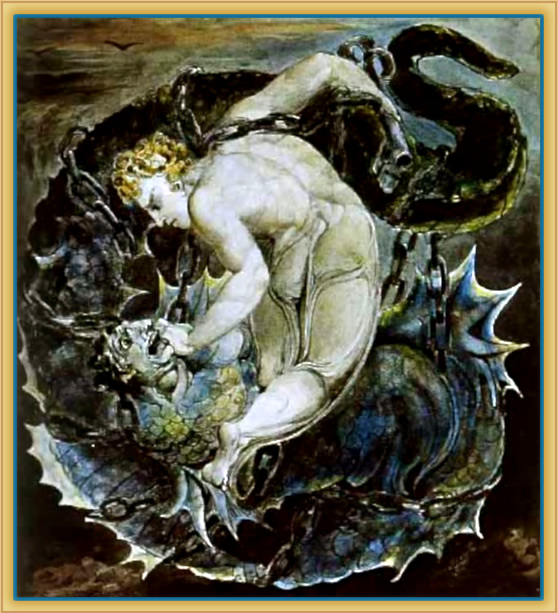
The painting is titled: 'Michael Binding Satan' and is of William Blake.
The second painting of Urizen praying is from The Song of
Los, 1794 , also by William Blake,
Production: Filognostic Association of The Order of Time

Feed-back | Links | Downloads | Music | Pictures | What's New | Search | Donations



 Text 1